Loading...
Ali Abdullah Saleh vs Napoleon Bonaparte
Napoleon Bonaparte leads by 23.3 pts · 2 figures compared
…
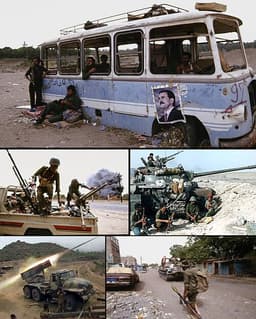
Ali Abdullah Saleh
Politician · Modern
47.6Total

Napoleon Bonaparte
General · Modern
70.9Total
Basic Information
Born
1947
1769
Died
—
1821
Era
Modern
Modern
Nationality
Yemen
France
Occupation
Politician
General
Civilization
Middle Eastern
Western
Score Comparison
Military (10%)
50.0
94.0
Political (20%)
35.1
72.0
Influence (20%)
51.0
40.0
Legacy (20%)
41.7
80.0
Leadership (15%)
74.0
78.0
Strategy (15%)
30.3
90.0
TOTAL
47.6
70.9
Ali Abdullah Saleh — Complete Timeline
1990 AD
Unification of North and South YemenPolitical Action
Ali Abdullah Saleh, as president of North Yemen, negotiated the unification with South Yemen on May 22, 1990. He became president of the unified Republic of Yemen, a major achievement in Arab unity.
UnificationYemenArab Unity
Impact: regionalconstructive
Support for Saddam Hussein in Gulf WarPolitical Action◆ Major
Saleh initially supported Iraq's invasion of Kuwait, straining relations with Saudi Arabia and the West. This led to the expulsion of nearly a million Yemeni workers from Saudi Arabia and economic hardship.
Gulf WarDiplomacyEconomic Crisis
Impact: regionaldestructive
1994 AD
Yemeni Civil War of 1994War◆ Major
After southern leaders attempted secession, Saleh's forces crushed the rebellion in a brief civil war. This solidified his control over a unified Yemen but deepened regional divisions.
Civil WarSecessionConflict
Impact: nationaldestructive
2011 AD
Arab Spring Protests and ResignationPolitical Action
Mass protests erupted against Saleh's 33-year rule. After months of violence and a failed assassination attempt, he agreed to a Gulf Cooperation Council-brokered deal to step down in exchange for immunity.
Arab SpringProtestsResignation
Impact: nationaltragic
2017 AD
Killing by Houthi ForcesWar◆ Major
After switching sides in the Yemeni Civil War to ally with the Houthis, Saleh was killed by Houthi forces on December 4, 2017, while trying to flee Sanaa. His death ended a complex political career.
DeathCivil WarHouthis
Impact: nationaltragic
Napoleon Bonaparte — Complete Timeline
1799 AD
Coup of 18 BrumaireOther◆ Major
Napoleon Bonaparte, with support from his brother Lucien and key political figures, overthrew the Directory in a bloodless coup. He established the Consulate with himself as First Consul, effectively becoming the ruler of France. This event ended the French Revolution's most unstable period.
French RevolutionCoupRise to Power
Impact: regional
1804 AD
Promulgation of the Napoleonic CodeOther◆ Major
Napoleon enacted the Civil Code of the French, known as the Napoleonic Code, a comprehensive set of laws that replaced the fragmented feudal legal systems. The code established legal equality, protected property rights, and secularized law. It became the basis for legal systems in many European and world countries.
Legal ReformNapoleonic CodeCivil Law
Impact: globalconstructive
1805 AD
Battle of AusterlitzWar◆ Major
Napoleon's Grande Arm
Napoleonic WarsBattleDecisive Victory
Impact: global
1812 AD
Invasion of RussiaWar◆ Major
Napoleon led the Grande Arm
Napoleonic WarsInvasionDisaster
Impact: globaldestructive
1815 AD
Battle of WaterlooWar◆ Major
Napoleon's French army was defeated by the combined forces of the Duke of Wellington's Anglo-Allied army and Gebhard Leberecht von Bl
Napoleonic WarsBattleFinal Defeat
Impact: globaldestructive
Expert Analysis
ali-abdullah-saleh-vs-napoleon-bonaparte
**The Emperor and the Strongman: Two Paths to Power, Two Ends of History**
In the spring of 1815, Napoleon Bonaparte returned from exile on Elba to a France that had turned its back on him. He raised an army, marched north, and met the combined forces of Europe at Waterloo. The battle was a masterpiece of tactical brilliance undone by a single afternoon of rain, a muddy field, and the Prussian arrival at dusk. Less than two centuries later, on a dusty street in Sana’a, another ruler met his end: Ali Abdullah Saleh, once the unifier of Yemen, killed by his own former allies, his body paraded through a city he had ruled for three decades. One died in exile on a remote Atlantic island, the other in the chaos of a civil war he had helped reignite. Both men sought to shape history; one reshaped a continent, the other a fractured corner of Arabia. Why did their journeys diverge so dramatically?
**Origins**
Napoleon was born in 1769 on Corsica, an island that had just become French. His family was minor nobility, but his father’s connections secured him a place at a military academy in mainland France. He was an outsider—a Corsican in a French world, short, intense, and fiercely ambitious. The France of his youth was a powder keg of revolution. The old order collapsed when he was twenty, and the chaos of the Revolutionary Wars created opportunities for talented young officers. Napoleon rose not by birth but by merit, his skill with artillery and his ability to inspire men propelling him through the ranks.
Ali Abdullah Saleh was born in 1947 in a mud-brick house in the highlands of North Yemen, a country that had barely entered the modern era. His family belonged to the Hashid tribe, and his early life was shaped by tribal loyalties and the slow decline of the Zaydi imamate. Yemen was a place of ancient feuds, scarce water, and shifting alliances. Saleh’s father died when he was young, and he was raised by his uncle, a tribal leader. He joined the military at age eleven, not as a promising officer but as a raw recruit, learning to navigate the brutal politics of a country where a man’s word was his bond—and his dagger was his argument. The era of decolonization and Cold War rivalry meant that Yemen was a chessboard for larger powers, but Saleh’s world remained local, personal, and unforgiving.
**Rise to Power**
Napoleon’s ascent was meteoric. In 1793, at age twenty-four, he drove the British out of Toulon. In 1796, he took command of the French army in Italy and, in a series of lightning campaigns, defeated the Austrians and their allies. He was not just a general; he was a propagandist of his own legend. The Egyptian campaign of 1798 was a military failure but a public relations triumph, cementing his image as a man of destiny. By 1799, he returned to a France exhausted by war and political paralysis. In the coup of 18 Brumaire, he seized power, becoming First Consul at age thirty. His rise was a product of revolution, war, and his own relentless will.
Saleh’s path was slower, more patient, and far more treacherous. He became president of North Yemen in 1978 after his predecessor was assassinated—a common fate in Yemeni politics. He survived by playing tribal factions against each other, buying loyalty with oil money, and balancing the interests of Saudi Arabia, the Soviet Union, and later the United States. His greatest achievement came in 1990, when he negotiated the unification of North and South Yemen. It was a political masterstroke, making him president of a united country. But unification was fragile: the South was Marxist, the North tribal and conservative, and Saleh’s rule depended on keeping everyone slightly dissatisfied but never desperate enough to unite against him.
**Leadership & Governance**
Napoleon ruled with a combination of military genius and administrative brilliance. He reformed French law with the Napoleonic Code, modernized education, and centralized the state. His military strategy was revolutionary: he used speed, massed artillery, and the division of his army into corps to defeat larger, slower enemies. At Austerlitz in 1805, he destroyed the combined armies of Russia and Austria, a victory that remains a textbook example of tactical deception. But his governance was also autocratic. He crowned himself emperor, suppressed dissent, and treated Europe as a conquest to be exploited. His ambition knew no bounds, and his wars grew ever more costly.
Saleh ruled Yemen with a very different toolkit. He was not a military genius—his scores in strategy and military command are far below Napoleon’s. Instead, he was a master of political survival. He called his style “dancing on the heads of snakes.” He balanced tribes by distributing patronage, kept the army weak by rotating commanders, and used the threat of chaos to convince foreign powers to support him. In 1994, when southern leaders attempted to secede, he crushed them in a brief civil war, but he did not annihilate them—he left them weak enough to need him. His governance was corrupt, inefficient, and deeply personal. Yemen remained one of the poorest countries in the Arab world, but Saleh stayed in power for thirty-three years.
**Triumph & Tragedy**
Napoleon’s greatest triumph was the Napoleonic Code, which spread the ideals of the French Revolution across Europe, influencing legal systems to this day. His greatest tragedy was the invasion of Russia in 1812. He marched with 600,000 men; fewer than 100,000 returned. The campaign broke his aura of invincibility, and within two years, he was forced to abdicate. His final defeat at Waterloo in 1815 was a tragedy of timing and hubris. He died in 1821 on Saint Helena, a prisoner of the British, his empire reduced to memory.
Saleh’s triumph was the unification of Yemen, a feat that had eluded previous rulers for centuries. But his tragedy was that he could not build a nation. His rule was a balancing act that eventually collapsed. The Arab Spring of 2011 brought hundreds of thousands of protesters into the streets. After a failed assassination attempt and months of violence, he agreed to step down in 2012. But he did not leave the stage. He remained in Yemen, plotting, switching sides, and eventually aligning with the Houthi rebels he had once fought. In 2017, after he tried to switch sides again, the Houthis killed him. His body was filmed by his killers, a final indignity for a man who had spent a lifetime avoiding death.
**Character & Destiny**
Napoleon was driven by a belief in his own destiny. He once said, “Impossible is a word to be found only in the dictionary of fools.” His ambition was boundless, his energy inexhaustible, but his arrogance blinded him to the limits of power. He could not stop, and that inability to consolidate his gains led to his downfall. Saleh was more cynical, more pragmatic. He once remarked, “Governing Yemen is like dancing on the heads of snakes.” He survived not by grand vision but by constant maneuver. His character was shaped by the tribal world he came from—a world where trust was a weapon and betrayal a tool. In the end, that world consumed him.
**Legacy**
Napoleon’s legacy is global. The Napoleonic Code, modern warfare, and the very idea of the nation-state in Europe bear his imprint. He is remembered as both a liberator and a tyrant, a man who spread revolution and then crushed it. His scores in military and political leadership are among the highest in history. Saleh’s legacy is smaller, more ambiguous. He unified Yemen, but he also left it fractured, corrupt, and ripe for civil war. He is remembered in Yemen as a survivor who ultimately failed to survive. His total score of 55.8 reflects a leader who was effective in his own context but left no lasting institutions.
**Conclusion**
Napoleon and Saleh were men of their times—the Corsican who remade Europe, the Yemeni who held together a fragile state. Their differences are not just about talent or ambition but about the worlds they inhabited. Napoleon’s Europe was a continent of empires and revolutions, where a single man could change the course of history. Saleh’s Yemen was a place of tribes, foreign interference, and ancient grievances, where power was a constant negotiation. One died on an island, his legend intact. The other died on a street, his legend destroyed. History offers no moral; it only offers the story.
Rankings
🥇
Napoleon BonaparteLeader
Mil: 94.0Pol: 72.0Inf: 40.0
70.9
🥈
Ali Abdullah Saleh
Mil: 50.0Pol: 35.1Inf: 51.0
47.6
+23.3 behind
How This Comparison Works
Algorithm
Each figure is scored on 6 dimensions (0—100 scale) based on structured historical data: Military (10%), Political (20%), Influence (20%), Legacy (20%), Leadership (15%), Strategy (15%). The weighted total produces the final ranking.
Data Sources
Scores are computed from structured sub-indicators in the database. Scale factors adjust for era (Ancient ×0.85, Modern ×1.0) and civilization size (Eastern ×1.05, Other ×0.80) to account for differences in population and military scale.
Maximum 3 Figures
Comparisons are limited to 2—3 figures to ensure readability and statistical meaningfulness.
Error Margins
±5 points per dimension — Sub-scores are derived from historical records with inherent uncertainty. Two figures within 5 points on a dimension should be considered roughly equivalent in that area.
Total Score Accuracy
±3 points overall — The weighted combination of 6 dimensions produces a total score with approximately ±3 points of uncertainty. Differences of less than 3 points are not statistically significant— the figures are effectively tied.
Known Limitations
- Historical records are incomplete and uneven across civilizations
- Figures from oral-tradition societies may be underrepresented
- Occupation labels can misclassify multi-role figures
- Scores measure capability and impact, not moral character
- Quantitative scoring is a comparison tool, not absolute truth
Capability Radar
Military (10%) — Battles & Warfare
Battles
30
95
Win Rate
25
90
Expansion
25
95
Political (20%) — Governance & Reform
Reform
20
95
Diplomacy
40
80
Economy
15
85
Influence (20%) — Cultural & Global Reach
Cultural
20
85
Global
25
90
Legacy (20%) — Historical Impact
Historical
30
95
Longevity
20
90
Leadership (15%) — Power & Stability
Tenure
75
85
Stability
10
70
Strategy (15%) — Tactics & Innovation
Strategy
30
95
Tactics
35
98
Reform
20
92
Similar Comparisons
Comments & Discussion
DesertFoxSamurai6/17/2026
Real talk: Saleh outsmarted everyone in that region for decades. He played tribes, Iran, Saudi Arabia, and the U.S. against each other like a chess master. Napoleon conquered Europe but couldn't hold it — too much pride, too many fronts. Saleh understood that survival means bending, not breaking. The Houthi betrayal? That's on par with Napoleon's marshals deserting him after Leipzig. Both men were victims of their own success breeding resentment.
VoltigeurVanguard6/17/2026
Waterloo wasn't a "masterpiece" undone by rain — it was a gamble by a genius past his prime. Napoleon's tactical brilliance at Austerlitz relied on speed and deception, but at Waterloo he repeated a dated frontal assault against Wellington's reverse-slope defense. Grouchy's absence was a failure of command, not luck. Saleh survived decades by outmaneuvering rivals, while Napoleon alienated all of Europe. One turned a kingdom into an empire; the other kept a fractured state together. Context matt
历史算盘侠6/17/2026
拿把拿破仑和萨利赫放在一起比,本身就是关公战秦琼。拿破仑的本事在于重塑了整个欧洲的政治版图——从《拿破仑法典》到现代民族国家的雏形,这是世界级的遗产。萨利赫呢?他统治也门三十年,留下的只有部族割据和胡塞武装崛起。把两人放在同一百磅秤上,萨利赫那头轻得翘起来。
春秋笔法师6/17/2026
数据上两人完全不对等:拿破仑打仗几十年,阵亡将士总数超过一百万人;萨利赫在也门内战中的直接死亡人数大约是两万。但你要细看战略后果——拿破仑的战争催生了民族主义浪潮,奠定了现代欧洲格局;萨利赫的倒台让也门变成中东最惨的人道灾难之一。悲剧的规模虽不同,但他们留给历史的都是烂摊子,只是量级有别:一个是洲际核弹,一个是城市炸弹。
CorseConqueror6/17/2026
People romanticize Napoleon's exile too much. He wasn't a tragic hero — he escaped Elba and got a second chance that he bungled with hubris. Saleh's "exile" was basically being forced to quit in 2012, but he never really left power. Both were master manipulators: Napoleon built a cult of personality through bulletins, Saleh through tribal patronage. But Napoleon's memoirs shaped his legend for centuries. Saleh? His story will be forgotten outside of Yemen within a generation. That's the real mea