Loading...
Amenemhat I vs Julius Caesar
Julius Caesar leads by 28.6 pts · 2 figures compared
…
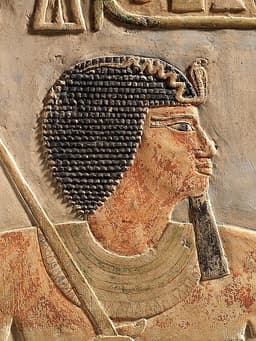
Amenemhat I
Emperor · Ancient
54.2Total

Julius Caesar
General · Ancient
82.8Total
Basic Information
Born
-1970
-100
Died
-1940
-44
Era
Ancient
Ancient
Nationality
Middle Kingdom Egypt
Roman Republic
Occupation
Emperor
General
Civilization
Middle Eastern
Western
Score Comparison
Military (10%)
30.0
88.0
Political (20%)
45.0
78.0
Influence (20%)
61.0
85.0
Legacy (20%)
54.0
82.0
Leadership (15%)
65.0
80.0
Strategy (15%)
60.0
85.0
TOTAL
54.2
82.8
Amenemhat I — Complete Timeline
1970 BC
Accession as pharaohPolitical Action◆ Major
Amenemhat I, formerly vizier to Mentuhotep IV, seized the throne and founded the 12th Dynasty. His accession marked a new era of strong central authority and administrative reform in the Middle Kingdom.
Accession12th DynastyMiddle Kingdom
Impact: nationalconstructive
1965 BC
Foundation of ItjtawyPolitical Action◆ Major
Amenemhat I founded a new capital city called Itjtawy ('Seizer of the Two Lands'), located near modern Lisht. This move shifted the political center from Thebes to a more central location, improving control over both Upper and Lower Egypt.
CapitalAdministrationReform
Impact: nationalconstructive
1960 BC
Construction of the 'Walls of the Ruler'War◆ Major
Amenemhat I built a series of fortifications in the eastern Delta, known as the 'Walls of the Ruler', to protect Egypt from Asiatic incursions. These defenses strengthened Egypt's borders and controlled trade routes into the Levant.
FortificationDefenseBorder Control
Impact: regionalconstructive
1955 BC
Military campaigns in NubiaWar◆ Major
Amenemhat I led military campaigns into Nubia, extending Egyptian control to the Second Cataract. These conquests secured access to gold mines and trade routes, and established Egyptian forts such as Buhen.
Nubian CampaignConquestGold
Impact: regional
1940 BC
Assassination in palace conspiracyPolitical Action◆ Major
Amenemhat I was assassinated in a palace conspiracy, as recorded in the 'Teaching of Amenemhat' text. The plot involved members of his own court, including possibly his guards and harem. His son Senusret I, who was on a campaign, returned to secure the throne.
AssassinationConspiracyPalace Intrigue
Impact: nationaltragic
Julius Caesar — Complete Timeline
58 BC
Gallic WarsWar◆ Major
Caesar, as proconsul of Gaul, launched a series of campaigns that conquered all of Gaul (modern France, Belgium, and parts of Switzerland). He fought numerous battles, including against the Helvetii, the Belgae, and the Gallic chieftain Vercingetorix. The wars brought immense wealth and a loyal army to Caesar.
Gallic WarsConquestRoman Expansion
Impact: regional
49 BC
Crossing the RubiconPolitical Action◆ Major
Caesar led Legio XIII across the Rubicon River into Italy, defying the Roman Senate's order to disband his army. This act triggered a civil war against Pompey and the Optimates, ultimately leading to Caesar's dictatorship and the end of the Roman Republic.
Roman Civil WarEnd of RepublicPower Struggle
Impact: global
48 BC
Battle of PharsalusWar◆ Major
Caesar's outnumbered army defeated the larger forces of Pompey the Great at Pharsalus in Greece. Caesar's tactical use of a reserve line to counter Pompey's cavalry charge proved decisive. Pompey fled to Egypt, where he was assassinated, leaving Caesar as the undisputed master of the Roman world.
Roman Civil WarBattleDecisive Victory
Impact: regional
44 BC
Appointment as Dictator for LifePolitical Action◆ Major
The Roman Senate appointed Caesar dictator perpetuo (dictator for life), granting him unprecedented personal power. This move concentrated military, legislative, and judicial authority in one person, effectively ending the Roman Republic's traditional system of checks and balances and alarming many senators.
DictatorshipEnd of RepublicPower Consolidation
Impact: regionaldestructive
Assassination on the Ides of MarchPolitical Action◆ Major
A group of Roman senators, led by Marcus Junius Brutus and Gaius Cassius Longinus, stabbed Caesar to death at a meeting of the Senate in the Theatre of Pompey. The assassination was intended to restore the Republic, but instead triggered another civil war that led to the rise of the Roman Empire.
AssassinationRoman PoliticsEnd of Republic
Impact: globaldestructive
Expert Analysis
amenemhat-i-vs-julius-caesar
# The Dictator and the Founder: Two Fates on the Ides of March
On the fifteenth day of March, 44 BCE, a man in a purple toga fell at the foot of a statue of his rival, Pompey. Sixty-three stab wounds later, Gaius Julius Caesar lay dead, his blood pooling on the marble floor of the Roman Senate. Nearly nineteen centuries earlier, around 1940 BCE, another ruler—Amenemhat I of Egypt—met a similar end, cut down in his own palace by trusted guards and courtiers. Both were assassinated. Both had seized power and transformed their nations. Yet one became the name that echoes through millennia, while the other is known only to specialists. Why? The answer lies not in the manner of their deaths, but in the shape of their lives.
Origins
Julius Caesar was born into the patrician Julian clan, a family that traced its lineage to the goddess Venus. But by 100 BCE, the Roman Republic was a cauldron of civil strife—senatorial corruption, populist uprisings, and generals who commanded personal armies. Caesar grew up amid political purges and street violence. His father died when he was sixteen, and he was forced to flee Rome during Sulla’s dictatorship. This crucible forged a man who understood that survival required both ruthlessness and charm.
Amenemhat I came from nowhere. He was not born royal. He served as vizier—the highest administrative official—under Pharaoh Mentuhotep IV, the last ruler of the 11th Dynasty. Egypt in 1970 BCE was recovering from the chaos of the First Intermediate Period, a century of division and famine. The old royal bloodline had weakened. Amenemhat saw an opportunity, and he took it. Unlike Caesar, he had no ancestral glory to invoke; he had to invent his own legitimacy.
Rise to Power
Caesar’s path was a ladder of debts and gambles. He borrowed fortunes to fund public games, bought votes, and formed the First Triumvirate with Pompey and Crassus—two men richer and more powerful than himself. His governorship of Gaul (58–50 BCE) was a calculated war of conquest. He invaded Britain, crossed the Rhine, and slaughtered perhaps a million Gauls. The Gallic Wars made him a hero to his soldiers and a threat to the Senate. When ordered to disband his army, he crossed the Rubicon River in 49 BCE, declaring civil war. Within three years, he was dictator of Rome.
Amenemhat’s rise was quieter but no less ambitious. As vizier, he likely organized an expedition to the Wadi Hammamat for Mentuhotep IV, a project that brought him prestige. Then, in 1970 BCE, he simply took the throne. The *Teaching of Amenemhat*, a text written after his death, portrays him as a careful planner who consolidated power by moving the capital away from Thebes, the stronghold of old loyalists. He built a new city called Itjtawy, meaning “Seizer of the Two Lands”—a name that announced his program. He did not cross a river with swords drawn; he built a city and waited.
Leadership & Governance
Caesar ruled Rome like a storm. As dictator, he reformed the calendar (creating the Julian calendar still used in modified form), granted citizenship to Gauls, launched public works, and restructured debt laws. But his style was autocratic and personal. He appointed himself dictator for life, minted coins with his own face, and accepted divine honors. He governed through speed and spectacle—dictating letters while riding, pardoning enemies to win loyalty, and staging triumphs that displayed his conquests. His military genius was total: at Alesia (52 BCE), he built a double ring of fortifications to trap both the Gauls inside and their relief army outside, a feat of logistics and nerve.
Amenemhat governed through structure. He built the “Walls of the Ruler” in the eastern Delta around 1960 BCE—a chain of fortresses to deter Asiatic nomads. He launched campaigns into Nubia, pushing Egypt’s border to the Second Cataract, securing gold mines and trade routes. But his greatest achievement was administrative: he established a stable dynasty that would rule for over 150 years. He appointed loyalists to key posts, curbed the power of provincial nomarchs, and created a centralized state that could survive his death. He was no Caesar on the battlefield—his military score of 33.1 reflects a cautious commander—but his political wisdom (55.0) was enough to found a dynasty.
Triumph & Tragedy
Caesar’s greatest triumph was Gaul. He conquered a territory larger than Italy, wrote a masterpiece of propaganda (the *Commentaries*), and built an army that worshipped him. His tragedy was that he could not stop. After defeating Pompey, he could have restored the Republic and retired. Instead, he centralized power, humiliated the Senate, and appointed his own men to magistracies. The conspiracy that killed him included former friends like Brutus and Cassius. His last words, according to legend, were “*Et tu, Brute?*”—a recognition that his own success had bred betrayal.
Amenemhat’s triumph was survival. He ruled for thirty years, a long reign by ancient standards, and died not in battle but in his own bedchamber. His tragedy was that even his own guards turned on him. The *Teaching of Amenemhat* is a ghostly document—a posthumous speech in which the pharaoh warns his son Senusret I to trust no one. “Beware of subjects who are not known,” the text reads, “they are not loyal at heart.” Amenemhat built walls against foreigners, but could not build walls against his own court.
Character & Destiny
Caesar was reckless with his own life. He dismissed his bodyguard, ignored warnings, and walked into the Senate unarmed. His arrogance was not stupidity but a kind of fatalism—he believed in his own luck, his *fortuna*. He had survived shipwrecks, ambushes, and civil war; he thought he was immortal. This hubris was his destroyer.
Amenemhat was cautious to a fault. He built walls, moved capitals, and wrote instructional texts for his son. His assassination came not from ignoring danger but from trusting the wrong people. He was a man who saw conspiracies everywhere—and was right. But his caution also limited his ambition. He did not conquer new worlds; he fortified his own.
Legacy
Caesar’s legacy is the Roman Empire. His adopted heir, Octavian, became Augustus, the first emperor. Every later European ruler who called himself “Caesar” (Kaiser, Tsar) was invoking his ghost. His reforms—the calendar, citizenship laws, provincial administration—outlasted the Republic. He is remembered as a hero and a tyrant, a genius and a warning.
Amenemhat’s legacy is the Middle Kingdom. His dynasty, the 12th, would produce Senusret III, perhaps Egypt’s greatest pharaoh, who pushed into Nubia and reformed the bureaucracy. The “Walls of the Ruler” became a symbol of Egyptian security. But Amenemhat himself is a footnote. His name appears in textbooks, not in popular culture. He founded a dynasty, but he did not become a legend.
Conclusion
Caesar and Amenemhat both died at the hands of those they trusted. But one died as a comet, the other as a foundation stone. Caesar burned bright and fast, transforming his world through sheer force of will. Amenemhat built slowly, knowing that a dynasty is stronger than any single man. The difference is not of merit but of scale: Caesar gambled on glory, Amenemhat on stability. One gave us an empire, the other a golden age. Both were assassinated, but only one became immortal—because immortality is not about how you die, but how you live while you can.
Rankings
🥇
Julius CaesarLeader
Mil: 88.0Pol: 78.0Inf: 85.0
82.8
🥈
Amenemhat I
Mil: 30.0Pol: 45.0Inf: 61.0
54.2
+28.6 behind
How This Comparison Works
Algorithm
Each figure is scored on 6 dimensions (0—100 scale) based on structured historical data: Military (10%), Political (20%), Influence (20%), Legacy (20%), Leadership (15%), Strategy (15%). The weighted total produces the final ranking.
Data Sources
Scores are computed from structured sub-indicators in the database. Scale factors adjust for era (Ancient ×0.85, Modern ×1.0) and civilization size (Eastern ×1.05, Other ×0.80) to account for differences in population and military scale.
Maximum 3 Figures
Comparisons are limited to 2—3 figures to ensure readability and statistical meaningfulness.
Error Margins
±5 points per dimension — Sub-scores are derived from historical records with inherent uncertainty. Two figures within 5 points on a dimension should be considered roughly equivalent in that area.
Total Score Accuracy
±3 points overall — The weighted combination of 6 dimensions produces a total score with approximately ±3 points of uncertainty. Differences of less than 3 points are not statistically significant— the figures are effectively tied.
Known Limitations
- Historical records are incomplete and uneven across civilizations
- Figures from oral-tradition societies may be underrepresented
- Occupation labels can misclassify multi-role figures
- Scores measure capability and impact, not moral character
- Quantitative scoring is a comparison tool, not absolute truth
Capability Radar
Military (10%) — Battles & Warfare
Battles
30
95
Win Rate
35
92
Expansion
55
97
Political (20%) — Governance & Reform
Reform
70
90
Diplomacy
65
85
Economy
60
82
Influence (20%) — Cultural & Global Reach
Cultural
55
88
Global
50
94
Legacy (20%) — Historical Impact
Historical
65
95
Longevity
60
96
Leadership (15%) — Power & Stability
Tenure
60
75
Stability
40
60
Strategy (15%) — Tactics & Innovation
Strategy
45
94
Tactics
40
96
Reform
50
88
Similar Comparisons
Comments & Discussion
The Bodyguard's Lesson6/17/2026
Amenemhat’s assassination matters more to soldiers. Caesar died by betrayal from equals—senators. His killers were amateurs; the Liberators fled Rome. But Amenemhat? His own bodyguards did the job. That’s professional. Sebeknakht, a palace guard, would’ve trained decades in close-quarters combat. Caesar got sixty-three sloppy wounds; Amenemhat likely died from a single, precise strike. Lesson: trust your chain of command, not your bloodline.
星盘叛徒6/17/2026
别被罗曼蒂克骗了。凯撒的死是个肥皂剧——背叛、元老院、布鲁图斯那张脸。Amenemhat一世的死才是制度性的:他的卫队是继承危机的手术刀。法老没留下清晰的继承人,结果近卫军选了新朝。十九世纪埃及的《阿蒙涅姆赫特一世教谕》里,他亲口警告“别信任兄弟,别交心朋友”。凯撒死于个人恩怨,Amenemhat死于系统缺陷。历史记住谁?那个浪漫的。该死。
Toga Hater6/17/2026
Caesar’s assassination is overrated. Yeah, I get it—Ides of March, “Et tu, Brute?”, drama. But Amenemhat’s death reshaped Egypt. The *Teaching of Amenemhat* tells how he was killed at night in his bed with his guards. That paranoia created the 12th Dynasty’s stability. Caesar’s death? Brought civil war, chaos, and Augustus. Big deal. Amenemhat’s legacy was a golden age; Caesar’s was just another power vacuum for Octavian to exploit.
译名纠错员6/17/2026
比较有纰漏。分析说Amenemhat一世“来自无名之地”,但埃及史料记载他父亲可能是塞索斯特里斯,一位地方贵族。更关键的是,他的死亡时间有争议。传统认为公元前1940年,但部分学者用树轮校正后推至1991年。凯撒的年度有共识;Amenemhat的日期在浮冰。比较历史学就这样,用模糊事实讲清晰叙事。两具尸体,一具在日历上,一具在气候学里。
Chronicler28106/17/2026
Caesar won the PR war. Amenemhat had no Ovid, no Shakespeare, no Hollywood. But look at the objects: Caesar’s death mask? Lost. Amenemhat’s? We have his pyramidion—a gilded capstone from the pyramid at El-Lisht. That thing’s carved with sacred texts. Caesar’s toga was bloodied for vanity; Amenemhat’s gold reached heaven. The founder of the 12th Dynasty built for eternity; the dictator built for his own legend. Guess which one crumbling ruins still