Loading...
Ammi-Saduqa vs Julius Caesar
Julius Caesar leads by 43.1 pts · 2 figures compared
…
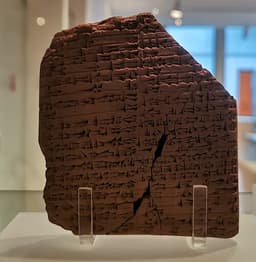
Ammi-Saduqa
Emperor · Ancient
39.7Total

Julius Caesar
General · Ancient
82.8Total
Basic Information
Born
-1646
-100
Died
-1626
-44
Era
Ancient
Ancient
Nationality
Babylon
Roman Republic
Occupation
Emperor
General
Civilization
Middle Eastern
Western
Score Comparison
Military (10%)
34.4
88.0
Political (20%)
32.1
78.0
Influence (20%)
44.0
85.0
Legacy (20%)
41.7
82.0
Leadership (15%)
31.2
80.0
Strategy (15%)
53.3
85.0
TOTAL
39.7
82.8
Ammi-Saduqa — Complete Timeline
1646 BC
Recording of Venus Tablet ObservationsCultural
During Ammi-Saduqa's reign, Babylonian astronomers recorded detailed observations of the planet Venus over a 21-year period. These records, preserved on cuneiform tablets, are now crucial for establishing the absolute chronology of the ancient Near East by correlating them with astronomical calculations.
AstronomyChronologyVenus
Impact: globalconstructive
Julius Caesar — Complete Timeline
58 BC
Gallic WarsWar◆ Major
Caesar, as proconsul of Gaul, launched a series of campaigns that conquered all of Gaul (modern France, Belgium, and parts of Switzerland). He fought numerous battles, including against the Helvetii, the Belgae, and the Gallic chieftain Vercingetorix. The wars brought immense wealth and a loyal army to Caesar.
Gallic WarsConquestRoman Expansion
Impact: regional
49 BC
Crossing the RubiconPolitical Action◆ Major
Caesar led Legio XIII across the Rubicon River into Italy, defying the Roman Senate's order to disband his army. This act triggered a civil war against Pompey and the Optimates, ultimately leading to Caesar's dictatorship and the end of the Roman Republic.
Roman Civil WarEnd of RepublicPower Struggle
Impact: global
48 BC
Battle of PharsalusWar◆ Major
Caesar's outnumbered army defeated the larger forces of Pompey the Great at Pharsalus in Greece. Caesar's tactical use of a reserve line to counter Pompey's cavalry charge proved decisive. Pompey fled to Egypt, where he was assassinated, leaving Caesar as the undisputed master of the Roman world.
Roman Civil WarBattleDecisive Victory
Impact: regional
44 BC
Appointment as Dictator for LifePolitical Action◆ Major
The Roman Senate appointed Caesar dictator perpetuo (dictator for life), granting him unprecedented personal power. This move concentrated military, legislative, and judicial authority in one person, effectively ending the Roman Republic's traditional system of checks and balances and alarming many senators.
DictatorshipEnd of RepublicPower Consolidation
Impact: regionaldestructive
Assassination on the Ides of MarchPolitical Action◆ Major
A group of Roman senators, led by Marcus Junius Brutus and Gaius Cassius Longinus, stabbed Caesar to death at a meeting of the Senate in the Theatre of Pompey. The assassination was intended to restore the Republic, but instead triggered another civil war that led to the rise of the Roman Empire.
AssassinationRoman PoliticsEnd of Republic
Impact: globaldestructive
Expert Analysis
ammi-saduqa-vs-julius-caesar
The Conqueror and the Stargazer
On a spring morning in 1626 BCE, King Ammi-Saduqa of Babylon died, leaving behind clay tablets inscribed with the movements of Venus. Nearly sixteen centuries later, on the Ides of March 44 BCE, Julius Caesar bled to death on the Senate floor, his body pierced by sixty daggers. One man watched the heavens; the other reshaped the earth. Their scores tell the story: Caesar’s total of 83.3 against Ammi-Saduqa’s 44.3. But numbers alone cannot capture why one name echoes across millennia while the other lingers only in footnotes. The answer lies not in talent but in ambition, not in intelligence but in will—and in the vast, silent gulf between a stable kingdom and a dying republic.
Origins
Ammi-Saduqa inherited a throne. Born in 1646 BCE, he was the tenth king of Babylon’s First Dynasty, a line that had ruled for three centuries. His world was one of order, ritual, and continuity. The Euphrates irrigated his fields, the ziggurats touched his sky, and the priests charted the stars. He had no need to prove himself; his blood was his credential. Ammi-Saduqa’s era was ancient even by ancient standards—a time when history moved slowly, and a king’s duty was to preserve, not transform.
Caesar’s origins were far more precarious. Born in 100 BCE into a patrician family of declining fortune, he entered a Roman Republic tearing itself apart. His uncle by marriage was Gaius Marius, a populist general who had slaughtered rivals; his father-in-law was Cinna, another Marian. When the dictator Sulla purged his enemies, young Caesar was forced to flee Rome, hiding in the Sabine hills. His noble name was a target, not a shield. From the start, he understood that survival required audacity.
Rise to Power
Ammi-Saduqa’s path was predetermined. He became king upon his father’s death, likely in his twenties. The machinery of Babylonian governance—scribes, priests, provincial governors—operated without his constant intervention. His great achievement was passive: during his reign, astronomers recorded the rising and setting of Venus over 21 years, creating the Venus Tablet observations that modern scholars still use to anchor ancient chronology. It was a feat of civilization, not of ambition. He did not seek power; he occupied it.
Caesar clawed his way upward. He won the praetorship, then the governorship of Further Spain, where he conquered tribes and amassed wealth. In 58 BCE, he secured command of Gaul—a province that would become his forge. Over eight years, he conquered over 300 tribes, fought 800 battles, and captured a million slaves. He crossed the Rhine, invaded Britain, and wrote his own commentaries to shape public opinion. When the Senate ordered him to disband his army, he crossed the Rubicon River in 49 BCE, plunging the Republic into civil war. “The die is cast,” he reportedly said. For Ammi-Saduqa, power was a birthright; for Caesar, it was a prize taken at swordpoint.
Leadership & Governance
Ammi-Saduqa governed as a traditional Near Eastern monarch. He maintained canals, upheld temple cults, and issued decrees that blended piety with pragmatism. One surviving edict fixed prices for barley, sesame oil, and wool—a ruler’s attempt to stabilize an economy. There is no record of military campaigns, no evidence of expansion. His leadership was administrative, not heroic. The Babylonians did not need a conqueror; they needed a caretaker.
Caesar was the opposite. His military genius was staggering: at Alesia (52 BCE), he besieged a Gallic fortress while simultaneously fighting off a relief army, a double envelopment that still astounds strategists. As dictator, he reformed the calendar, granted citizenship to provincials, initiated public works, and centralized tax collection. He packed the Senate with his supporters and assumed the title “dictator for life.” Yet his political wisdom had limits. He pardoned his enemies—Brutus, Cassius, and others—believing clemency would bind them to him. It did not. He failed to understand that the Republic’s elite preferred death to monarchy.
Triumph & Tragedy
Ammi-Saduqa’s triumph was silent. The Venus tablets survived the fall of Babylon, the rise of Persia, the conquests of Alexander, and the coming of Islam. When modern archaeologists deciphered them in the 19th century, they provided the key to dating the ancient Near East. A king who never fought a major battle left a gift to history.
Caesar’s triumph was spectacular. After defeating Pompey at Pharsalus (48 BCE), he returned to Rome as master of the Mediterranean. He celebrated four triumphs—over Gaul, Egypt, Pontus, and Africa—parading captives, treasures, and exotic animals. But his tragedy was equally immense. On the Ides of March, senators surrounded him and struck. He fell at the base of Pompey’s statue, blood pooling on the marble. His last words, according to tradition, were “*Et tu, Brute?*” — “And you, Brutus?”
Character & Destiny
Ammi-Saduqa’s character is opaque, buried under four millennia of silence. He was likely a dutiful king, respectful of tradition, content with the rhythms of Babylonian life. His destiny was to be remembered not for himself but for his scribes.
Caesar’s character blazes through history. He was reckless yet calculating, generous yet ruthless, charming yet cold. He wept for Alexander, who had conquered the world at thirty-two, while he himself was still a debt-ridden politician. He slept with his enemies’ wives, pardoned assassins, and believed himself invincible. His destiny was to destroy the Republic he purported to save—and in doing so, to create the Empire that would define Western civilization. His personality was not incidental to his fate; it was the engine of it.
Legacy
Ammi-Saduqa’s legacy is narrow but profound. The Venus tablets remain a cornerstone of ancient chronology, allowing historians to date the Hammurabi dynasty with precision. His name appears in scholarly footnotes, not in schoolbooks. He is a king of data, not of myth.
Caesar’s legacy is immeasurable. His name became a title: Kaiser, Tsar, Caesar. His reforms shaped Roman governance for centuries. His writings are studied as literature. His assassination sparked another civil war that ended the Republic forever. He is the archetype of the ambitious general who overthrows a democracy—and the cautionary tale of what happens when one man becomes too powerful.
Conclusion
Standing at the edge of history, one sees two figures: a Babylonian king who looked at the stars and a Roman general who grasped at the earth. Ammi-Saduqa’s quiet reign reminds us that not all greatness is loud; sometimes, the most enduring contributions are the ones we barely notice. Caesar’s violent life reminds us that ambition can reshape the world—but often at a terrible cost. Both left marks on time, but only one changed the course of history itself. Perhaps the real question is not who was greater, but what kind of greatness we choose to remember.
Rankings
🥇
Julius CaesarLeader
Mil: 88.0Pol: 78.0Inf: 85.0
82.8
🥈
Ammi-Saduqa
Mil: 34.4Pol: 32.1Inf: 44.0
39.7
+43.1 behind
How This Comparison Works
Algorithm
Each figure is scored on 6 dimensions (0—100 scale) based on structured historical data: Military (10%), Political (20%), Influence (20%), Legacy (20%), Leadership (15%), Strategy (15%). The weighted total produces the final ranking.
Data Sources
Scores are computed from structured sub-indicators in the database. Scale factors adjust for era (Ancient ×0.85, Modern ×1.0) and civilization size (Eastern ×1.05, Other ×0.80) to account for differences in population and military scale.
Maximum 3 Figures
Comparisons are limited to 2—3 figures to ensure readability and statistical meaningfulness.
Error Margins
±5 points per dimension — Sub-scores are derived from historical records with inherent uncertainty. Two figures within 5 points on a dimension should be considered roughly equivalent in that area.
Total Score Accuracy
±3 points overall — The weighted combination of 6 dimensions produces a total score with approximately ±3 points of uncertainty. Differences of less than 3 points are not statistically significant— the figures are effectively tied.
Known Limitations
- Historical records are incomplete and uneven across civilizations
- Figures from oral-tradition societies may be underrepresented
- Occupation labels can misclassify multi-role figures
- Scores measure capability and impact, not moral character
- Quantitative scoring is a comparison tool, not absolute truth
Capability Radar
Military (10%) — Battles & Warfare
Battles
37
95
Win Rate
39
92
Expansion
47
97
Political (20%) — Governance & Reform
Reform
10
90
Diplomacy
10
85
Economy
10
82
Influence (20%) — Cultural & Global Reach
Cultural
10
88
Global
10
94
Legacy (20%) — Historical Impact
Historical
40
95
Longevity
30
96
Leadership (15%) — Power & Stability
Tenure
20
75
Stability
15
60
Strategy (15%) — Tactics & Innovation
Strategy
47
94
Tactics
52
96
Reform
54
88
Similar Comparisons
Comments & Discussion
Starry-Eyed Scribe6/17/2026
You classicists always romanticize the "stargazer" angle, but let's be real: Ammi-Saduqa was a Bronze Age bureaucrat who inherited a stable kingdom and did nothing remarkable except pay priests to record Venus. Caesar rewrote the calendar, conquered Gaul, and crossed the Rubicon. That Venus tablet is a footnote — Caesar's Commentaries are literature. Score difference isn't close: 83 vs 44. Give me the man who broke the republic over the one who watched the sky from his palace.
帝王星陨6/17/2026
作为军事史研究者,我得说这比较太荒谬了。阿米-萨杜卡活在公元前1600年,那是个连铁器都没普及的时代,他的"王国"不过是幼发拉底河畔的一座城邦。凯撒征服了高卢全境,打败了庞培,改写了欧洲政治版图。你拿一个记录金星运行的地方领主跟改变人类文明进程的巨人比?44分对83分,这数字本身就已经给出了答案。
History's Accountant6/17/2026
The math doesn't lie — Caesar's 83.3 to Ammi-Saduqa's 44.3 is a landslide. But data skeptics should note: we're comparing apples to irradiated oranges. Ammi-Saduqa ruled in 1626 BCE, an era where "recorded history" means a few clay tablets. Caesar left us letters, speeches, military commentaries, accounts by contemporaries. The score gap partly reflects information asymmetry. That said, even adjusted for data quality, Caesar still wins by 20+ points. One man shaped Western civilization; the othe
星尘守望者6/17/2026
别太迷恋那些数字了。你们知道阿米-萨杜卡的维纳斯泥板吗?那是人类最早的天文观测记录之一,整整21年的金星运行数据,精确到让人震撼。凯撒当然伟大,但阿米-萨杜卡在公元前17世纪就开始系统性地记录天体运动,为后世的天文学奠定了基础。文明的伟大不只是征服和流血,还有仰望星空的那份勇气。44分太低了,至少也该60分。
Revisionist's Quill6/17/2026
Spare me the Caesar worship. Ammi-Saduqa's Venus tablets are the earliest known astronomical records that directly influenced later Babylonian, Greek, and even Islamic science. Caesar? He got himself assassinated because he couldn't read the room (or his own omens). Sure, he conquered Gaul and wrote good Latin, but the republic he "saved" collapsed into empire anyway. Meanwhile, Ammi-Saduqa's dynasty ruled peacefully for generations. Score-wise, 44 seems fair — but let's not pretend Caesar's 83