Loading...
This comparison has not been analyzed yet.
One-time AI generation (~1 minute). Scores and timeline are already available below.
Anawrahta vs Emperor Uda
Anawrahta leads by 18.0 pts · 2 figures compared
…
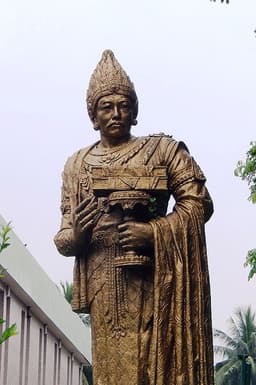
Anawrahta
Emperor · Medieval
65.2Total

Emperor Uda
Emperor · Medieval
47.2Total
Basic Information
Born
1014
867
Died
1077
931
Era
Medieval
Medieval
Nationality
Myanmar
Japan
Occupation
Emperor
Emperor
Civilization
Eastern
Eastern
Score Comparison
Military (10%)
70.0
52.0
Political (20%)
68.0
37.9
Influence (20%)
72.0
50.2
Legacy (20%)
55.0
42.5
Leadership (15%)
72.0
41.5
Strategy (15%)
55.0
68.9
TOTAL
65.2
47.2
Anawrahta — Complete Timeline
1044 AD
Founding of the Pagan EmpirePolitical Action
Anawrahta ascended the throne and unified the Irrawaddy River valley, founding the Pagan Empire. He conquered the Mon kingdom of Thaton and other neighboring states, creating the first unified Burmese kingdom and establishing Bagan as its capital.
UnificationEmpireBagan
Impact: regionalconstructive
1056 AD
Introduction of Theravada Buddhism to PaganCultural
Anawrahta adopted Theravada Buddhism after being converted by the Mon monk Shin Arahan. He made Theravada the state religion, replacing the existing Mahayana and animist practices. This religious shift had a lasting impact on Burmese culture and politics.
BuddhismReligionConversion
Impact: regionalconstructive
1057 AD
Conquest of the Thaton KingdomWar◆ Major
Anawrahta led a military campaign against the Mon kingdom of Thaton, capturing the city and bringing back Buddhist scriptures, monks, and artisans to Bagan. This conquest enriched Pagan's culture and solidified its dominance in the region.
ConquestMonCultural Exchange
Impact: regional
Emperor Uda — Complete Timeline
887 AD
Attempt to Counter Fujiwara DominancePolitical Action◆ Major
Emperor Uda attempted to rule without a Fujiwara regent after his abdication. He appointed his own advisors and promoted scholarship. His efforts to reduce Fujiwara influence were partially successful but ultimately temporary.
FujiwaraImperial PowerResistance
Impact: national
Promotion of Sugawara no MichizanePolitical Action◆ Major
Emperor Uda elevated the scholar Sugawara no Michizane to high court rank, bypassing the Fujiwara. Michizane became a key advisor and was appointed to the Council of State. This move was part of Uda's strategy to counter Fujiwara power.
Sugawara no MichizaneAdvisorFaction
Impact: nationalconstructive
897 AD
Abdication and Cloistered RulePolitical Action◆ Major
Emperor Uda abdicated and became a Buddhist monk, but continued to exert influence as a retired emperor (daijo tenno). This system of cloistered rule allowed him to govern from behind the scenes, a practice that later emperors would emulate.
Cloistered RuleAbdicationInsei
Impact: national
This comparison has not been analyzed yet.
One-time AI generation (~1 minute). Scores and timeline are already available below.
Rankings
🥇
AnawrahtaLeader
Mil: 70.0Pol: 68.0Inf: 72.0
65.2
🥈
Emperor Uda
Mil: 52.0Pol: 37.9Inf: 50.2
47.2
+18.0 behind
How This Comparison Works
Algorithm
Each figure is scored on 6 dimensions (0—100 scale) based on structured historical data: Military (10%), Political (20%), Influence (20%), Legacy (20%), Leadership (15%), Strategy (15%). The weighted total produces the final ranking.
Data Sources
Scores are computed from structured sub-indicators in the database. Scale factors adjust for era (Ancient ×0.85, Modern ×1.0) and civilization size (Eastern ×1.05, Other ×0.80) to account for differences in population and military scale.
Maximum 3 Figures
Comparisons are limited to 2—3 figures to ensure readability and statistical meaningfulness.
Error Margins
±5 points per dimension — Sub-scores are derived from historical records with inherent uncertainty. Two figures within 5 points on a dimension should be considered roughly equivalent in that area.
Total Score Accuracy
±3 points overall — The weighted combination of 6 dimensions produces a total score with approximately ±3 points of uncertainty. Differences of less than 3 points are not statistically significant— the figures are effectively tied.
Known Limitations
- Historical records are incomplete and uneven across civilizations
- Figures from oral-tradition societies may be underrepresented
- Occupation labels can misclassify multi-role figures
- Scores measure capability and impact, not moral character
- Quantitative scoring is a comparison tool, not absolute truth
Capability Radar
Military (10%) — Battles & Warfare
Battles
55
43
Win Rate
60
49
Expansion
60
50
Political (20%) — Governance & Reform
Reform
65
40
Diplomacy
60
35
Economy
55
25
Influence (20%) — Cultural & Global Reach
Cultural
70
30
Global
55
10
Legacy (20%) — Historical Impact
Historical
75
35
Longevity
70
20
Leadership (15%) — Power & Stability
Tenure
70
30
Stability
60
20
Strategy (15%) — Tactics & Innovation
Strategy
55
55
Tactics
50
57
Reform
45
61
Similar Comparisons
Comments & Discussion
No comments yet. Be the first to share your thoughts!