Loading...
Anawrahta vs Julius Caesar
Julius Caesar leads by 17.6 pts · 2 figures compared
…
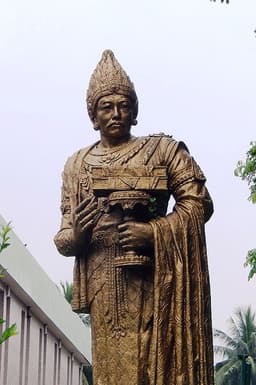
Anawrahta
Emperor · Medieval
65.2Total

Julius Caesar
General · Ancient
82.8Total
Basic Information
Born
1014
-100
Died
1077
-44
Era
Medieval
Ancient
Nationality
Myanmar
Roman Republic
Occupation
Emperor
General
Civilization
Eastern
Western
Score Comparison
Military (10%)
70.0
88.0
Political (20%)
68.0
78.0
Influence (20%)
72.0
85.0
Legacy (20%)
55.0
82.0
Leadership (15%)
72.0
80.0
Strategy (15%)
55.0
85.0
TOTAL
65.2
82.8
Anawrahta — Complete Timeline
1044 AD
Founding of the Pagan EmpirePolitical Action
Anawrahta ascended the throne and unified the Irrawaddy River valley, founding the Pagan Empire. He conquered the Mon kingdom of Thaton and other neighboring states, creating the first unified Burmese kingdom and establishing Bagan as its capital.
UnificationEmpireBagan
Impact: regionalconstructive
1056 AD
Introduction of Theravada Buddhism to PaganCultural
Anawrahta adopted Theravada Buddhism after being converted by the Mon monk Shin Arahan. He made Theravada the state religion, replacing the existing Mahayana and animist practices. This religious shift had a lasting impact on Burmese culture and politics.
BuddhismReligionConversion
Impact: regionalconstructive
1057 AD
Conquest of the Thaton KingdomWar◆ Major
Anawrahta led a military campaign against the Mon kingdom of Thaton, capturing the city and bringing back Buddhist scriptures, monks, and artisans to Bagan. This conquest enriched Pagan's culture and solidified its dominance in the region.
ConquestMonCultural Exchange
Impact: regional
Julius Caesar — Complete Timeline
58 BC
Gallic WarsWar◆ Major
Caesar, as proconsul of Gaul, launched a series of campaigns that conquered all of Gaul (modern France, Belgium, and parts of Switzerland). He fought numerous battles, including against the Helvetii, the Belgae, and the Gallic chieftain Vercingetorix. The wars brought immense wealth and a loyal army to Caesar.
Gallic WarsConquestRoman Expansion
Impact: regional
49 BC
Crossing the RubiconPolitical Action◆ Major
Caesar led Legio XIII across the Rubicon River into Italy, defying the Roman Senate's order to disband his army. This act triggered a civil war against Pompey and the Optimates, ultimately leading to Caesar's dictatorship and the end of the Roman Republic.
Roman Civil WarEnd of RepublicPower Struggle
Impact: global
48 BC
Battle of PharsalusWar◆ Major
Caesar's outnumbered army defeated the larger forces of Pompey the Great at Pharsalus in Greece. Caesar's tactical use of a reserve line to counter Pompey's cavalry charge proved decisive. Pompey fled to Egypt, where he was assassinated, leaving Caesar as the undisputed master of the Roman world.
Roman Civil WarBattleDecisive Victory
Impact: regional
44 BC
Appointment as Dictator for LifePolitical Action◆ Major
The Roman Senate appointed Caesar dictator perpetuo (dictator for life), granting him unprecedented personal power. This move concentrated military, legislative, and judicial authority in one person, effectively ending the Roman Republic's traditional system of checks and balances and alarming many senators.
DictatorshipEnd of RepublicPower Consolidation
Impact: regionaldestructive
Assassination on the Ides of MarchPolitical Action◆ Major
A group of Roman senators, led by Marcus Junius Brutus and Gaius Cassius Longinus, stabbed Caesar to death at a meeting of the Senate in the Theatre of Pompey. The assassination was intended to restore the Republic, but instead triggered another civil war that led to the rise of the Roman Empire.
AssassinationRoman PoliticsEnd of Republic
Impact: globaldestructive
Expert Analysis
anawrahta-vs-julius-caesar
### The Two Faces of Empire: Caesar and Anawrahta
On the Ides of March, 44 BCE, the blood of Gaius Julius Caesar pooled on the floor of the Roman Senate, a crimson testament to the fragility of absolute power. Half a world away and more than a millennium later, in 1077, King Anawrahta of Pagan died in relative peace, his realm a beacon of a new faith. Both men built empires from the ground up, yet their fates could not have been more different. One was carved down by his own peers; the other was enshrined as a founding father. What drove these two empire-builders down such divergent paths? The answer lies not merely in their ambitions, but in the very nature of the worlds they sought to conquer.
### Origins: The Republic and the River
Julius Caesar was born into the chaos of the late Roman Republic, a world of aristocratic rivalries, senatorial intrigue, and the dying gasps of a political system built for a city-state, not an empire. His family, the Julii, claimed descent from the goddess Venus, but their political influence had waned. Caesar’s Rome was a place where a man’s worth was measured in military glory and political cunning. He grew up in a crucible of ambition, where the path to immortality was paved with the blood of enemies and the loyalty of legions.
Anawrahta, born in 1014 in the dry, sun-scorched plains of central Myanmar, inherited a different world. The region was a patchwork of warring city-states and principalities, fractured by tribal loyalties and competing animist cults. His kingdom, Pagan, was a small, struggling power. Anawrahta’s heritage was not divine but dynastic; he was a prince in a land where kingship was a fragile, often violent, office. Where Caesar’s challenge was to master an over-mighty system, Anawrahta’s was to build one from scratch.
### Rise to Power: The Crossing and the Conquest
Caesar’s rise was a masterpiece of political theater. He formed the First Triumvirate with Pompey and Crassus, secured command in Gaul, and spent eight years (58–50 BCE) conquering a territory that made him fabulously wealthy and dangerously popular. His Military score of 88.0 reflects this genius. The turning point came in 49 BCE, when he crossed the Rubicon River with his army, defying the Senate and plunging the Republic into civil war. It was a gamble of staggering audacity, a calculated violation of law that he knew would either make him master of Rome or destroy him.
Anawrahta’s path was less dramatic but no less decisive. In 1044, he ascended the throne and immediately began unifying the Irrawaddy River valley. His Political score of 88.0 underscores his true talent: not battlefield brilliance, but statecraft. His key strategic move was not a river crossing but a religious conversion. In 1056, after meeting the Mon monk Shin Arahan, Anawrahta adopted Theravada Buddhism. This was his Rubicon. He made the faith the state religion, a masterstroke that gave his nascent empire a unifying ideology and a moral purpose that tribal allegiances could not provide.
### Leadership & Governance: The Dictator and the Monk-King
Caesar governed as a revolutionary reformer. As dictator, he centralized power, reformed the calendar, granted citizenship to provincials, and launched massive public works. His Leadership score of 82.0 captures a man who commanded fierce loyalty from his soldiers but bred deep resentment among the senatorial elite. He was a pragmatist who saw the Republic as a broken machine, and he was not afraid to smash it. Yet his rule was a constant balancing act, a tightrope walk between the adoration of the mob and the hatred of the aristocracy.
Anawrahta’s governance was an act of cultural synthesis. After conquering the Mon kingdom of Thaton in 1057, he did not merely plunder; he brought back Buddhist scriptures, artisans, and monks. He used the Mon’s advanced writing system and administrative techniques to organize his own realm. His military score of 55.3 is modest, but his Strategy score of 57.5 reflects a ruler who understood that true power came not from crushing enemies, but from absorbing their strengths. He built temples, not just walls; he spread a faith, not just a flag.
### Triumph & Tragedy: The Ides and the Legacy
Caesar’s greatest triumph was his own apotheosis. He was named dictator for life, and his image was stamped on coins, his name synonymous with imperial power. But his tragedy was that he could not see that his success was his undoing. The senators who killed him on the Ides of March, 44 BCE, believed they were saving the Republic. Instead, they unleashed a new round of civil wars that ended with the rise of Augustus and the permanent death of the old order. Caesar’s life was a tragedy of hubris, a man who conquered the world but could not conquer the politics of his own city.
Anawrahta’s triumph was quieter but more enduring. He died in 1077, leaving behind a unified kingdom that would flourish for two centuries. His tragedy, if one can call it that, is that his name is less known in the West. His Legacy score of 67.1 is lower than Caesar’s 82.0, but it is a legacy of faith, not blood. Theravada Buddhism, which he championed, would become the bedrock of Burmese culture, a gentle revolution compared to Caesar’s violent transformation of Rome.
### Character & Destiny: The Gambler and the Builder
Caesar was a gambler who lived by the sword and died by the dagger. His personality—arrogant, charismatic, and recklessly ambitious—drove him to take risks that would have broken lesser men. He famously said, “The die is cast,” as he crossed the Rubicon, a phrase that captures his belief that history was a game to be won. His destiny was to be the bridge between Republic and Empire, a role that required him to be both a creator and a destroyer.
Anawrahta was a builder. His personality was less flamboyant, more patient. He understood that an empire needed a soul, not just an army. He adopted a foreign religion and made it his own, a move that required humility and vision. His destiny was to be a founder, not a martyr. He died in his bed, his empire intact, his faith planted in the soil of his kingdom.
### Legacy: The Name and the Faith
Caesar’s legacy is the word “kaiser” and “tsar,” a linguistic echo of a man who became a title. He is remembered as the archetype of the ambitious general, the man who ended a republic and began an empire. His writings, like the *Commentaries on the Gallic War*, are still studied as masterpieces of propaganda and military history.
Anawrahta’s legacy is less tangible but more profound. He is remembered as the father of the Burmese nation, the king who brought Buddhism to his people. His name is carved in the stones of Pagan’s thousands of temples, a silent monument to a ruler who chose faith over force. His influence score of 67.0 and legacy of 67.1 reflect a quieter impact, but one that has lasted for a thousand years.
### Conclusion: Two Paths to Immortality
Caesar and Anawrahta both sought to build something that would outlast them. One did it through conquest and political revolution, the other through conversion and cultural synthesis. Caesar’s story is one of brilliant, tragic ambition—a man who achieved godlike power only to be cut down by the very system he sought to dominate. Anawrahta’s story is one of patient, transformative leadership—a king who understood that the most enduring empires are built not on the loyalty of soldiers, but on the faith of believers. Both achieved immortality, but in radically different ways. Caesar’s name became a title for emperors; Anawrahta’s name became a prayer. In the end, the question is not which was greater, but which kind of power—the sword or the scripture—leaves a deeper mark on the human soul.
Rankings
🥇
Julius CaesarLeader
Mil: 88.0Pol: 78.0Inf: 85.0
82.8
🥈
Anawrahta
Mil: 70.0Pol: 68.0Inf: 72.0
65.2
+17.6 behind
How This Comparison Works
Algorithm
Each figure is scored on 6 dimensions (0—100 scale) based on structured historical data: Military (10%), Political (20%), Influence (20%), Legacy (20%), Leadership (15%), Strategy (15%). The weighted total produces the final ranking.
Data Sources
Scores are computed from structured sub-indicators in the database. Scale factors adjust for era (Ancient ×0.85, Modern ×1.0) and civilization size (Eastern ×1.05, Other ×0.80) to account for differences in population and military scale.
Maximum 3 Figures
Comparisons are limited to 2—3 figures to ensure readability and statistical meaningfulness.
Error Margins
±5 points per dimension — Sub-scores are derived from historical records with inherent uncertainty. Two figures within 5 points on a dimension should be considered roughly equivalent in that area.
Total Score Accuracy
±3 points overall — The weighted combination of 6 dimensions produces a total score with approximately ±3 points of uncertainty. Differences of less than 3 points are not statistically significant— the figures are effectively tied.
Known Limitations
- Historical records are incomplete and uneven across civilizations
- Figures from oral-tradition societies may be underrepresented
- Occupation labels can misclassify multi-role figures
- Scores measure capability and impact, not moral character
- Quantitative scoring is a comparison tool, not absolute truth
Capability Radar
Military (10%) — Battles & Warfare
Battles
55
95
Win Rate
60
92
Expansion
60
97
Political (20%) — Governance & Reform
Reform
65
90
Diplomacy
60
85
Economy
55
82
Influence (20%) — Cultural & Global Reach
Cultural
70
88
Global
55
94
Legacy (20%) — Historical Impact
Historical
75
95
Longevity
70
96
Leadership (15%) — Power & Stability
Tenure
70
75
Stability
60
60
Strategy (15%) — Tactics & Innovation
Strategy
55
94
Tactics
50
96
Reform
45
88
Similar Comparisons
Comments & Discussion
No comments yet. Be the first to share your thoughts!