Loading...
Andrei Bogolyubsky vs Julius Caesar
Julius Caesar leads by 36.0 pts · 2 figures compared
…
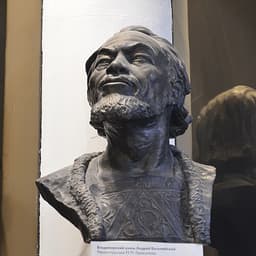
Andrei Bogolyubsky
Emperor · Medieval
46.8Total

Julius Caesar
General · Ancient
82.8Total
Basic Information
Born
1111
-100
Died
1174
-44
Era
Medieval
Ancient
Nationality
Vladimir-Suzdal
Roman Republic
Occupation
Emperor
General
Civilization
Western
Western
Score Comparison
Military (10%)
10.0
88.0
Political (20%)
43.7
78.0
Influence (20%)
54.9
85.0
Legacy (20%)
46.7
82.0
Leadership (15%)
62.2
80.0
Strategy (15%)
45.0
85.0
TOTAL
46.8
82.8
Andrei Bogolyubsky — Complete Timeline
1157 AD
Transfer of the Capital to VladimirPolitical Action
After becoming Grand Prince, Andrei moved his capital from Kiev to Vladimir, a city in the northeast. He made Vladimir the political and religious center of his realm, building the Assumption Cathedral and Golden Gate.
Capital MoveVladimirPolitical Shift
Impact: regionalconstructive
1165 AD
Construction of the Church of the Intercession on the NerlCultural◆ Major
Andrei commissioned the Church of the Intercession on the Nerl River near Vladimir. This white-stone church is a masterpiece of medieval Russian architecture and a symbol of the Vladimir-Suzdal principality's cultural flourishing.
ArchitectureChurchCultural Symbol
Impact: regionalconstructive
1169 AD
Sack of KievWar
Andrei Bogolyubsky led a coalition of Rus princes in sacking Kiev, the traditional capital. His forces looted and burned the city, marking a decline in Kiev's power and the rise of Vladimir-Suzdal as a new center.
Sack of KievDeclineVladimir-Suzdal
Impact: regionaldestructive
1174 AD
Assassination by BoyarsPolitical Action◆ Major
Andrei was assassinated by a group of boyars in his palace at Bogolyubovo. The conspiracy was driven by his autocratic rule and conflicts with the nobility. His death led to a period of civil strife in Vladimir-Suzdal.
AssassinationBoyar RevoltCivil Strife
Impact: nationaltragic
Julius Caesar — Complete Timeline
58 BC
Gallic WarsWar◆ Major
Caesar, as proconsul of Gaul, launched a series of campaigns that conquered all of Gaul (modern France, Belgium, and parts of Switzerland). He fought numerous battles, including against the Helvetii, the Belgae, and the Gallic chieftain Vercingetorix. The wars brought immense wealth and a loyal army to Caesar.
Gallic WarsConquestRoman Expansion
Impact: regional
49 BC
Crossing the RubiconPolitical Action◆ Major
Caesar led Legio XIII across the Rubicon River into Italy, defying the Roman Senate's order to disband his army. This act triggered a civil war against Pompey and the Optimates, ultimately leading to Caesar's dictatorship and the end of the Roman Republic.
Roman Civil WarEnd of RepublicPower Struggle
Impact: global
48 BC
Battle of PharsalusWar◆ Major
Caesar's outnumbered army defeated the larger forces of Pompey the Great at Pharsalus in Greece. Caesar's tactical use of a reserve line to counter Pompey's cavalry charge proved decisive. Pompey fled to Egypt, where he was assassinated, leaving Caesar as the undisputed master of the Roman world.
Roman Civil WarBattleDecisive Victory
Impact: regional
44 BC
Appointment as Dictator for LifePolitical Action◆ Major
The Roman Senate appointed Caesar dictator perpetuo (dictator for life), granting him unprecedented personal power. This move concentrated military, legislative, and judicial authority in one person, effectively ending the Roman Republic's traditional system of checks and balances and alarming many senators.
DictatorshipEnd of RepublicPower Consolidation
Impact: regionaldestructive
Assassination on the Ides of MarchPolitical Action◆ Major
A group of Roman senators, led by Marcus Junius Brutus and Gaius Cassius Longinus, stabbed Caesar to death at a meeting of the Senate in the Theatre of Pompey. The assassination was intended to restore the Republic, but instead triggered another civil war that led to the rise of the Roman Empire.
AssassinationRoman PoliticsEnd of Republic
Impact: globaldestructive
Expert Analysis
andrei-bogolyubsky-vs-julius-caesar
# The Road to Glory and the Path to Ruin
On a January morning in 49 BCE, Julius Caesar stood at the banks of the Rubicon River, a small stream that marked the boundary between his province of Gaul and Italy proper. To cross with his army was treason; to turn back was political oblivion. He made his choice, uttering the famous words, *"Alea iacta est"* — the die is cast. More than twelve centuries later, in 1174, another ruler met a very different fate. Andrei Bogolyubsky, Grand Prince of Vladimir-Suzdal, was cornered in his bedchamber by his own boyars, stabbed to death in the darkness of his palace at Bogolyubovo. Two men, both ambitious, both seeking to centralize power. One built an empire; the other built a church and left a corpse.
Origins
Julius Caesar was born into the patrician Julian clan in 100 BCE, a time when the Roman Republic was already groaning under the weight of its own success. His family was ancient but not wealthy, and Caesar grew up in the shadow of civil wars and the dictatorship of Sulla. He learned early that survival meant navigating politics with a knife's edge.
Andrei Bogolyubsky, born around 1111, came from a world far removed from the marble forums of Rome. He was a prince of the Rurikid dynasty, the sprawling, quarrelsome family that ruled the fragmented lands of the Rus. His father, Yuri Dolgoruky, had founded Moscow, but the real power lay in the south, in Kiev. Andrei was raised in a world of wooden fortresses, Orthodox icons, and endless feuds between cousins. Where Caesar inherited a republic in crisis, Andrei inherited a patchwork of principalities held together by blood, faith, and the occasional marriage alliance.
Rise to Power
Caesar's path was a masterclass in calculated risk. He climbed the political ladder through military command in Spain, then formed the First Triumvirate with Pompey and Crassus in 60 BCE. His real springboard came when he secured the governorship of Gaul in 58 BCE. Over the next eight years, he conquered the entire region, amassed a loyal army, and built a personal fortune. The Gallic Wars were not just conquests; they were a political machine.
Andrei's rise was far quieter. In 1157, after his father's death, he became Grand Prince of Kiev — the traditional seat of power. But instead of staying in the ancient capital, he made a stunning decision: he moved his capital to Vladimir, a small city in the northeast. It was a deliberate break from tradition, a declaration that the old order was dead. Where Caesar expanded outward, Andrei retreated inward, building a new center of gravity far from the intrigues of Kiev.
Leadership & Governance
Caesar governed with a blend of ruthlessness and magnanimity. He pardoned former enemies, extended citizenship to Gauls, and reformed the calendar. His military genius was undeniable: at the Battle of Alesia in 52 BCE, he surrounded a Gallic army that outnumbered his own, building siege works that remain a marvel of engineering. His political score of 78.0 reflects a man who understood that power was not just about winning battles but about winning hearts — or at least silencing opposition.
Andrei's governance was more autocratic and less forgiving. He ruled Vladimir with an iron hand, sidelining the traditional boyar councils and ruling through personal decree. His military score of 61.0 and strategy of 41.3 suggest he was no Caesar on the battlefield. But his political score of 72.0 shows he understood power in his own way. He commissioned the Church of the Intercession on the Nerl in 1165, a masterpiece of white-stone architecture that still stands as a symbol of Vladimir's rise. He was building a legacy, not an empire.
Triumph & Tragedy
Caesar's greatest triumph was the conquest of Gaul, a campaign that added a vast territory to the Roman sphere and made him the most powerful man in the Republic. His greatest tragedy came on the Ides of March in 44 BCE, when he was stabbed to death by senators who feared his ambition. He had become dictator for life, but he never saw the empire he helped create.
Andrei's triumph was the sack of Kiev in 1169. He led a coalition of Rus princes against the ancient capital, looting and burning the city that had once been the heart of the Rus world. It was a symbolic victory, but it also marked the definitive shift of power from Kiev to the northeast. His tragedy came five years later, in 1174, when his own boyars assassinated him. He had tried to rule without their consent, and they repaid him with daggers.
Character & Destiny
Caesar was a gambler who calculated his odds with precision. He knew when to be generous and when to be cruel. His personality — ambitious, charismatic, and relentlessly pragmatic — drove him to cross the Rubicon and remake the Roman world. He believed in his own star, and history proved him right, at least in the long run.
Andrei was a builder, not a conqueror. He was pious enough to commission churches but autocratic enough to alienate his own nobility. His decision to move the capital to Vladimir was visionary, but his inability to secure loyalty proved fatal. He lacked Caesar's political flexibility, his willingness to pardon and co-opt. In the end, Andrei's character was his undoing: he wanted absolute power in a world that still demanded consultation.
Legacy
Julius Caesar's legacy is imprinted on the DNA of Western civilization. His name became synonymous with imperial power — *Kaiser* in German, *Tsar* in Russian. His writings, especially the *Commentaries on the Gallic War*, remain classics of military literature. His reforms outlived him, and the Roman Empire he unwittingly founded lasted for centuries.
Andrei Bogolyubsky's legacy is more modest but no less significant. By moving the capital to Vladimir, he set the stage for the rise of Moscow and the eventual unification of Russia. The Church of the Intercession on the Nerl is a UNESCO World Heritage site, a quiet monument to his vision. His total score of 64.9 reflects a man who was competent but not transformative. Yet in the long arc of history, his decision to abandon Kiev was as consequential as Caesar's crossing of the Rubicon.
Conclusion
One man built an empire that stretched from the Atlantic to the Euphrates. Another built a church on a river and moved a capital that would one day become the heart of a vast Eurasian power. Caesar died at the height of his ambition, betrayed by friends. Andrei died in the dark, betrayed by his own court. Both sought to centralize power in their own hands; both paid the ultimate price. But Caesar's death launched a legend, while Andrei's death marked the end of an era. In the end, the difference between them is not just in their scores or their achievements, but in the scale of their vision. Caesar saw a world to conquer; Andrei saw a kingdom to build. History remembers the conqueror, but it lives in the foundations laid by the builder.
Rankings
🥇
Julius CaesarLeader
Mil: 88.0Pol: 78.0Inf: 85.0
82.8
🥈
Andrei Bogolyubsky
Mil: 10.0Pol: 43.7Inf: 54.9
46.8
+36.0 behind
How This Comparison Works
Algorithm
Each figure is scored on 6 dimensions (0—100 scale) based on structured historical data: Military (10%), Political (20%), Influence (20%), Legacy (20%), Leadership (15%), Strategy (15%). The weighted total produces the final ranking.
Data Sources
Scores are computed from structured sub-indicators in the database. Scale factors adjust for era (Ancient ×0.85, Modern ×1.0) and civilization size (Eastern ×1.05, Other ×0.80) to account for differences in population and military scale.
Maximum 3 Figures
Comparisons are limited to 2—3 figures to ensure readability and statistical meaningfulness.
Error Margins
±5 points per dimension — Sub-scores are derived from historical records with inherent uncertainty. Two figures within 5 points on a dimension should be considered roughly equivalent in that area.
Total Score Accuracy
±3 points overall — The weighted combination of 6 dimensions produces a total score with approximately ±3 points of uncertainty. Differences of less than 3 points are not statistically significant— the figures are effectively tied.
Known Limitations
- Historical records are incomplete and uneven across civilizations
- Figures from oral-tradition societies may be underrepresented
- Occupation labels can misclassify multi-role figures
- Scores measure capability and impact, not moral character
- Quantitative scoring is a comparison tool, not absolute truth
Capability Radar
Military (10%) — Battles & Warfare
Battles
35
95
Win Rate
40
92
Expansion
45
97
Political (20%) — Governance & Reform
Reform
45
90
Diplomacy
40
85
Economy
35
82
Influence (20%) — Cultural & Global Reach
Cultural
40
88
Global
30
94
Legacy (20%) — Historical Impact
Historical
45
95
Longevity
35
96
Leadership (15%) — Power & Stability
Tenure
50
75
Stability
30
60
Strategy (15%) — Tactics & Innovation
Strategy
35
94
Tactics
30
96
Reform
20
88
Similar Comparisons
Comments & Discussion
DONETSK_DISILLUSIONED6/17/2026
我不懂你们为什么把这两个人并列在一起讨论。这是什么“比较”?凯撒在公元前49年劈开了地中海世界的政治脊柱;安德烈在1174年被自己的刀剁在漆黑的卧室里。一个是塑造历史走向的巨人,一个是连自己贵族都摆不平的地方领主。安德烈也许是个虔诚的东正教徒、一个不错的城堡建筑师——
RUBICON_SHIFTER6/17/2026
Caesar crossing the Rubicon was a calculated gamble by a political genius; Andrei dying in his bedchamber was a predictable outcome of amateurish rule. Caesar understood that absolute power requires speed—he secured Gaul, bribed his legions, and crushed the Senate in five years. Andrei alienated the very boyars he needed by favoring upstarts and church-building over land grants. He literally built himself a fortress at Bogolyubovo without building loyalty. No military commander with Caesar's ins
CAESARIAN_SHADOW6/17/2026
The real measure isn't glory or death—it's what you leave standing. Caesar left a hundred years of civil war and an imperial system that eventually collapsed under its own corruption. Andrei left the Assumption Cathedral in Vladimir and a cult of saintly martyrdom that unified the Russian north. Most historians fixate on Caesar's military genius, but his "empire" was a personalist regime that required his constant presence. Andrei's failure was political, but his architectural and religious lega
DEVILS_INK6/17/2026
你们都在谈战略和遗产,但这根本是鸡同鸭讲。凯撒的核心武器是罗马军团的组织纪律和元老院的制度博弈,安德烈手里有什么?一群随时叛变的波雅尔、几座木墙堡垒和东正教圣像——这不是同一种游戏。说安德烈是“失败者”太廉价了;他是用错误的工具做不可能的事。凯撒跨过卢比孔河时,他赌罗马会理解他的野心。安德烈闭眼时,他连自己的卧室都控制不了。工具决定剧本。
RED_STAR_PRAXIS6/17/2026
历史唯物主义一读就明白:凯撒代表了新兴奴隶制帝国对旧共和秩序的镇压,他的成功基于对高卢、埃及、西班牙的系统性掠夺——每年几万吨谷物和数十万奴隶流入罗马。安德烈呢?他是封建分封制走向中央集权过程中的牺牲品,他的“失败”不是个人愚蠢,是弗拉基米尔-苏兹达尔的物质基础——农耕、毛皮、少量贸易——根本撑不起一个专制君主国。凯撒有军团和黄金,安德烈只有教堂和祈祷。这从来不是同一场比赛。