Loading...
This comparison has not been analyzed yet.
One-time AI generation (~1 minute). Scores and timeline are already available below.
Anerood Jugnauth vs Einar Gerhardsen
Anerood Jugnauth leads by 0.7 pts · 2 figures compared
…
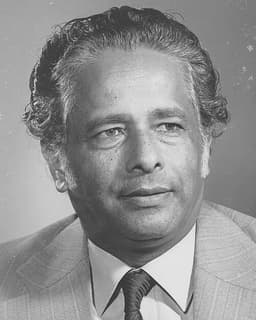
Anerood Jugnauth
Politician · Modern
59.0Total

Einar Gerhardsen
Politician · Modern
58.3Total
Basic Information
Born
1930
1897
Died
—
1987
Era
Modern
Modern
Nationality
Mauritius
Norway
Occupation
Politician
Politician
Civilization
Other
Western
Score Comparison
Military (10%)
46.1
48.6
Political (20%)
70.3
62.7
Influence (20%)
59.0
58.3
Legacy (20%)
52.0
52.0
Leadership (15%)
78.0
80.7
Strategy (15%)
43.5
43.4
TOTAL
59.0
58.3
Anerood Jugnauth — Complete Timeline
1982 AD
Elected Prime Minister of MauritiusPolitical Action◆ Major
Jugnauth became Prime Minister after his Militant Socialist Movement (MSM) won the 1982 general election, defeating Seewoosagur Ramgoolam. He inherited an economy facing high unemployment and debt.
Electoral VictoryPower Transition
Impact: national
1983 AD
Established the Mauritius Export Processing ZoneReform
Jugnauth's government expanded the Export Processing Zone (EPZ) scheme, attracting foreign investment in textile manufacturing. This policy transformed Mauritius from a sugar-dependent economy to a diversified one, reducing unemployment.
Economic ReformIndustrialization
Impact: nationalconstructive
1987 AD
Re-elected Prime Minister (1987)Political Action◆ Major
Jugnauth won the 1987 general election, securing a second term. His government continued economic liberalization policies, leading to sustained growth and the emergence of Mauritius as a middle-income country.
Re-electionEconomic Growth
Impact: nationalconstructive
2003 AD
Became President of MauritiusPolitical Action
Jugnauth was elected President of Mauritius by the National Assembly, a largely ceremonial role. He served until 2012, providing a figurehead role after his long tenure as Prime Minister.
PresidencyCeremonial Role
Impact: national
2014 AD
Returned as Prime Minister (2014)Political Action◆ Major
Jugnauth returned as Prime Minister after his MSM-led alliance won the 2014 general election. At age 84, he became one of the world's oldest serving leaders, focusing on infrastructure projects.
Political ComebackInfrastructure
Impact: national
2017 AD
Resigned as Prime MinisterPolitical Action◆ Major
Jugnauth resigned as Prime Minister in January 2017, handing power to his son, Pravind Jugnauth. The succession was criticized as dynastic but was legal under the constitution.
ResignationDynastic Succession
Impact: national
Einar Gerhardsen — Complete Timeline
1945 AD
First Term as Prime Minister of NorwayPolitical Action
Gerhardsen became Prime Minister in June 1945, leading a coalition government after World War II. He oversaw Norway's reconstruction and economic recovery.
Norwegian PoliticsPost-War Reconstruction
Impact: nationalconstructive
Longest-Serving Prime Minister of NorwayPolitical Action◆ Major
Gerhardsen served as Prime Minister for 17 years (1945-1951, 1955-1965). He led the Labour Party and implemented the welfare state, including universal social security.
Norwegian PoliticsWelfare State
Impact: nationalconstructive
1949 AD
NATO Membership DecisionPolitical Action◆ Major
Gerhardsen's government led Norway into NATO in 1949, abandoning neutrality. This decision aligned Norway with Western powers during the Cold War.
NATOCold War
Impact: national
1963 AD
Resignation After Kings Bay AffairPolitical Action◆ Major
Gerhardsen resigned in August 1963 after a no-confidence vote triggered by the Kings Bay mining accident. The accident killed 21 workers and revealed government negligence.
Norwegian PoliticsScandal
Impact: nationaltragic
This comparison has not been analyzed yet.
One-time AI generation (~1 minute). Scores and timeline are already available below.
Rankings
🥇
Anerood JugnauthLeader
Mil: 46.1Pol: 70.3Inf: 59.0
59.0
🥈
Einar Gerhardsen
Mil: 48.6Pol: 62.7Inf: 58.3
58.3
+0.7 behind
How This Comparison Works
Algorithm
Each figure is scored on 6 dimensions (0—100 scale) based on structured historical data: Military (10%), Political (20%), Influence (20%), Legacy (20%), Leadership (15%), Strategy (15%). The weighted total produces the final ranking.
Data Sources
Scores are computed from structured sub-indicators in the database. Scale factors adjust for era (Ancient ×0.85, Modern ×1.0) and civilization size (Eastern ×1.05, Other ×0.80) to account for differences in population and military scale.
Maximum 3 Figures
Comparisons are limited to 2—3 figures to ensure readability and statistical meaningfulness.
Error Margins
±5 points per dimension — Sub-scores are derived from historical records with inherent uncertainty. Two figures within 5 points on a dimension should be considered roughly equivalent in that area.
Total Score Accuracy
±3 points overall — The weighted combination of 6 dimensions produces a total score with approximately ±3 points of uncertainty. Differences of less than 3 points are not statistically significant— the figures are effectively tied.
Known Limitations
- Historical records are incomplete and uneven across civilizations
- Figures from oral-tradition societies may be underrepresented
- Occupation labels can misclassify multi-role figures
- Scores measure capability and impact, not moral character
- Quantitative scoring is a comparison tool, not absolute truth
Capability Radar
Military (10%) — Battles & Warfare
Battles
24
30
Win Rate
23
32
Expansion
27
36
Political (20%) — Governance & Reform
Reform
70
80
Diplomacy
75
75
Economy
80
80
Influence (20%) — Cultural & Global Reach
Cultural
40
60
Global
45
50
Legacy (20%) — Historical Impact
Historical
50
65
Longevity
60
55
Leadership (15%) — Power & Stability
Tenure
85
85
Stability
75
85
Strategy (15%) — Tactics & Innovation
Strategy
31
41
Tactics
32
39
Reform
37
46
Similar Comparisons
Comments & Discussion
No comments yet. Be the first to share your thoughts!