Loading...
This comparison has not been analyzed yet.
One-time AI generation (~1 minute). Scores and timeline are already available below.
Antigonus I Monophthalmus vs Euthydemus I
Antigonus I Monophthalmus leads by 9.9 pts · 2 figures compared
…

Antigonus I Monophthalmus
Emperor · Ancient
63.4Total
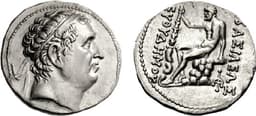
Euthydemus I
Emperor · Ancient
53.5Total
Basic Information
Born
-382
-260
Died
-301
-190
Era
Ancient
Ancient
Nationality
Macedon
Greco-Bactrian Kingdom
Occupation
Emperor
Emperor
Civilization
Western
Eastern
Score Comparison
Military (10%)
78.5
65.0
Political (20%)
55.8
68.0
Influence (20%)
62.0
55.7
Legacy (20%)
56.0
46.7
Leadership (15%)
68.0
40.0
Strategy (15%)
75.0
52.5
TOTAL
63.4
53.5
Antigonus I Monophthalmus — Complete Timeline
316 BC
Battle of GabieneWar◆ Major
Antigonus I defeated Eumenes, a former general of Alexander, at Gabiene in Persia. This victory eliminated a major rival and gave Antigonus control over the eastern satrapies, making him the most powerful of the Diadochi at that time.
DiadochiBattlePersia
Impact: regional
315 BC
Siege of TyreWar
Antigonus I besieged and captured the city of Tyre from Ptolemy I's forces. The siege demonstrated his military capabilities and expanded his control over Phoenicia and Syria, strengthening his position in the Diadochi conflicts.
DiadochiSiegePhoenicia
Impact: regional
306 BC
Proclamation as King of AsiaPolitical Action◆ Major
Antigonus I declared himself king of Asia, claiming authority over the entire former empire of Alexander. This act prompted other Diadochi to also assume royal titles, formalizing the breakup of Alexander's empire into separate Hellenistic kingdoms.
DiadochiKingshipHellenistic
Impact: regional
301 BC
Battle of IpsusWar
Antigonus I Monophthalmus commanded his army against the allied forces of Seleucus, Lysimachus, and Cassander at Ipsus. He was defeated and killed in battle, ending his ambition to reunite Alexander's empire. His death solidified the division of the empire among the other Diadochi.
DiadochiBattleAntigonid
Impact: regionaltragic
Euthydemus I — Complete Timeline
225 BC
Overthrow of Diodotus IIPolitical Action◆ Major
Euthydemus I, a Magnesian Greek, overthrew and killed Diodotus II, seizing the throne of the Greco-Bactrian Kingdom. This began the Euthydemid dynasty.
CoupDynasty ChangeGreco-Bactrian Kingdom
Impact: nationaldestructive
208 BC
Siege of Bactra by Antiochus IIIWar◆ Major
Euthydemus I was besieged in Bactra by the Seleucid king Antiochus III for two years. The siege ended with a negotiated peace that recognized Euthydemus's rule.
SiegeSeleucid EmpireGreco-Bactrian Kingdom
Impact: regional
206 BC
Treaty with Antiochus IIIPolitical Action◆ Major
Euthydemus I negotiated a peace treaty with Antiochus III, recognizing Seleucid suzerainty in name but securing Greco-Bactrian independence. The treaty included a marriage alliance between the two dynasties.
TreatySeleucid EmpireIndependence
Impact: regionalconstructive
200 BC
Expansion of Bactrian TerritoryWar
Euthydemus I expanded the Greco-Bactrian Kingdom eastward into Sogdiana and possibly Ferghana. This extended Hellenistic influence deeper into Central Asia.
ExpansionCentral AsiaHellenistic
Impact: regionalconstructive
This comparison has not been analyzed yet.
One-time AI generation (~1 minute). Scores and timeline are already available below.
Rankings
🥇
Antigonus I MonophthalmusLeader
Mil: 78.5Pol: 55.8Inf: 62.0
63.4
🥈
Euthydemus I
Mil: 65.0Pol: 68.0Inf: 55.7
53.5
+9.9 behind
How This Comparison Works
Algorithm
Each figure is scored on 6 dimensions (0—100 scale) based on structured historical data: Military (10%), Political (20%), Influence (20%), Legacy (20%), Leadership (15%), Strategy (15%). The weighted total produces the final ranking.
Data Sources
Scores are computed from structured sub-indicators in the database. Scale factors adjust for era (Ancient ×0.85, Modern ×1.0) and civilization size (Eastern ×1.05, Other ×0.80) to account for differences in population and military scale.
Maximum 3 Figures
Comparisons are limited to 2—3 figures to ensure readability and statistical meaningfulness.
Error Margins
±5 points per dimension — Sub-scores are derived from historical records with inherent uncertainty. Two figures within 5 points on a dimension should be considered roughly equivalent in that area.
Total Score Accuracy
±3 points overall — The weighted combination of 6 dimensions produces a total score with approximately ±3 points of uncertainty. Differences of less than 3 points are not statistically significant— the figures are effectively tied.
Known Limitations
- Historical records are incomplete and uneven across civilizations
- Figures from oral-tradition societies may be underrepresented
- Occupation labels can misclassify multi-role figures
- Scores measure capability and impact, not moral character
- Quantitative scoring is a comparison tool, not absolute truth
Capability Radar
Military (10%) — Battles & Warfare
Battles
85
55
Win Rate
80
60
Expansion
90
70
Political (20%) — Governance & Reform
Reform
65
45
Diplomacy
72
70
Economy
60
50
Influence (20%) — Cultural & Global Reach
Cultural
60
40
Global
70
35
Legacy (20%) — Historical Impact
Historical
75
50
Longevity
65
40
Leadership (15%) — Power & Stability
Tenure
70
60
Stability
55
55
Strategy (15%) — Tactics & Innovation
Strategy
88
65
Tactics
82
50
Reform
75
40
Similar Comparisons
Comments & Discussion
No comments yet. Be the first to share your thoughts!