Loading...
Euthydemus I vs Napoleon Bonaparte
Napoleon Bonaparte leads by 17.4 pts · 2 figures compared
…
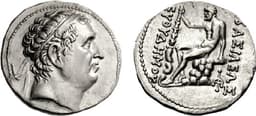
Euthydemus I
Emperor · Ancient
53.5Total

Napoleon Bonaparte
General · Modern
70.9Total
Basic Information
Born
-260
1769
Died
-190
1821
Era
Ancient
Modern
Nationality
Greco-Bactrian Kingdom
France
Occupation
Emperor
General
Civilization
Eastern
Western
Score Comparison
Military (10%)
65.0
94.0
Political (20%)
68.0
72.0
Influence (20%)
55.7
40.0
Legacy (20%)
46.7
80.0
Leadership (15%)
40.0
78.0
Strategy (15%)
52.5
90.0
TOTAL
53.5
70.9
Euthydemus I — Complete Timeline
225 BC
Overthrow of Diodotus IIPolitical Action◆ Major
Euthydemus I, a Magnesian Greek, overthrew and killed Diodotus II, seizing the throne of the Greco-Bactrian Kingdom. This began the Euthydemid dynasty.
CoupDynasty ChangeGreco-Bactrian Kingdom
Impact: nationaldestructive
208 BC
Siege of Bactra by Antiochus IIIWar◆ Major
Euthydemus I was besieged in Bactra by the Seleucid king Antiochus III for two years. The siege ended with a negotiated peace that recognized Euthydemus's rule.
SiegeSeleucid EmpireGreco-Bactrian Kingdom
Impact: regional
206 BC
Treaty with Antiochus IIIPolitical Action◆ Major
Euthydemus I negotiated a peace treaty with Antiochus III, recognizing Seleucid suzerainty in name but securing Greco-Bactrian independence. The treaty included a marriage alliance between the two dynasties.
TreatySeleucid EmpireIndependence
Impact: regionalconstructive
200 BC
Expansion of Bactrian TerritoryWar
Euthydemus I expanded the Greco-Bactrian Kingdom eastward into Sogdiana and possibly Ferghana. This extended Hellenistic influence deeper into Central Asia.
ExpansionCentral AsiaHellenistic
Impact: regionalconstructive
Napoleon Bonaparte — Complete Timeline
1799 AD
Coup of 18 BrumaireOther◆ Major
Napoleon Bonaparte, with support from his brother Lucien and key political figures, overthrew the Directory in a bloodless coup. He established the Consulate with himself as First Consul, effectively becoming the ruler of France. This event ended the French Revolution's most unstable period.
French RevolutionCoupRise to Power
Impact: regional
1804 AD
Promulgation of the Napoleonic CodeOther◆ Major
Napoleon enacted the Civil Code of the French, known as the Napoleonic Code, a comprehensive set of laws that replaced the fragmented feudal legal systems. The code established legal equality, protected property rights, and secularized law. It became the basis for legal systems in many European and world countries.
Legal ReformNapoleonic CodeCivil Law
Impact: globalconstructive
1805 AD
Battle of AusterlitzWar◆ Major
Napoleon's Grande Arm
Napoleonic WarsBattleDecisive Victory
Impact: global
1812 AD
Invasion of RussiaWar◆ Major
Napoleon led the Grande Arm
Napoleonic WarsInvasionDisaster
Impact: globaldestructive
1815 AD
Battle of WaterlooWar◆ Major
Napoleon's French army was defeated by the combined forces of the Duke of Wellington's Anglo-Allied army and Gebhard Leberecht von Bl
Napoleonic WarsBattleFinal Defeat
Impact: globaldestructive
Expert Analysis
euthydemus-i-vs-napoleon-bonaparte
# The Emperor and the Kingmaker: Napoleon and Euthydemus I
On a June morning in 1815, Napoleon Bonaparte stood on a muddy ridge near Waterloo, watching the sun burn away the mist that had shrouded the battlefield. He was about to gamble everything on a final, desperate charge. Some 2,000 years earlier, another ruler faced a similar moment of truth. Euthydemus I, a Greek king in distant Central Asia, stared out from the walls of Bactra at the army of Antiochus III, the greatest Seleucid king of his age. Both men were at the peak of their powers. Both faced annihilation. Yet one would fall in a blaze of glory that still dazzles the world, while the other would negotiate his way into an obscure but stable victory. The question is not simply who was greater, but why their paths diverged so dramatically.
Origins
Napoleon Bonaparte was born in 1769 on the island of Corsica, a place that had only recently become French. His family was minor nobility, but his education at French military academies gave him a fierce ambition and a deep understanding of Enlightenment ideas. He was a product of revolution—a world where old hierarchies were crumbling and a man of talent could rise to the top. His era was one of upheaval, of nations in arms, of the first modern wars fought with mass conscription and nationalist fervor.
Euthydemus I, by contrast, was born around 260 BCE, a Magnesian Greek in a world shaped by the conquests of Alexander the Great. His kingdom, Greco-Bactria, was a Hellenistic outpost in what is now Afghanistan and Tajikistan, surrounded by nomadic steppe peoples and the vast Seleucid Empire. It was a world of small, fragile states, where power rested on personal loyalty, mercenary armies, and the careful management of a mixed population of Greeks and locals. Euthydemus came from the same Greek tradition as Alexander, but his world was one of survival, not conquest.
Rise to Power
Napoleon’s rise was meteoric. By 1796, at just 26, he was commanding the French army in Italy, where his lightning campaigns shattered the Austrian Empire. He seized power in a coup in 1799, crowned himself emperor in 1804, and by 1807 controlled most of Europe from Spain to Poland. His path was one of relentless war, brilliant strategy, and an almost supernatural ability to inspire his soldiers.
Euthydemus’s rise was quieter but no less ruthless. In 225 BCE, he overthrew and killed Diodotus II, the reigning king of Greco-Bactria. It was a palace coup, not a battlefield triumph. He did not conquer a continent; he seized a kingdom. His path was one of calculation, not charisma. He understood that in his world, the greatest threat was not a rival army but the vast Seleucid Empire to the west, which considered Bactria a rebellious province.
Leadership & Governance
Napoleon’s leadership was a paradox. He was a military genius—his scores of 94 in military and 93 in strategy are among the highest in history—but his political score of 75 reveals a man who was brilliant at winning wars and poor at consolidating peace. He reformed French law through the Napoleonic Code, creating a system that still influences legal systems worldwide. He centralized the state, built roads and schools, and spread the ideals of the French Revolution. But he also made terrible mistakes: the invasion of Russia in 1812, the Peninsular War in Spain, and his refusal to accept a negotiated peace when he still had the upper hand.
Euthydemus, with a military score of 69.9 and a strategy score of 65.4, was no Napoleon on the battlefield. But his political score of 76.3 and leadership score of 83.5 tell a different story. He was a master of survival. When Antiochus III besieged him in Bactra for two years, from 208 to 206 BCE, Euthydemus did not break. Instead, he negotiated. He argued that if Antiochus destroyed Bactria, the nomadic tribes to the north would sweep in, and both Greeks would lose. He offered to recognize Seleucid suzerainty in name, while keeping real power. Antiochus accepted. Euthydemus then expanded his kingdom eastward into Sogdiana and Ferghana, extending Hellenistic culture deeper into Central Asia.
Triumph & Tragedy
Napoleon’s greatest triumph was Austerlitz in 1805, where he destroyed a combined Russian and Austrian army with a masterful trap. His greatest tragedy was Waterloo in 1815, where his gamble failed, and he was exiled to St. Helena to die in 1821. His tragedy was one of hubris—he could not stop, could not compromise, could not see that his empire was unsustainable.
Euthydemus’s greatest triumph was not a battle but a treaty. The peace of 206 BCE secured his kingdom for another generation. His tragedy is that we know so little about him. He died around 190 BCE, and his kingdom was eventually overrun by nomadic invaders. But in his time, he succeeded where Napoleon failed: he preserved his realm through diplomacy, not destruction.
Character & Destiny
Napoleon’s character was forged in the fire of revolution. He believed in destiny, in his own myth. “Impossible is a word to be found only in the dictionary of fools,” he once said. He was restless, ambitious, and incapable of moderation. His personality drove him to conquer, but also to fall.
Euthydemus was a pragmatist. He understood that in the ancient world, a small kingdom could survive only by knowing when to fight and when to bend. He was a kingmaker, not a conqueror. His personality was one of patience and realism. He did not dream of ruling the world; he dreamed of ruling his small corner of it, and he succeeded.
Legacy
Napoleon’s legacy is global. His legal code, his military tactics, his very name are etched into history. He is remembered as a titan, a genius, a cautionary tale. His total score of 82.4 reflects his immense impact.
Euthydemus’s legacy is faint. His total score of 72.5 is modest, and he is known only to specialists. But his legacy is real: he kept Hellenistic culture alive in Central Asia long after it had faded in the West. His kingdom was a bridge between East and West, a testament to the fact that history is not only made by conquerors.
Conclusion
Napoleon and Euthydemus I were both Greeks in a sense—one a product of the Enlightenment, the other of Alexander’s world. But their fates were shaped by their eras and their characters. Napoleon, the child of revolution, could not stop fighting. Euthydemus, the child of a fragile kingdom, knew when to stop. One burned bright and fast; the other burned steady and long. In the end, perhaps the greater lesson is not about who was more powerful, but about the wisdom of knowing one’s limits. Napoleon’s ambition reshaped the world, but Euthydemus’s prudence preserved it.
Rankings
🥇
Napoleon BonaparteLeader
Mil: 94.0Pol: 72.0Inf: 40.0
70.9
🥈
Euthydemus I
Mil: 65.0Pol: 68.0Inf: 55.7
53.5
+17.4 behind
How This Comparison Works
Algorithm
Each figure is scored on 6 dimensions (0—100 scale) based on structured historical data: Military (10%), Political (20%), Influence (20%), Legacy (20%), Leadership (15%), Strategy (15%). The weighted total produces the final ranking.
Data Sources
Scores are computed from structured sub-indicators in the database. Scale factors adjust for era (Ancient ×0.85, Modern ×1.0) and civilization size (Eastern ×1.05, Other ×0.80) to account for differences in population and military scale.
Maximum 3 Figures
Comparisons are limited to 2—3 figures to ensure readability and statistical meaningfulness.
Error Margins
±5 points per dimension — Sub-scores are derived from historical records with inherent uncertainty. Two figures within 5 points on a dimension should be considered roughly equivalent in that area.
Total Score Accuracy
±3 points overall — The weighted combination of 6 dimensions produces a total score with approximately ±3 points of uncertainty. Differences of less than 3 points are not statistically significant— the figures are effectively tied.
Known Limitations
- Historical records are incomplete and uneven across civilizations
- Figures from oral-tradition societies may be underrepresented
- Occupation labels can misclassify multi-role figures
- Scores measure capability and impact, not moral character
- Quantitative scoring is a comparison tool, not absolute truth
Capability Radar
Military (10%) — Battles & Warfare
Battles
55
95
Win Rate
60
90
Expansion
70
95
Political (20%) — Governance & Reform
Reform
45
95
Diplomacy
70
80
Economy
50
85
Influence (20%) — Cultural & Global Reach
Cultural
40
85
Global
35
90
Legacy (20%) — Historical Impact
Historical
50
95
Longevity
40
90
Leadership (15%) — Power & Stability
Tenure
60
85
Stability
55
70
Strategy (15%) — Tactics & Innovation
Strategy
65
95
Tactics
50
98
Reform
40
92
Similar Comparisons
Comments & Discussion
No comments yet. Be the first to share your thoughts!