Loading...
Euthydemus I vs Julius Caesar
Julius Caesar leads by 29.3 pts · 2 figures compared
…
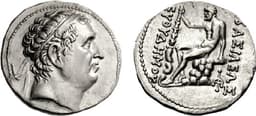
Euthydemus I
Emperor · Ancient
53.5Total

Julius Caesar
General · Ancient
82.8Total
Basic Information
Born
-260
-100
Died
-190
-44
Era
Ancient
Ancient
Nationality
Greco-Bactrian Kingdom
Roman Republic
Occupation
Emperor
General
Civilization
Eastern
Western
Score Comparison
Military (10%)
65.0
88.0
Political (20%)
68.0
78.0
Influence (20%)
55.7
85.0
Legacy (20%)
46.7
82.0
Leadership (15%)
40.0
80.0
Strategy (15%)
52.5
85.0
TOTAL
53.5
82.8
Euthydemus I — Complete Timeline
225 BC
Overthrow of Diodotus IIPolitical Action◆ Major
Euthydemus I, a Magnesian Greek, overthrew and killed Diodotus II, seizing the throne of the Greco-Bactrian Kingdom. This began the Euthydemid dynasty.
CoupDynasty ChangeGreco-Bactrian Kingdom
Impact: nationaldestructive
208 BC
Siege of Bactra by Antiochus IIIWar◆ Major
Euthydemus I was besieged in Bactra by the Seleucid king Antiochus III for two years. The siege ended with a negotiated peace that recognized Euthydemus's rule.
SiegeSeleucid EmpireGreco-Bactrian Kingdom
Impact: regional
206 BC
Treaty with Antiochus IIIPolitical Action◆ Major
Euthydemus I negotiated a peace treaty with Antiochus III, recognizing Seleucid suzerainty in name but securing Greco-Bactrian independence. The treaty included a marriage alliance between the two dynasties.
TreatySeleucid EmpireIndependence
Impact: regionalconstructive
200 BC
Expansion of Bactrian TerritoryWar
Euthydemus I expanded the Greco-Bactrian Kingdom eastward into Sogdiana and possibly Ferghana. This extended Hellenistic influence deeper into Central Asia.
ExpansionCentral AsiaHellenistic
Impact: regionalconstructive
Julius Caesar — Complete Timeline
58 BC
Gallic WarsWar◆ Major
Caesar, as proconsul of Gaul, launched a series of campaigns that conquered all of Gaul (modern France, Belgium, and parts of Switzerland). He fought numerous battles, including against the Helvetii, the Belgae, and the Gallic chieftain Vercingetorix. The wars brought immense wealth and a loyal army to Caesar.
Gallic WarsConquestRoman Expansion
Impact: regional
49 BC
Crossing the RubiconPolitical Action◆ Major
Caesar led Legio XIII across the Rubicon River into Italy, defying the Roman Senate's order to disband his army. This act triggered a civil war against Pompey and the Optimates, ultimately leading to Caesar's dictatorship and the end of the Roman Republic.
Roman Civil WarEnd of RepublicPower Struggle
Impact: global
48 BC
Battle of PharsalusWar◆ Major
Caesar's outnumbered army defeated the larger forces of Pompey the Great at Pharsalus in Greece. Caesar's tactical use of a reserve line to counter Pompey's cavalry charge proved decisive. Pompey fled to Egypt, where he was assassinated, leaving Caesar as the undisputed master of the Roman world.
Roman Civil WarBattleDecisive Victory
Impact: regional
44 BC
Appointment as Dictator for LifePolitical Action◆ Major
The Roman Senate appointed Caesar dictator perpetuo (dictator for life), granting him unprecedented personal power. This move concentrated military, legislative, and judicial authority in one person, effectively ending the Roman Republic's traditional system of checks and balances and alarming many senators.
DictatorshipEnd of RepublicPower Consolidation
Impact: regionaldestructive
Assassination on the Ides of MarchPolitical Action◆ Major
A group of Roman senators, led by Marcus Junius Brutus and Gaius Cassius Longinus, stabbed Caesar to death at a meeting of the Senate in the Theatre of Pompey. The assassination was intended to restore the Republic, but instead triggered another civil war that led to the rise of the Roman Empire.
AssassinationRoman PoliticsEnd of Republic
Impact: globaldestructive
Expert Analysis
euthydemus-i-vs-julius-caesar
# The Crossroads of Ambition: Caesar and Euthydemus I
On a spring morning in 44 BCE, Julius Caesar walked into the Senate chamber in Rome, ignoring a soothsayer’s warning. Moments later, he lay dead at the foot of a statue of Pompey, stabbed twenty-three times by men he had called friends. Half a world away and two centuries earlier, another ruler—Euthydemus I of the Greco-Bactrian Kingdom—faced his own moment of reckoning: besieged in the city of Bactra by the Seleucid king Antiochus III, his army starving, his kingdom hanging by a thread. Yet Euthydemus walked away from that siege with a treaty, not a dagger. What made one man’s ambition end in blood and the other’s in survival?
Origins
Julius Caesar was born into the patrician Julian clan in 100 BCE, a time when the Roman Republic was already cracking under the weight of its own success. His family claimed descent from the goddess Venus, but they were politically marginal, and Caesar grew up in a Rome where ambitious men clawed for power through military glory, bribery, and civil war. His father died when he was sixteen, leaving him to navigate a brutal world of Sullan proscriptions and Marian loyalties. From the start, Caesar learned that survival meant audacity.
Euthydemus I, born around 260 BCE, came from a different world entirely. A Magnesian Greek, he was a product of the Hellenistic East—a region where Greek culture had spread with Alexander’s conquests but where local dynasties now fought for scraps of that legacy. The Greco-Bactrian Kingdom, nestled in what is today Afghanistan and Central Asia, was a remote outpost of Hellenism, surrounded by Seleucid empires, nomadic steppe peoples, and Indian kingdoms. Euthydemus was not born a king; he was a usurper, a man who saw opportunity in the cracks of a fading empire.
Rise to Power
Caesar’s path was a masterclass in calculated risk. He climbed the Roman political ladder—quaestor, aedile, praetor—spending vast sums on games and bribes to win popularity. In 60 BCE, he formed the First Triumvirate with Pompey and Crassus, a backroom deal that handed him the governorship of Gaul. Over the next eight years, he conquered a territory larger than Italy itself, writing his own propaganda in the *Commentaries* and amassing an army loyal to him alone.
Euthydemus’s rise was swifter and more direct. In 225 BCE, he overthrew Diodotus II, the young king of the Greco-Bactrian Kingdom, and killed him. It was a palace coup, not a conquest—a seizure of power by a Greek nobleman who saw a weak ruler and took his chance. There was no triumvirate, no long campaign of public favor. In the Hellenistic East, power was taken, not earned.
Leadership & Governance
Caesar governed through sheer force of personality and military genius. He reorganized the Roman calendar, extended citizenship to provincials, and launched massive building projects. In battle, he led from the front—at Alesia, he personally rallied his legions against a Gallic relief force; at Pharsalus, he outmaneuvered Pompey’s superior numbers. Yet his political wisdom was brittle. He centralized power, packed the Senate with his supporters, and accepted the title “dictator for life,” a move that alienated the very aristocrats who had once backed him.
Euthydemus governed in a different key. When Antiochus III besieged him at Bactra in 208 BCE, Euthydemus held out for two years, not through brilliant tactics but sheer endurance. When he finally negotiated a peace in 206 BCE, he did something Caesar never could: he compromised. Euthydemus accepted Seleucid suzerainty in name, but in practice secured Greco-Bactrian independence. He then turned east, expanding his kingdom into Sogdiana and perhaps Ferghana, extending Hellenistic influence deep into Central Asia. His strategy was not about glory but about survival.
Triumph & Tragedy
Caesar’s greatest triumph was the conquest of Gaul, which made him the richest and most powerful man in Rome. His greatest tragedy was his assassination on the Ides of March, 44 BCE—a death that, ironically, proved his point: the Republic was already dead. His murder sparked a civil war that ended with his adopted son Octavian becoming Augustus, the first Roman emperor.
Euthydemus’s triumph was the treaty with Antiochus III. He saved his kingdom from destruction and even expanded it. His tragedy is that we know so little of his end. He died around 190 BCE, probably in peace, but his dynasty soon faced new threats from nomadic invaders and internal strife. The Greco-Bactrian Kingdom would eventually fall, its Greek cities buried under the dust of Central Asia.
Character & Destiny
Caesar was driven by an insatiable hunger for personal glory. He once said, “I would rather be first in a little Iberian village than second in Rome.” That ambition made him brilliant—and blind. He could not imagine a world where he was not in control, so he never prepared for the daggers of his friends.
Euthydemus was a pragmatist. He knew when to fight and when to bend. His treaty with Antiochus was a masterpiece of political realism: he gave up a crown in name to keep it in fact. He was not a conqueror like Caesar, but he was a survivor. In the harsh world of the Hellenistic East, that was the greater virtue.
Legacy
Caesar’s legacy is written in stone across Western civilization. His name became a title—Caesar, Kaiser, Tsar. His reforms shaped the Roman Empire, and his assassination became the archetype of political betrayal. He is remembered as a genius and a tyrant, a man who destroyed a republic and founded an empire.
Euthydemus’s legacy is more fragile. His coins, stamped with Greek gods and his own profile, survive in museum drawers. His kingdom is a footnote in histories of the Hellenistic world. Yet he proved that Greek culture could thrive beyond the Mediterranean, in the shadow of the Himalayas. He was a bridge between East and West, a reminder that ambition does not always end in tragedy.
Conclusion
Two men, two centuries, two worlds. Caesar and Euthydemus both seized power, both fought empires, both faced existential crises. One died in a Senate chamber, his blood on the marble floor. The other died in his bed, his kingdom intact. The difference was not in talent or ambition—both had plenty of both. It was in wisdom. Caesar knew how to conquer; Euthydemus knew how to survive. In the end, the survivor may have been the greater statesman. For what is a kingdom, after all, if you are not alive to rule it?
Rankings
🥇
Julius CaesarLeader
Mil: 88.0Pol: 78.0Inf: 85.0
82.8
🥈
Euthydemus I
Mil: 65.0Pol: 68.0Inf: 55.7
53.5
+29.3 behind
How This Comparison Works
Algorithm
Each figure is scored on 6 dimensions (0—100 scale) based on structured historical data: Military (10%), Political (20%), Influence (20%), Legacy (20%), Leadership (15%), Strategy (15%). The weighted total produces the final ranking.
Data Sources
Scores are computed from structured sub-indicators in the database. Scale factors adjust for era (Ancient ×0.85, Modern ×1.0) and civilization size (Eastern ×1.05, Other ×0.80) to account for differences in population and military scale.
Maximum 3 Figures
Comparisons are limited to 2—3 figures to ensure readability and statistical meaningfulness.
Error Margins
±5 points per dimension — Sub-scores are derived from historical records with inherent uncertainty. Two figures within 5 points on a dimension should be considered roughly equivalent in that area.
Total Score Accuracy
±3 points overall — The weighted combination of 6 dimensions produces a total score with approximately ±3 points of uncertainty. Differences of less than 3 points are not statistically significant— the figures are effectively tied.
Known Limitations
- Historical records are incomplete and uneven across civilizations
- Figures from oral-tradition societies may be underrepresented
- Occupation labels can misclassify multi-role figures
- Scores measure capability and impact, not moral character
- Quantitative scoring is a comparison tool, not absolute truth
Capability Radar
Military (10%) — Battles & Warfare
Battles
55
95
Win Rate
60
92
Expansion
70
97
Political (20%) — Governance & Reform
Reform
45
90
Diplomacy
70
85
Economy
50
82
Influence (20%) — Cultural & Global Reach
Cultural
40
88
Global
35
94
Legacy (20%) — Historical Impact
Historical
50
95
Longevity
40
96
Leadership (15%) — Power & Stability
Tenure
60
75
Stability
55
60
Strategy (15%) — Tactics & Innovation
Strategy
65
94
Tactics
50
96
Reform
40
88
Similar Comparisons
Comments & Discussion
No comments yet. Be the first to share your thoughts!