Loading...
Antoninus Pius vs Cao Fang
Antoninus Pius leads by 9.4 pts · 2 figures compared
…
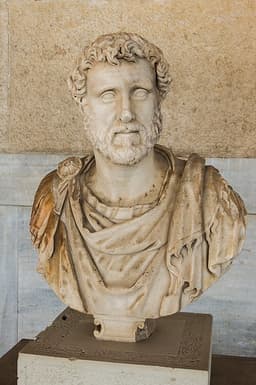
Antoninus Pius
Emperor · Ancient
53.5Total

Cao Fang
Emperor · Ancient
44.1Total
Basic Information
Born
86
232
Died
161
274
Era
Ancient
Ancient
Nationality
Roman Empire
China
Occupation
Emperor
Emperor
Civilization
Western
Eastern
Score Comparison
Military (10%)
21.2
14.0
Political (20%)
70.0
39.4
Influence (20%)
54.9
54.9
Legacy (20%)
47.5
39.2
Leadership (15%)
78.0
48.4
Strategy (15%)
35.7
60.0
TOTAL
53.5
44.1
Antoninus Pius — Complete Timeline
132 AD
Suppression of the Jewish RevoltWar
Antoninus Pius, as governor of Asia, was involved in suppressing the Bar Kokhba revolt in Judea. The revolt was crushed with heavy casualties, and Jews were expelled from Jerusalem. This event occurred before his accession to the throne.
Jewish RevoltSuppressionJudea
Impact: regionaldestructive
138 AD
Reign of Peace and ProsperityPolitical Action◆ Major
Antoninus Pius became Roman emperor upon the death of Hadrian. His reign was characterized by internal stability, legal reforms, and economic prosperity, with no major military campaigns. He maintained the borders through diplomacy and client kingdoms.
Pax RomanaStabilityGood Emperor
Impact: globalconstructive
Adoption of Marcus Aurelius and Lucius VerusPolitical Action◆ Major
Following Hadrian's death, Antoninus Pius adopted Marcus Aurelius and Lucius Verus as his sons and heirs, as required by Hadrian's will. This ensured a smooth succession and continued the system of adoptive emperors.
SuccessionAdoptionDynasty
Impact: globalconstructive
142 AD
Construction of the Antonine WallOther◆ Major
Antoninus Pius ordered the construction of a turf and stone fortification across the narrowest part of Scotland, north of Hadrian's Wall. The wall marked the northernmost boundary of the Roman Empire in Britain and was manned for about 20 years before being abandoned.
FrontierFortificationBritain
Impact: regional
Cao Fang — Complete Timeline
239 AD
Accession as Emperor of WeiPolitical Action◆ Major
Cao Fang ascended the throne of Cao Wei at age 7 after the death of his adoptive father Cao Rui. He was placed under the regency of Cao Shuang and Sima Yi, beginning a period of factional struggle that would define his reign.
AccessionThree KingdomsWei Dynasty
Impact: national
249 AD
Coup of Cao Shuang's FallPolitical Action
During Cao Fang's reign, Sima Yi staged a coup at the Gaoping Tombs, seizing power from regent Cao Shuang. Cao Shuang was executed, and the Sima clan gained effective control of Wei, reducing Cao Fang to a puppet ruler.
CoupThree KingdomsPower Shift
Impact: nationaldestructive
254 AD
Deposition by Sima ShiPolitical Action◆ Major
Cao Fang was deposed as emperor of Cao Wei by the regent Sima Shi, who accused him of plotting rebellion. Cao Fang was reduced to the rank of Prince of Qi and replaced by Cao Mao, marking a further consolidation of Sima clan power.
CoupThree KingdomsWei Dynasty
Impact: nationaldestructive
Expert Analysis
Origins
Antoninus Pius (born 86 AD) came from a wealthy senatorial family in Lanuvium, Italy. His father was a consul, and his grandfathers held high office. He received a thorough education in rhetoric and law, and his early career included serving as quaestor, praetor, and consul. His administrative competence caught the attention of Emperor Hadrian, who appointed him as one of the four consulars to govern Italy.
Cao Fang (born 232 AD) was adopted by Emperor Cao Rui of Cao Wei, one of the Three Kingdoms. His biological father was Cao Kai, a prince of Wei. Cao Fang became emperor at age 7 after Cao Rui's death in 239 AD. His upbringing was controlled by regents, and he lacked military or administrative training. He was a figurehead from the start.
Rise to Power
Antoninus Pius rose through a combination of merit and imperial favor. He served as proconsul of Asia (c. 134-135 AD) and was later adopted by Hadrian on his deathbed in 138 AD, becoming emperor at age 51. His adoption was conditional on him adopting Marcus Aurelius and Lucius Verus, ensuring a stable succession. He faced no serious opposition and began a reign marked by peace.
Cao Fang became emperor at age 7 under the regency of Cao Shuang and Sima Yi. The real power lay with these regents. In 249 AD, Sima Yi staged a coup at the Gaoping Tombs, overthrowing Cao Shuang and assuming sole regency. Cao Fang remained a puppet, with Sima Yi and later his son Sima Shi controlling the government. His rise was not due to his own actions but to dynastic accident.
Leadership & Governance
Antoninus Pius governed with a focus on legal reforms, economic stability, and public works. He improved the administration of provinces, supported education, and built the Antonine Wall in Scotland. He maintained good relations with the Senate and avoided costly wars. His leadership score of 78.0 reflects his effective but passive style.
Cao Fang, with a leadership score of 48.4, had little real authority. He was dominated by the Sima clan. During his reign, the Sima family consolidated power, executing rivals and suppressing dissent. Cao Fang attempted a plot to remove Sima Shi in 254 AD, but it failed, leading to his deposition. His governance was nonexistent; he was a puppet whose reign saw the decline of Wei.
Triumph & Tragedy
Antoninus Pius's greatest triumph was his peaceful reign of 23 years, during which the Roman Empire prospered. He completed the Antonine Wall and suppressed minor revolts without major bloodshed. His tragedy was his lack of military ambition; he missed opportunities to expand Rome's borders. He scored 21.2 in military, reflecting his passive stance.
Cao Fang's triumph was surviving as emperor for 15 years despite being a puppet. His tragedy was his deposition and the loss of the Wei throne to the Sima family. His attempt to regain power led to his downfall. He scored 14.0 in military, the lowest possible.
Character & Destiny
Antoninus Pius was known for his piety, modesty, and administrative diligence. He was called 'Pius' for his devotion to the gods and his predecessor. His character ensured a stable reign, but his lack of aggression allowed external pressures to build. His destiny was to be remembered as one of the Five Good Emperors.
Cao Fang was weak and indecisive, unable to act against the Simas until it was too late. His character was shaped by his upbringing as a puppet. His destiny was to be a footnote in history, deposed and forgotten. Historical assessments view him as a tragic figure but ineffective ruler.
Legacy
Antoninus Pius left a legacy of legal reforms, infrastructure, and the Antonine Wall. He is remembered as a model of peaceful governance. His scores: Influence 54.9, Legacy 47.5. His reign set the stage for the later Antonine dynasty.
Cao Fang's legacy is minimal. He is remembered as the emperor who lost the Wei dynasty to the Sima clan, leading to the Jin dynasty. His scores: Influence 54.9, Legacy 39.2. His reign is a cautionary tale of weak leadership.
Conclusion
Antoninus Pius had a greater impact due to his stable reign and lasting contributions. His total score of 53.5 versus Cao Fang's 44.1 reflects his superior political and leadership abilities. While Cao Fang was a victim of circumstance, Antoninus Pius actively governed and left a positive legacy. Thus, Antoninus Pius is the more significant historical figure.
Rankings
🥇
Antoninus PiusLeader
Mil: 21.2Pol: 70.0Inf: 54.9
53.5
🥈
Cao Fang
Mil: 14.0Pol: 39.4Inf: 54.9
44.1
+9.4 behind
How This Comparison Works
Algorithm
Each figure is scored on 6 dimensions (0—100 scale) based on structured historical data: Military (10%), Political (20%), Influence (20%), Legacy (20%), Leadership (15%), Strategy (15%). The weighted total produces the final ranking.
Data Sources
Scores are computed from structured sub-indicators in the database. Scale factors adjust for era (Ancient ×0.85, Modern ×1.0) and civilization size (Eastern ×1.05, Other ×0.80) to account for differences in population and military scale.
Maximum 3 Figures
Comparisons are limited to 2—3 figures to ensure readability and statistical meaningfulness.
Error Margins
±5 points per dimension — Sub-scores are derived from historical records with inherent uncertainty. Two figures within 5 points on a dimension should be considered roughly equivalent in that area.
Total Score Accuracy
±3 points overall — The weighted combination of 6 dimensions produces a total score with approximately ±3 points of uncertainty. Differences of less than 3 points are not statistically significant— the figures are effectively tied.
Known Limitations
- Historical records are incomplete and uneven across civilizations
- Figures from oral-tradition societies may be underrepresented
- Occupation labels can misclassify multi-role figures
- Scores measure capability and impact, not moral character
- Quantitative scoring is a comparison tool, not absolute truth
Capability Radar
Military (10%) — Battles & Warfare
Battles
5
35
Win Rate
10
37
Expansion
5
40
Political (20%) — Governance & Reform
Reform
70
0
Diplomacy
85
5
Economy
80
0
Influence (20%) — Cultural & Global Reach
Cultural
50
0
Global
40
0
Legacy (20%) — Historical Impact
Historical
55
5
Longevity
50
0
Leadership (15%) — Power & Stability
Tenure
85
10
Stability
95
0
Strategy (15%) — Tactics & Innovation
Strategy
15
40
Tactics
10
43
Reform
20
49
Similar Comparisons
Comments & Discussion
No comments yet. Be the first to share your thoughts!