Loading...
Antonio de Oliveira Salazar vs Jomo Kenyatta
Jomo Kenyatta leads by 2.0 pts · 2 figures compared
…

Antonio de Oliveira Salazar
Politician · Modern
56.1Total
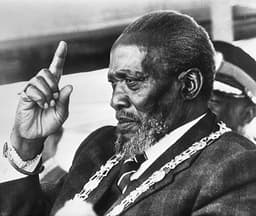
Jomo Kenyatta
Politician · Modern
58.1Total
Basic Information
Born
1889
1897
Died
1970
1978
Era
Modern
Modern
Nationality
Portugal
Kenya
Occupation
Politician
Politician
Civilization
Western
Other
Score Comparison
Military (10%)
10.0
25.9
Political (20%)
75.0
72.0
Influence (20%)
59.0
65.0
Legacy (20%)
50.0
55.0
Leadership (15%)
85.0
72.0
Strategy (15%)
38.3
39.3
TOTAL
56.1
58.1
Antonio de Oliveira Salazar — Complete Timeline
1926 AD
Appointed Minister of FinancePolitical Action◆ Major
After the May 28, 1926 coup, Salazar was appointed Minister of Finance by President
Portuguese PoliticsFinancial ReformRise to Power
Impact: national
1933 AD
Established the Estado Novo RegimeReform◆ Major
Salazar oversaw the promulgation of a new constitution on April 11, 1933, creating the Estado Novo (New State). This corporatist, authoritarian regime replaced the unstable First Republic, concentrating power in Salazar's hands as Prime Minister and suppressing political opposition, trade unions, and free press.
AuthoritarianismConstitutionPolitical System
Impact: nationaldestructive
1939 AD
Maintained Portuguese Neutrality in World War IIOther◆ Major
Throughout World War II (1939-1945), Salazar kept Portugal officially neutral while leaning toward the Allies. He allowed the Allies to use bases in the Azores from 1943, while continuing to sell tungsten to Germany. This policy preserved Portuguese sovereignty and avoided invasion.
World War IINeutralityDiplomacy
Impact: global
1961 AD
Refused to Decolonize Portuguese AfricaOther◆ Major
When anti-colonial wars erupted in Angola (1961), Guinea-Bissau (1963), and Mozambique (1964), Salazar refused to grant independence, declaring Portugal's African territories as 'overseas provinces.' This decision led to the Portuguese Colonial War, lasting until 1974 and draining Portuguese resources.
Colonial WarDecolonizationAfrican Policy
Impact: globaldestructive
1968 AD
Suffered a Stroke and Lost PowerOther◆ Major
In September 1968, Salazar suffered a severe stroke that left him incapacitated. President Am
End of EraHealthSuccession Crisis
Impact: nationaldestructive
Jomo Kenyatta — Complete Timeline
1952 AD
Mau Mau Uprising and DetentionPolitical Action◆ Major
Kenyatta was arrested and tried for his alleged involvement in the Mau Mau rebellion against British rule. He was sentenced to seven years' imprisonment, becoming a symbol of African nationalism. His detention galvanized support for independence.
Mau MauImprisonmentNationalism
Impact: regional
1963 AD
Kenya IndependencePolitical Action
Jomo Kenyatta became the first Prime Minister of independent Kenya after negotiations with British colonial authorities. His leadership marked the end of British rule and the beginning of Kenya's sovereignty, with Kenyatta advocating for racial reconciliation and economic development.
IndependenceDecolonizationPrime Minister
Impact: nationalconstructive
1964 AD
Presidency and One-Party StatePolitical Action◆ Major
Kenyatta became the first President of Kenya and established a de facto one-party state under the Kenya African National Union (KANU). He consolidated power, suppressed opposition, and promoted a capitalist economy, diverging from the socialist paths of other African leaders.
PresidencyOne-Party StateKANU
Impact: national
1965 AD
Land Redistribution PoliciesReform◆ Major
Kenyatta implemented land redistribution programs that transferred large tracts of land from white settlers to Africans. However, the policies favored his political allies and ethnic Kikuyu supporters, leading to land inequality and ethnic tensions that persisted for decades.
Land ReformEthnic PoliticsEconomic Policy
Impact: national
Expert Analysis
Origins
Antonio de Oliveira Salazar was born on April 28, 1889, in Vimieiro, Portugal, to a modest family of small landowners. He studied law at the University of Coimbra, later becoming a professor of political economy. His academic background shaped his technocratic approach to governance, emphasizing financial orthodoxy and order over political freedom.
Jomo Kenyatta was born around 1891 in Gatundu, British East Africa (now Kenya), to a Kikuyu farming family. He was educated at a Scottish mission school and later studied at the London School of Economics, where he was influenced by pan-Africanist ideas. His early experiences with colonialism fueled his lifelong commitment to Kenyan independence.
Rise to Power
Salazar rose to prominence after the 1926 military coup, when President Óscar Carmona appointed him Minister of Finance in 1928. Given extraordinary powers to stabilize Portugal's economy, Salazar achieved a budget surplus within a year. He used his fiscal success to leverage political influence, and by 1932 he became Prime Minister. In 1933, he promulgated the Estado Novo constitution, establishing a corporatist dictatorship that lasted until 1974.
Kenyatta's rise was rooted in nationalist activism. He was a leading figure in the Kenya African Union (KAU) and represented African interests at the Lancaster House Conferences. Despite being detained from 1952 to 1961 for alleged involvement in the Mau Mau uprising, he emerged as the key symbol of Kenyan nationalism. In 1963, he became the first Prime Minister of independent Kenya, and in 1964, the first President.
Leadership & Governance
Salazar's leadership style was authoritarian and technocratic. He centralized power, suppressed opposition through the secret police (PIDE), and controlled the media. His economic policies focused on balancing budgets and maintaining gold reserves, but they stifled industrial growth. He scored 85.0 in leadership, reflecting his firm control, but only 10.0 in military, as he avoided direct war despite colonial conflicts.
Kenyatta's governance was pragmatic and conciliatory. He promoted a mixed economy, encouraged foreign investment, and pursued land redistribution that favored the Kikuyu elite. He maintained a de facto one-party state under KANU, but allowed some political space. His political score of 72.0 reflects his ability to unite diverse ethnic groups, though his leadership was marred by corruption and growing inequality.
Triumph & Tragedy
Salazar's greatest success was maintaining Portuguese neutrality in World War II, preserving the regime and avoiding devastation. He also stabilized Portugal's economy, reducing inflation and debt. However, his refusal to decolonize African territories led to the costly Portuguese Colonial War (1961-1974), which drained resources and ultimately caused the regime's collapse. His legacy is tarnished by repression and economic stagnation.
Kenyatta's triumph was leading Kenya to independence peacefully and establishing a stable government. He promoted Africanization of the civil service and education. However, his land redistribution policies favored loyalists, exacerbating ethnic tensions and corruption. The growing gap between rich and poor and the suppression of dissent under his one-party state are significant failures.
Character & Destiny
Salazar was reclusive, ascetic, and deeply conservative. He believed in order, hierarchy, and Catholic values. His rigid control and distrust of change prevented necessary reforms, and his refusal to decolonize was a fatal miscalculation. His character—cautious, stubborn, and paternalistic—shaped Portugal's isolation and eventual decline.
Kenyatta was charismatic, pragmatic, and shrewd. He understood the need to balance ethnic interests and maintain stability. However, his personal accumulation of wealth and power, and his tolerance of corruption, undermined his ideals. His destiny was to be revered as 'Father of the Nation' but also criticized for authoritarian tendencies.
Legacy
Salazar's Estado Novo lasted until the 1974 Carnation Revolution, which ended the dictatorship and led to democracy and decolonization. His economic policies left a legacy of low debt but also underdevelopment. Portugal's integration into Europe and decolonization were direct reactions against his rule. His legacy score is 50.0, reflecting a mixed but significant impact.
Kenyatta's legacy as the founding father of Kenya is enduring. His policies shaped Kenya's political and economic trajectory, including its capitalist orientation and ethnic-based politics. However, the corruption and authoritarian practices he tolerated persisted. His legacy score of 55.0 recognizes his foundational role, tempered by subsequent challenges.
Conclusion
Jomo Kenyatta had a greater overall impact because he successfully transitioned Kenya from colonialism to independence, laying the foundation for a nation. His total score of 58.1 edges Salazar's 56.1. While Salazar maintained stability, his refusal to adapt ultimately led to the collapse of his regime and prolonged colonial wars. Kenyatta's ability to guide a diverse country through decolonization, despite flaws, marks a more positive and enduring legacy. Salazar's influence was largely negative and reversed, whereas Kenyatta's foundational role persists.
Rankings
🥇
Jomo KenyattaLeader
Mil: 25.9Pol: 72.0Inf: 65.0
58.1
🥈
Antonio de Oliveira Salazar
Mil: 10.0Pol: 75.0Inf: 59.0
56.1
+2.0 behind
How This Comparison Works
Algorithm
Each figure is scored on 6 dimensions (0—100 scale) based on structured historical data: Military (10%), Political (20%), Influence (20%), Legacy (20%), Leadership (15%), Strategy (15%). The weighted total produces the final ranking.
Data Sources
Scores are computed from structured sub-indicators in the database. Scale factors adjust for era (Ancient ×0.85, Modern ×1.0) and civilization size (Eastern ×1.05, Other ×0.80) to account for differences in population and military scale.
Maximum 3 Figures
Comparisons are limited to 2—3 figures to ensure readability and statistical meaningfulness.
Error Margins
±5 points per dimension — Sub-scores are derived from historical records with inherent uncertainty. Two figures within 5 points on a dimension should be considered roughly equivalent in that area.
Total Score Accuracy
±3 points overall — The weighted combination of 6 dimensions produces a total score with approximately ±3 points of uncertainty. Differences of less than 3 points are not statistically significant— the figures are effectively tied.
Known Limitations
- Historical records are incomplete and uneven across civilizations
- Figures from oral-tradition societies may be underrepresented
- Occupation labels can misclassify multi-role figures
- Scores measure capability and impact, not moral character
- Quantitative scoring is a comparison tool, not absolute truth
Capability Radar
Military (10%) — Battles & Warfare
Battles
0
20
Win Rate
0
26
Expansion
0
24
Political (20%) — Governance & Reform
Reform
75
65
Diplomacy
70
70
Economy
80
55
Influence (20%) — Cultural & Global Reach
Cultural
40
65
Global
45
55
Legacy (20%) — Historical Impact
Historical
55
70
Longevity
50
60
Leadership (15%) — Power & Stability
Tenure
85
60
Stability
85
50
Strategy (15%) — Tactics & Innovation
Strategy
0
33
Tactics
0
34
Reform
10
38
Similar Comparisons
Comments & Discussion
No comments yet. Be the first to share your thoughts!