Loading...
Jomo Kenyatta vs Napoleon Bonaparte
Napoleon Bonaparte leads by 12.8 pts · 2 figures compared
…
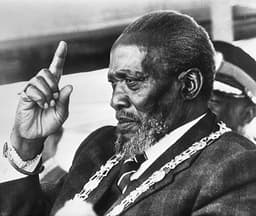
Jomo Kenyatta
Politician · Modern
58.1Total

Napoleon Bonaparte
General · Modern
70.9Total
Basic Information
Born
1897
1769
Died
1978
1821
Era
Modern
Modern
Nationality
Kenya
France
Occupation
Politician
General
Civilization
Other
Western
Score Comparison
Military (10%)
25.9
94.0
Political (20%)
72.0
72.0
Influence (20%)
65.0
40.0
Legacy (20%)
55.0
80.0
Leadership (15%)
72.0
78.0
Strategy (15%)
39.3
90.0
TOTAL
58.1
70.9
Jomo Kenyatta — Complete Timeline
1952 AD
Mau Mau Uprising and DetentionPolitical Action◆ Major
Kenyatta was arrested and tried for his alleged involvement in the Mau Mau rebellion against British rule. He was sentenced to seven years' imprisonment, becoming a symbol of African nationalism. His detention galvanized support for independence.
Mau MauImprisonmentNationalism
Impact: regional
1963 AD
Kenya IndependencePolitical Action
Jomo Kenyatta became the first Prime Minister of independent Kenya after negotiations with British colonial authorities. His leadership marked the end of British rule and the beginning of Kenya's sovereignty, with Kenyatta advocating for racial reconciliation and economic development.
IndependenceDecolonizationPrime Minister
Impact: nationalconstructive
1964 AD
Presidency and One-Party StatePolitical Action◆ Major
Kenyatta became the first President of Kenya and established a de facto one-party state under the Kenya African National Union (KANU). He consolidated power, suppressed opposition, and promoted a capitalist economy, diverging from the socialist paths of other African leaders.
PresidencyOne-Party StateKANU
Impact: national
1965 AD
Land Redistribution PoliciesReform◆ Major
Kenyatta implemented land redistribution programs that transferred large tracts of land from white settlers to Africans. However, the policies favored his political allies and ethnic Kikuyu supporters, leading to land inequality and ethnic tensions that persisted for decades.
Land ReformEthnic PoliticsEconomic Policy
Impact: national
Napoleon Bonaparte — Complete Timeline
1799 AD
Coup of 18 BrumaireOther◆ Major
Napoleon Bonaparte, with support from his brother Lucien and key political figures, overthrew the Directory in a bloodless coup. He established the Consulate with himself as First Consul, effectively becoming the ruler of France. This event ended the French Revolution's most unstable period.
French RevolutionCoupRise to Power
Impact: regional
1804 AD
Promulgation of the Napoleonic CodeOther◆ Major
Napoleon enacted the Civil Code of the French, known as the Napoleonic Code, a comprehensive set of laws that replaced the fragmented feudal legal systems. The code established legal equality, protected property rights, and secularized law. It became the basis for legal systems in many European and world countries.
Legal ReformNapoleonic CodeCivil Law
Impact: globalconstructive
1805 AD
Battle of AusterlitzWar◆ Major
Napoleon's Grande Arm
Napoleonic WarsBattleDecisive Victory
Impact: global
1812 AD
Invasion of RussiaWar◆ Major
Napoleon led the Grande Arm
Napoleonic WarsInvasionDisaster
Impact: globaldestructive
1815 AD
Battle of WaterlooWar◆ Major
Napoleon's French army was defeated by the combined forces of the Duke of Wellington's Anglo-Allied army and Gebhard Leberecht von Bl
Napoleonic WarsBattleFinal Defeat
Impact: globaldestructive
Expert Analysis
jomo-kenyatta-vs-napoleon-bonaparte
# The Emperor and the Elder: Two Paths to Power in a Century of Change
In the winter of 1812, Napoleon Bonaparte watched his Grand Army burn Moscow, a city he had conquered but could not hold. A hundred and fifty years later, on a December day in 1963, Jomo Kenyatta stood in Nairobi and watched the Union Jack descend for the last time over Kenya. One man commanded the most formidable military machine the world had ever seen; the other led a ragtag independence movement with little more than words and will. Both sought to reshape their worlds. One ended in exile, the other in a palace. Why?
Origins
Napoleon was born in 1769 on Corsica, an island that had just passed from Italian to French control. His family was minor nobility, poor enough to resent the French, ambitious enough to serve them. He spoke French with an accent that marked him as an outsider all his life. The French Revolution, which erupted when he was twenty, shattered the old order and created a ladder for talent. Napoleon climbed it.
Jomo Kenyatta was born in 1897 in Gatundu, a village in British East Africa. His people, the Kikuyu, had lost their best lands to white settlers. His father died when he was young; his mother raised him in poverty. Education came through Scottish missionaries, who taught him English and gave him a Bible. He spent his twenties in Nairobi, working as a clerk, a meter reader, and a political organizer. He would spend years in London, studying, writing, and pleading with the British for justice.
The difference in their eras is stark. Napoleon rose in a Europe convulsing with revolution, where a young artillery officer could become emperor in a decade. Kenyatta rose in a colonial world that seemed permanent, where change came slowly, if at all.
Rise to Power
Napoleon’s path was war. In 1793, at twenty-four, he drove British forces out of Toulon with a brilliant artillery plan. In 1795, he saved the revolutionary government from a royalist uprising. By 1796, he commanded the Army of Italy and won six victories in a single month. Each battle made him more famous, more feared, more necessary. In 1799, he staged a coup and made himself First Consul. By 1804, he was Emperor.
Kenyatta’s path was patience. He returned to Kenya in 1946 after fifteen years abroad, a respected but untested leader. The Mau Mau uprising of 1952 changed everything. The British, panicked, arrested Kenyatta and sentenced him to seven years in prison for leading a rebellion he had tried to moderate. His trial made him a martyr. When he emerged in 1961, Kenya’s independence was inevitable—and he was the only leader who could hold the country together.
Leadership & Governance
Napoleon governed like a general. He centralized power, crushed dissent, and imposed order. His Napoleonic Code, enacted in 1804, standardized French law, protected property rights, and limited the power of the church. It was a genuine reform, but it also gave him control over every aspect of French life. He built roads, founded banks, and reformed education—all while waging war across Europe.
Kenyatta governed like an elder. He understood that Kenya was a patchwork of tribes—Kikuyu, Luo, Maasai, Kalenjin—that could easily tear apart. His presidency, beginning in 1964, focused on stability above all. He kept former British administrators in place, protected white farmers, and redistributed land slowly, through purchase rather than seizure. He tolerated no opposition, establishing a one-party state by 1964. But he also kept the peace.
Napoleon’s military genius is beyond dispute. He won sixty battles, from Austerlitz in 1805 to Wagram in 1809, using speed, deception, and devastating artillery. His strategy score of ninety-three reflects a mind that could see the entire battlefield at once. Kenyatta never commanded an army. His military score of thirty is almost irrelevant—he fought with speeches and negotiations, not cannons.
Triumph & Tragedy
Napoleon’s greatest moment was 1805, when he crushed the Austrian and Russian armies at Austerlitz, a battle so perfect it became a textbook example of military genius. His greatest failure was 1812, when he invaded Russia with six hundred thousand men and returned with fewer than forty thousand. The Russian winter, the scorched-earth tactics, and his own refusal to retreat destroyed him.
Kenyatta’s triumph was 1963, when he became Prime Minister of an independent Kenya. His tragedy was subtler: the land redistribution program he launched in 1965 never satisfied anyone. White farmers left, but the land went to Kikuyu elites, not the poor. Corruption grew. The inequalities that had fueled the Mau Mau rebellion persisted.
Character & Destiny
Napoleon was driven by ambition. “Impossible is a word to be found only in the dictionary of fools,” he said. He believed he could conquer anything—nations, nature, history itself. That belief made him great and destroyed him. He could not stop. He invaded Russia because he had to dominate everything. He fought at Waterloo because he could not accept exile.
Kenyatta was driven by caution. He had seen what happened to leaders who moved too fast—Patrice Lumumba of the Congo, assassinated in 1961. He knew that Kenya’s tribes, its white settlers, its British creditors, and its Cold War patrons all had to be managed. “We must forgive our enemies,” he said in 1963, “but we must not forget them.” He survived because he understood limits.
Legacy
Napoleon left a legend. The Napoleonic Code influenced legal systems across Europe and the world. His military tactics are still studied. His name is synonymous with genius and tyranny, glory and disaster. He died in 1821 on Saint Helena, a British prisoner, but his body was returned to Paris in 1840 and placed in a tomb that draws millions.
Kenyatta left a nation. He died in 1978, still president, still respected. Kenya remained stable for decades, a rare achievement in post-colonial Africa. But the failures of his era—land inequality, ethnic patronage, authoritarian habits—eventually erupted. The Kenya of 2023 is not the Kenya he dreamed of.
Conclusion
Napoleon and Kenyatta never met, never could have met. One conquered Europe; the other built a country. One died in exile; the other in power. Yet both faced the same question: what do you do when the world is broken? Napoleon answered by trying to remake it in his own image. Kenyatta answered by trying to hold it together. Both succeeded. Both failed. History does not judge one better than the other—only differently.
Rankings
🥇
Napoleon BonaparteLeader
Mil: 94.0Pol: 72.0Inf: 40.0
70.9
🥈
Jomo Kenyatta
Mil: 25.9Pol: 72.0Inf: 65.0
58.1
+12.8 behind
How This Comparison Works
Algorithm
Each figure is scored on 6 dimensions (0—100 scale) based on structured historical data: Military (10%), Political (20%), Influence (20%), Legacy (20%), Leadership (15%), Strategy (15%). The weighted total produces the final ranking.
Data Sources
Scores are computed from structured sub-indicators in the database. Scale factors adjust for era (Ancient ×0.85, Modern ×1.0) and civilization size (Eastern ×1.05, Other ×0.80) to account for differences in population and military scale.
Maximum 3 Figures
Comparisons are limited to 2—3 figures to ensure readability and statistical meaningfulness.
Error Margins
±5 points per dimension — Sub-scores are derived from historical records with inherent uncertainty. Two figures within 5 points on a dimension should be considered roughly equivalent in that area.
Total Score Accuracy
±3 points overall — The weighted combination of 6 dimensions produces a total score with approximately ±3 points of uncertainty. Differences of less than 3 points are not statistically significant— the figures are effectively tied.
Known Limitations
- Historical records are incomplete and uneven across civilizations
- Figures from oral-tradition societies may be underrepresented
- Occupation labels can misclassify multi-role figures
- Scores measure capability and impact, not moral character
- Quantitative scoring is a comparison tool, not absolute truth
Capability Radar
Military (10%) — Battles & Warfare
Battles
20
95
Win Rate
26
90
Expansion
24
95
Political (20%) — Governance & Reform
Reform
65
95
Diplomacy
70
80
Economy
55
85
Influence (20%) — Cultural & Global Reach
Cultural
65
85
Global
55
90
Legacy (20%) — Historical Impact
Historical
70
95
Longevity
60
90
Leadership (15%) — Power & Stability
Tenure
60
85
Stability
50
70
Strategy (15%) — Tactics & Innovation
Strategy
33
95
Tactics
34
98
Reform
38
92
Similar Comparisons
Comments & Discussion
CorsicanCannon6/17/2026
Napoleon’s military genius is overrated outside set-piece battles. He lost 400,000 men in Russia because he couldn’t adapt to logistics beyond Europe—meanwhile, Kenyatta never commanded a single army, yet he outmaneuvered the British Empire without firing a shot. One burned a continent for glory; the other built a nation with words. Give me the diplomat every time.
寒铁老农6/17/2026
拿皇和肯雅塔比?真是鲜花插在牛粪上。拿破仑是法国大革命的产物,他靠着炮火和法典征服了半个欧洲;而肯雅塔靠的不过是KAU那些破破烂烂的请愿书和“独立、土地、自由”的廉价口号。你问问Mau Mau里的老战士:拿枪的硬汉在丛林里打了八年,肯雅塔在牢里坐了九年,谁最后拿下了内罗毕?历史是赢家写的,肯雅塔写了最后一行。
ImperialSkeptic6/17/2026
Look at their body counts: Napoleon racked up over 3 million military deaths across a decade of war, while Kenyatta’s path to power involved maybe a few thousand casualties during the Mau Mau uprising. One called himself Emperor, the other Mzee—wise elder. The Frenchman’s legacy is Waterloo, a defeat so total it bankrupted France. The Kenyan’s legacy is Uhuru, a peaceful transition. Power without bloodlust wins long-term.
炮灰掘墓人6/17/2026
你们这些西方学者天天吹拿破仑的“法典”和“改革”,却忘了1815年滑铁卢后法国被四国联军占领、赔款7亿法郎的屈辱。而肯雅塔在1963年接手的肯尼亚,虽说穷,但至少是个完整的主权国家,没欠一屁股战争债。批评肯雅塔搞威权?拜托,拿破仑当第一执政时就搞了全民公投加帝制,谁更虚伪?成王败寇,肯雅塔赢了,拿破仑输成了课本里的小丑。
DataMiner6/17/2026
Statistically, Napoleon’s France had a GDP of about $8 billion (1790s) vs. Kenya’s $1.6 billion (1960s)—disparate economies, but Napoleon blew his on guns while Kenyatta invested in schools. The Emperor executed an average of 100 prisoners per battle; the Elder signed amnesty for Mau Mau fighters. Numbers don’t lie: one man’s empire was a debt machine, the other’s nation built human capital. Give me the schoolmaster over the artilleryman.