Loading...
Anxi Khan vs Julius Caesar
Julius Caesar leads by 42.8 pts · 2 figures compared
…
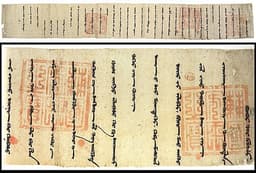
Anxi Khan
Emperor · Medieval
40.0Total

Julius Caesar
General · Ancient
82.8Total
Basic Information
Born
832
-100
Died
847
-44
Era
Medieval
Ancient
Nationality
Uyghur Khaganate
Roman Republic
Occupation
Emperor
General
Civilization
Eastern
Western
Score Comparison
Military (10%)
50.0
88.0
Political (20%)
29.3
78.0
Influence (20%)
47.1
85.0
Legacy (20%)
37.5
82.0
Leadership (15%)
39.0
80.0
Strategy (15%)
35.7
85.0
TOTAL
40.0
82.8
Anxi Khan — Complete Timeline
840 AD
Collapse of the Uyghur KhaganateWar◆ Major
Anxi Khan's reign saw the final collapse of the Uyghur Khaganate after a Kyrgyz invasion. The Kyrgyz sacked the capital Ordu-Baliq and destroyed Uyghur power, forcing the Uyghurs to flee south and west, ending their empire.
CollapseKyrgyz InvasionEnd of Empire
Impact: regionaltragic
843 AD
Flight to the Tarim BasinPolitical Action◆ Major
After the fall of the Khaganate, Anxi Khan led a remnant of Uyghurs to the Tarim Basin, where they established the Kingdom of Qocho. This migration preserved Uyghur culture and led to the formation of the Uyghur states in Xinjiang.
MigrationUyghur DiasporaQocho
Impact: regional
847 AD
Death in ExileOther
Anxi Khan died in exile in the Tarim Basin, likely killed by local rivals or in a skirmish. His death marked the end of the Uyghur imperial line, though Uyghur successor states continued to exist in the region.
DeathExileEnd of Dynasty
tragic
Julius Caesar — Complete Timeline
58 BC
Gallic WarsWar◆ Major
Caesar, as proconsul of Gaul, launched a series of campaigns that conquered all of Gaul (modern France, Belgium, and parts of Switzerland). He fought numerous battles, including against the Helvetii, the Belgae, and the Gallic chieftain Vercingetorix. The wars brought immense wealth and a loyal army to Caesar.
Gallic WarsConquestRoman Expansion
Impact: regional
49 BC
Crossing the RubiconPolitical Action◆ Major
Caesar led Legio XIII across the Rubicon River into Italy, defying the Roman Senate's order to disband his army. This act triggered a civil war against Pompey and the Optimates, ultimately leading to Caesar's dictatorship and the end of the Roman Republic.
Roman Civil WarEnd of RepublicPower Struggle
Impact: global
48 BC
Battle of PharsalusWar◆ Major
Caesar's outnumbered army defeated the larger forces of Pompey the Great at Pharsalus in Greece. Caesar's tactical use of a reserve line to counter Pompey's cavalry charge proved decisive. Pompey fled to Egypt, where he was assassinated, leaving Caesar as the undisputed master of the Roman world.
Roman Civil WarBattleDecisive Victory
Impact: regional
44 BC
Appointment as Dictator for LifePolitical Action◆ Major
The Roman Senate appointed Caesar dictator perpetuo (dictator for life), granting him unprecedented personal power. This move concentrated military, legislative, and judicial authority in one person, effectively ending the Roman Republic's traditional system of checks and balances and alarming many senators.
DictatorshipEnd of RepublicPower Consolidation
Impact: regionaldestructive
Assassination on the Ides of MarchPolitical Action◆ Major
A group of Roman senators, led by Marcus Junius Brutus and Gaius Cassius Longinus, stabbed Caesar to death at a meeting of the Senate in the Theatre of Pompey. The assassination was intended to restore the Republic, but instead triggered another civil war that led to the rise of the Roman Empire.
AssassinationRoman PoliticsEnd of Republic
Impact: globaldestructive
Expert Analysis
anxi-khan-vs-julius-caesar
# The Rise and Fall: Caesar and Anxi Khan
On a March morning in 44 BCE, Julius Caesar walked into the Senate chamber in Rome, ignoring a soothsayer’s warning about the Ides of March. Within minutes, sixty senators would surround him, drawing daggers from their togas. Nearly nine centuries later and thousands of miles east, another ruler—Anxi Khan, the last khagan of the Uyghur Empire—fled his burning capital as the Yenisei Kyrgyz swept through its gates. Both men died violently, but their stories could not be more different. One transformed the course of Western civilization; the other became a footnote in the collapse of a steppe empire. What explains this chasm between two figures who both claimed supreme authority?
Origins
Julius Caesar was born into the patrician Julian clan, an ancient but politically diminished family in the late Roman Republic. His upbringing was steeped in the brutal factionalism of Roman politics—his uncle Marius was a populist reformer, his father-in-law Cinna a rival of the dictator Sulla. Caesar’s education combined Greek philosophy, rhetoric, and military theory, but his real classroom was the Forum, where he watched senators bribe, betray, and assassinate one another. The Republic was already rotting when he was born, a system designed for a city-state but forced to govern an empire.
Anxi Khan, by contrast, inherited a steppe empire already in its death throes. Born in 832, he was a member of the Uyghur royal house that had dominated the Mongolian Plateau for a century. The Uyghur Khaganate, once a sophisticated Buddhist state with a written script and trade networks stretching from China to Persia, had been weakened by internal clan rivalries, religious tensions between Manichaeans and Buddhists, and the rising power of the Kyrgyz to the north. Anxi Khan ascended to the throne not as a young conqueror but as a caretaker of a crumbling legacy. His world was one of nomadic alliances and sudden betrayals, where a khagan’s authority depended on the loyalty of tribal chiefs who could vanish into the steppe at any moment.
Rise to Power
Caesar’s path to power was a masterclass in calculated risk. After serving as a military tribune and quaestor, he climbed the cursus honorum—the ladder of Roman offices—through a combination of military glory, lavish spending, and strategic marriages. His real breakthrough came in 58 BCE, when he secured the governorship of Gaul. Over the next eight years, he conquered the entire region, writing his own propaganda in *The Gallic Wars* and building a loyal army that would obey him, not the Senate. When the Senate ordered him to disband his forces and return to Rome as a private citizen—facing certain prosecution—Caesar made his legendary choice: he crossed the Rubicon River with his legion in 49 BCE, igniting a civil war. “The die is cast,” he reportedly said, and within four years he was dictator for life.
Anxi Khan’s rise was less a climb than a stumble into power. He became khagan around 840, just as the Kyrgyz launched their decisive invasion. There was no Rubicon moment for him—no dramatic defiance or brilliant gambit. The historical record suggests he was chosen by a faction of Uyghur nobles desperate for a leader who could hold the empire together. But the Kyrgyz had already sacked the capital, Ordu-Baliq, and the Uyghur army was shattered. Anxi Khan’s “rise” was an act of survival, not ambition. He led a remnant of his people south into the Tarim Basin, where they established the Kingdom of Qocho—a rump state that would survive for centuries, but not under his leadership.
Leadership & Governance
Caesar governed with a blend of military genius and political audacity. His campaigns in Gaul demonstrated tactical brilliance—the siege of Alesia in 52 BCE, where he defeated a massive Gallic relief force while besieging Vercingetorix, is still studied in military academies. As dictator, he reformed the calendar, initiated public works projects, granted citizenship to provincial elites, and centralized power in ways that made the later Empire possible. Yet his governance was also autocratic: he packed the Senate with his supporters, minted coins with his image, and accepted the title “dictator for life.” He believed the Republic was beyond saving, and he was probably right—but his methods ensured his assassination.
Anxi Khan’s leadership was defined by defeat. His military score of 31.1 reflects a khagan who could not defend his realm, though the Kyrgyz invasion was likely unstoppable. His political score of 38.9 suggests he lacked the diplomatic tools to forge alliances against the Kyrgyz or to unite his fractious nobles. His one significant act was the flight to the Tarim Basin in 843, where he established a new kingdom—but even this was a retreat, not a conquest. Unlike Caesar, who expanded Rome’s borders, Anxi Khan presided over the contraction of his world. He was a leader of refugees, not of legions.
Triumph & Tragedy
Caesar’s greatest triumph was the conquest of Gaul, which added a vast, wealthy province to Rome and made him a legend. His most devastating failure was his inability to secure his own safety. The Ides of March assassination was not just a personal tragedy—it plunged Rome into another civil war, from which his adopted heir Octavian eventually emerged as Augustus, the first emperor. Caesar’s death was the price of his ambition, but it also proved his point: the Republic could not contain men like him.
Anxi Khan’s “triumph” was survival itself. He kept a remnant of Uyghur culture alive in the Tarim Basin, where the Kingdom of Qocho would endure as a Buddhist state until the Mongol conquests. But his tragedy was total: his empire fell, his capital was sacked, and he died in exile in 847, likely killed by local rivals. He left no memoirs, no monuments, no legend—only a name in Chinese annals and Turkic inscriptions.
Character & Destiny
Caesar was a man of relentless drive, intellectual curiosity, and cold calculation. He could forgive his enemies (he famously pardoned Brutus after the civil war) but never forgot a slight. His personality shaped his decisions: he crossed the Rubicon because he could not imagine defeat, and he dismissed his guards because he believed his popularity made him invulnerable. His destiny was to destroy the Republic to save it, and his character ensured he would die for that paradox.
Anxi Khan was a man of circumstance, not will. He did not choose his moment; it chose him. His low scores across the board—military, political, leadership—suggest a ruler overwhelmed by forces beyond his control. His destiny was to be the last khagan, a symbol of an empire that had run its course. Where Caesar shaped history, Anxi Khan was shaped by it.
Legacy
Caesar’s legacy is immeasurable. His name became synonymous with autocracy (Kaiser, Tsar), his calendar lasted 1,500 years, and his writings shaped Latin prose. He transformed Rome from a republic into an empire, and the Western world has never stopped grappling with that transformation. His assassination made him a martyr, and his life became a cautionary tale about power and ambition.
Anxi Khan’s legacy is modest but real. The Kingdom of Qocho preserved Uyghur language, culture, and Buddhism for centuries, influencing the later Uyghur identity. Yet he is remembered as a failure, a ruler who lost an empire. His total score of 47.3, compared to Caesar’s 83.3, is not just a number—it reflects the judgment of history: one man changed the world, the other could not save his own.
Conclusion
Standing side by side, Caesar and Anxi Khan seem to belong to different species of history. One was a genius who remade civilization; the other was a victim of its currents. Yet both faced the same fundamental challenge: how to hold power in a world that was collapsing around them. Caesar chose to break the system; Anxi Khan tried to salvage the pieces. Their different outcomes were not just matters of talent—they were products of their worlds. The Roman Republic, for all its corruption, offered Caesar a stage; the Uyghur Khaganate, for all its sophistication, offered Anxi Khan only a trap. In the end, the Ides of March and the flight to the Tarim Basin are two sides of the same coin: the terrible cost of leadership in an age of empires.
Rankings
🥇
Julius CaesarLeader
Mil: 88.0Pol: 78.0Inf: 85.0
82.8
🥈
Anxi Khan
Mil: 50.0Pol: 29.3Inf: 47.1
40.0
+42.8 behind
How This Comparison Works
Algorithm
Each figure is scored on 6 dimensions (0—100 scale) based on structured historical data: Military (10%), Political (20%), Influence (20%), Legacy (20%), Leadership (15%), Strategy (15%). The weighted total produces the final ranking.
Data Sources
Scores are computed from structured sub-indicators in the database. Scale factors adjust for era (Ancient ×0.85, Modern ×1.0) and civilization size (Eastern ×1.05, Other ×0.80) to account for differences in population and military scale.
Maximum 3 Figures
Comparisons are limited to 2—3 figures to ensure readability and statistical meaningfulness.
Error Margins
±5 points per dimension — Sub-scores are derived from historical records with inherent uncertainty. Two figures within 5 points on a dimension should be considered roughly equivalent in that area.
Total Score Accuracy
±3 points overall — The weighted combination of 6 dimensions produces a total score with approximately ±3 points of uncertainty. Differences of less than 3 points are not statistically significant— the figures are effectively tied.
Known Limitations
- Historical records are incomplete and uneven across civilizations
- Figures from oral-tradition societies may be underrepresented
- Occupation labels can misclassify multi-role figures
- Scores measure capability and impact, not moral character
- Quantitative scoring is a comparison tool, not absolute truth
Capability Radar
Military (10%) — Battles & Warfare
Battles
20
95
Win Rate
15
92
Expansion
10
97
Political (20%) — Governance & Reform
Reform
10
90
Diplomacy
20
85
Economy
10
82
Influence (20%) — Cultural & Global Reach
Cultural
10
88
Global
10
94
Legacy (20%) — Historical Impact
Historical
15
95
Longevity
10
96
Leadership (15%) — Power & Stability
Tenure
15
75
Stability
10
60
Strategy (15%) — Tactics & Innovation
Strategy
15
94
Tactics
20
96
Reform
10
88
Similar Comparisons
Comments & Discussion
MarcusMaximus6/17/2026
Let's be real: comparing Caesar to Anxi Khan is like comparing a Ferrari to a broken cart. Caesar conquered Gaul, crossed the Rubicon, and literally changed the calendar we still use today. Anxi Khan got his capital sacked by some Kyrgyz raiders and vanished from history. The Uyghur Empire was already a dying animal when he took the throne—climate change, internal revolts, and trade disruptions sealed its fate. Caesar was an architect of destiny. Anxi Khan was a caretaker of collapse. One name e
数据猎手6/17/2026
这对比简直搞笑。Caesar有普鲁塔克写传记,有西塞罗写辞藻,有凯撒自己写《高卢战记》吹牛。Anxi Khan只有残损的突厥文碑铭、汉语史书里半句话。样本偏差懂吗?一个被传颂两千年的主角,另一个只是考古学家的拼图碎片。你拿一本畅销书和一页碎纸比厚度?这根本不是客观历史比较,是西方中心主义加幸存者偏差的完美示例。
PalatinePriest6/17/2026
The real chasm is in institutional legacy. Caesar didn't just die—he became a template. His adopted son Octavian built the Principate; his name became "Kaiser" and "Tsar." Every European emperor for 1,500 years traced legitimacy back to him. Anxi Khan? His Uyghur Empire was a tribal confederation held together by trade routes and personal loyalty. When the Kyrgyz burned the capital, the entire political structure evaporated. Caesar's death launched a bureaucratic empire. Anxi Khan's death launch
丝路幽灵6/17/2026
别急着踩Anxi Khan。他接手的是被回鹘割礼、佛教内斗和漠北干旱三重打击的帝国。Caesar死时罗马正上升期,Anxi死时回鹘已在垂死边缘——但他仍然在可汗位子上撑了七年,对抗契丹、黠戛斯和内部叛乱的四面合围。最后他不是战死沙场,而是城破自焚而亡,某种程度上有尊严。讽刺的是:凯撒被吹成神,安西被遗忘成零。但谁知道再过一千年,特朗普会不会也成"奇迹"?历史记忆本身就是暴力筛选的东西。