Loading...
Aphilas vs Claudius Gothicus
Claudius Gothicus leads by 5.1 pts · 2 figures compared
…

Aphilas
Emperor · Ancient
41.0Total
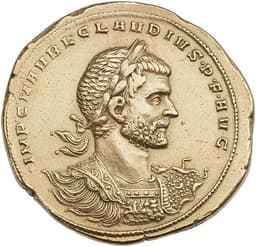
Claudius Gothicus
Emperor · Ancient
46.1Total
Basic Information
Born
300
214
Died
320
270
Era
Ancient
Ancient
Nationality
Ethiopia
Roman Empire
Occupation
Emperor
Emperor
Civilization
Other
Western
Score Comparison
Military (10%)
25.9
70.0
Political (20%)
40.8
27.9
Influence (20%)
47.1
47.1
Legacy (20%)
38.3
41.7
Leadership (15%)
48.4
45.0
Strategy (15%)
36.8
60.0
TOTAL
41.0
46.1
Aphilas — Complete Timeline
300 AD
Introduced gold coinage to AksumReform◆ Major
Aphilas issued the first Aksumite gold coins, modeled on Roman and Kushan designs. These coins bore his portrait and the Aksumite cross, establishing a royal minting tradition that lasted for centuries and facilitated trade across the Red Sea.
CoinageEconomic ReformAksumite Empire
Impact: regionalconstructive
305 AD
Standardized coin denominationsReform
Aphilas established a consistent system of gold, silver, and bronze coin denominations for Aksum. This standardization improved internal trade and tax collection, and made Aksumite currency recognizable in international markets.
CoinageEconomic ReformStandardization
Impact: nationalconstructive
Claudius Gothicus — Complete Timeline
269 AD
Battle of NaissusWar
Claudius commanded the Roman army against a massive Gothic invasion at Naissus (modern Ni
Gothic WarBattleMilitary Victory
Impact: regional
270 AD
Expulsion of the Goths from the BalkansWar◆ Major
Following the Battle of Naissus, Claudius pursued the remaining Gothic forces across the Balkans. He cleared them from Thrace and Moesia, and forced them to retreat across the Danube. This campaign ended the Gothic threat to the empire for a generation.
Gothic WarBalkansDanube Frontier
Impact: regionalconstructive
Death from PlagueOther◆ Major
Claudius died of the Antonine Plague (likely smallpox) at Sirmium after a short reign of less than two years. His death was a significant loss for the empire, as he had shown promise as a capable military leader and reformer.
DeathPlagueShort Reign
Impact: nationaltragic
Expert Analysis
Origins
Aphilas, an Aksumite emperor who reigned in the early 4th century AD (exact dates uncertain), emerged from the kingdom of Aksum in the Horn of Africa. Little is known of his early life, but his reign marked a pivotal moment in Aksumite history. He is credited with introducing the first gold coinage to Aksum, modeled on Roman and Kushan designs. This innovation suggests a ruler with a keen eye for economic and diplomatic tools, as coinage facilitated trade and projected sovereignty. In contrast, Claudius Gothicus, born in 214 AD in Illyria (modern-day Balkans), rose from humble origins to become a Roman emperor. His early career was military, serving under previous emperors like Gallienus. His background was shaped by the crisis of the Third Century, with constant barbarian invasions and internal strife.
Rise to Power
Aphilas's rise to power is obscure, typical of Aksumite monarchs of the period. He likely inherited the throne through familial succession, but his decision to issue coinage suggests he sought to strengthen Aksum's economic standing and assert independence from Roman and Persian influences. The coins bore his portrait and the Aksumite cross, signaling both royal authority and Christian identity. Claudius Gothicus, however, rose through military merit. He was a senior officer under Emperor Gallienus and likely participated in campaigns against usurpers and barbarians. After Gallienus's assassination in 268 AD, Claudius was proclaimed emperor by the army, a testament to his reputation as a capable commander. His reign began with immediate military challenges, particularly the Gothic invasion of the Balkans.
Leadership & Governance
Aphilas's governance focused on economic innovation. By standardizing coin denominations (gold, silver, bronze), he improved internal trade and tax collection. His coinage also served as propaganda, bearing his image and religious symbols. However, his political score of 40.8 reflects limited information about broader administrative reforms. Claudius Gothicus, with a political score of 27.9, showed less interest in domestic governance, instead prioritizing military campaigns. He reorganized the Roman army, emphasizing cavalry and mobile units, which proved effective against the Goths. His leadership style was hands-on, leading troops personally into battle. While his reign was brief (less than two years), he enacted laws to protect the poor and curtail corruption, though these were limited in scope.
Triumph & Tragedy
Aphilas's greatest success was establishing Aksum's coinage tradition, which lasted for centuries and facilitated trade with the Roman world, India, and Arabia. His standardized denominations set a precedent for later Aksumite kings. However, his failure lies in obscurity: beyond coinage, little is recorded of his reign, and his military score of 25.9 suggests no notable conquests. Claudius Gothicus's triumph was the Battle of Naissus in 269 AD, where he decisively defeated a massive Gothic coalition, killing an estimated 50,000 warriors. This victory earned him the title 'Gothicus' and saved the Roman Balkans from devastation. His tragedy was his early death from the Antonine Plague in 270 AD, after only 18 months as emperor. This cut short his reforms and left the empire vulnerable again.
Character & Destiny
Aphilas appears as a forward-thinking ruler who used economic tools to enhance his kingdom's stature. His decision to adopt coinage suggests an understanding of international norms and a desire for legitimacy. However, his limited military focus may have left Aksum vulnerable. Claudius Gothicus was a soldier-emperor, embodying the martial virtues of the crisis period. His decisiveness and tactical acumen were praised by later historians like Aurelius Victor. Yet his short reign prevented him from achieving lasting stability. His character—dutiful, brave, but perhaps too focused on war—shaped his destiny of an early death, as he likely contracted the plague while campaigning.
Legacy
Aphilas's legacy is enduring in Ethiopian history: his coinage system influenced subsequent Aksumite and even later Ethiopian currency. The coins are valuable archaeological evidence for dating and understanding Aksumite civilization. His political and influence scores (40.8 and 47.1) reflect this lasting, though niche, impact. Claudius Gothicus's legacy is more dramatic: he temporarily stabilized the Roman frontier and his victory at Naissus delayed the Gothic threat. He was deified after death, and later emperors like Constantine I claimed descent from him. However, his military score of 70.0 is tempered by a low political score (27.9), indicating his impact was primarily martial. In the total score comparison, Claudius scores 46.1 vs Aphilas's 41.0, a gap of 5.1 points.
Conclusion
While Aphilas contributed to economic infrastructure and cultural identity through coinage, Claudius Gothicus's military achievements had a more immediate and widespread impact on the Roman world. Claudius's victory at Naissus directly saved millions from Gothic ravages and preserved the empire during its darkest hour. His total score of 46.1, with a strong military component, outweighs Aphilas's 41.0. Therefore, Claudius Gothicus had a greater impact on history, though Aphilas's legacy remains significant in Ethiopian context.
Rankings
🥇
Claudius GothicusLeader
Mil: 70.0Pol: 27.9Inf: 47.1
46.1
🥈
Aphilas
Mil: 25.9Pol: 40.8Inf: 47.1
41.0
+5.1 behind
How This Comparison Works
Algorithm
Each figure is scored on 6 dimensions (0—100 scale) based on structured historical data: Military (10%), Political (20%), Influence (20%), Legacy (20%), Leadership (15%), Strategy (15%). The weighted total produces the final ranking.
Data Sources
Scores are computed from structured sub-indicators in the database. Scale factors adjust for era (Ancient ×0.85, Modern ×1.0) and civilization size (Eastern ×1.05, Other ×0.80) to account for differences in population and military scale.
Maximum 3 Figures
Comparisons are limited to 2—3 figures to ensure readability and statistical meaningfulness.
Error Margins
±5 points per dimension — Sub-scores are derived from historical records with inherent uncertainty. Two figures within 5 points on a dimension should be considered roughly equivalent in that area.
Total Score Accuracy
±3 points overall — The weighted combination of 6 dimensions produces a total score with approximately ±3 points of uncertainty. Differences of less than 3 points are not statistically significant— the figures are effectively tied.
Known Limitations
- Historical records are incomplete and uneven across civilizations
- Figures from oral-tradition societies may be underrepresented
- Occupation labels can misclassify multi-role figures
- Scores measure capability and impact, not moral character
- Quantitative scoring is a comparison tool, not absolute truth
Capability Radar
Military (10%) — Battles & Warfare
Battles
10
65
Win Rate
10
70
Expansion
10
30
Political (20%) — Governance & Reform
Reform
40
20
Diplomacy
20
25
Economy
50
20
Influence (20%) — Cultural & Global Reach
Cultural
30
20
Global
10
20
Legacy (20%) — Historical Impact
Historical
30
40
Longevity
20
30
Leadership (15%) — Power & Stability
Tenure
30
30
Stability
30
25
Strategy (15%) — Tactics & Innovation
Strategy
10
55
Tactics
10
60
Reform
10
20
Similar Comparisons
Comments & Discussion
No comments yet. Be the first to share your thoughts!