Loading...
Claudius Gothicus vs Ptolemy XII Auletes
Claudius Gothicus leads by 0.7 pts · 2 figures compared
…
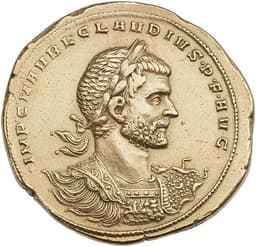
Claudius Gothicus
Emperor · Ancient
46.1Total

Ptolemy XII Auletes
Emperor · Ancient
45.4Total
Basic Information
Born
214
-117
Died
270
-51
Era
Ancient
Ancient
Nationality
Roman Empire
Egypt
Occupation
Emperor
Emperor
Civilization
Western
Middle Eastern
Score Comparison
Military (10%)
70.0
22.6
Political (20%)
27.9
37.9
Influence (20%)
47.1
53.3
Legacy (20%)
41.7
43.3
Leadership (15%)
45.0
62.2
Strategy (15%)
60.0
39.6
TOTAL
46.1
45.4
Claudius Gothicus — Complete Timeline
269 AD
Battle of NaissusWar
Claudius commanded the Roman army against a massive Gothic invasion at Naissus (modern Ni
Gothic WarBattleMilitary Victory
Impact: regional
270 AD
Expulsion of the Goths from the BalkansWar◆ Major
Following the Battle of Naissus, Claudius pursued the remaining Gothic forces across the Balkans. He cleared them from Thrace and Moesia, and forced them to retreat across the Danube. This campaign ended the Gothic threat to the empire for a generation.
Gothic WarBalkansDanube Frontier
Impact: regionalconstructive
Death from PlagueOther◆ Major
Claudius died of the Antonine Plague (likely smallpox) at Sirmium after a short reign of less than two years. His death was a significant loss for the empire, as he had shown promise as a capable military leader and reformer.
DeathPlagueShort Reign
Impact: nationaltragic
Ptolemy XII Auletes — Complete Timeline
80 BC
Accession as Pharaoh of EgyptPolitical Action◆ Major
Ptolemy XII Auletes became pharaoh of Egypt after the death of Ptolemy XI Alexander II. His reign was marked by political instability, economic decline, and increasing Roman influence. He was known for his pro-Roman policies and lavish spending.
AccessionPtolemaic DynastyRoman Influence
Impact: regional
58 BC
Exile from EgyptPolitical Action◆ Major
Ptolemy XII was driven from Egypt by a popular revolt, likely due to his heavy taxation and pro-Roman stance. He fled to Rome, where he sought support for his restoration. His daughter Berenice IV took the throne in his absence.
ExileRevoltRoman Support
Impact: regionaltragic
55 BC
Restoration to the ThronePolitical Action◆ Major
Ptolemy XII was restored to the Egyptian throne with military support from the Roman governor of Syria, Aulus Gabinius. The Roman army helped him defeat the forces of Berenice IV. He executed his daughter and resumed his pro-Roman policies.
RestorationRoman InterventionExecution
Impact: regionaldestructive
Will Naming Rome as GuardianPolitical Action◆ Major
Ptolemy XII made a will naming the Roman Republic as the guardian of his children and the Egyptian kingdom. This will later be used by Julius Caesar to justify Roman intervention in Egypt after Ptolemy's death, leading to the Alexandrian War.
WillRoman GuardianshipSuccession
Impact: regional
Expert Analysis
Origins
Claudius Gothicus, born Marcus Aurelius Claudius in 214 AD in Illyria (modern Balkans), came from humble origins. Little is known of his early life, but he rose through the military ranks of the Roman army. His background was that of a soldier-emperor in the Crisis of the Third Century, when the empire faced internal fragmentation and external invasions. Ptolemy XII Auletes, born around 117 BC, was a member of the Ptolemaic dynasty, the Macedonian Greek ruling family of Egypt. He was likely the illegitimate son of Ptolemy IX Soter II. His upbringing was steeped in Hellenistic court intrigue and the declining power of a dynasty that relied increasingly on Roman support.
Rise to Power
Claudius Gothicus came to power in 268 AD following the death of Emperor Gallienus. He was acclaimed by the army, likely with the support of the cavalry commander Aurelian. His rise was swift and based on military competence. He immediately faced a massive Gothic invasion that had swept into the Balkans. Ptolemy XII Auletes became pharaoh in 80 BC after the death of Ptolemy XI Alexander II, who had been installed by the Roman dictator Sulla. Ptolemy XII's reign began under Roman shadow. He was known as "Auletes" (the flute-player) for his enthusiasm for music, but his political position was weak from the start, forced to pay huge bribes to Rome to secure recognition.
Leadership & Governance
Claudius Gothicus ruled for only 1 year and 9 months (268-270 AD). His governance was focused on military defense. He reorganized the army, emphasizing cavalry, and restored discipline. His leadership style was direct and hands-on, leading troops personally at Naissus. He scored 45.0 in leadership and 60.0 in strategy, reflecting his tactical acumen. Ptolemy XII Auletes ruled for 29 years (80-58 BC and 55-51 BC). His governance was marked by heavy taxation to pay for Roman bribes, leading to economic decline. He was a weak administrator, and his pro-Roman stance provoked a rebellion that forced him into exile in 58 BC. He scored 62.2 in leadership but only 37.9 in political, indicating his poor strategic judgment.
Triumph & Tragedy
Claudius Gothicus's greatest triumph was the Battle of Naissus in 269 AD, where he defeated a huge Gothic army, reportedly killing 50,000 and capturing many more. He then expelled the Goths from the Balkans, securing the Danube frontier. His tragedy was his death from the Antonine Plague (likely smallpox) in 270 AD at Sirmium, cutting short his promising reign. His military score of 70.0 reflects this success. Ptolemy XII Auletes's triumph was his restoration to the throne in 55 BC by Roman forces under Aulus Gabinius, with the help of the young Mark Antony. His tragedy was his utter dependence on Rome; he made a will naming Rome as guardian of his children, which later justified Roman intervention. His military score of 22.6 reflects his inability to defend his own rule.
Character & Destiny
Claudius Gothicus was a capable and decisive commander, known for his stern discipline and concern for the welfare of his soldiers. His character was forged in the crucible of war, and his destiny was to be a savior of the Roman Empire, albeit briefly. He was later deified by the Senate. Ptolemy XII Auletes was a cunning but ultimately weak ruler, prioritizing his own survival over the independence of Egypt. He was willing to mortgage his kingdom to Rome. His character was that of a survivor, but his legacy was the erosion of Egyptian sovereignty. He scored 53.3 in influence, partly due to his daughter Cleopatra VII.
Legacy
Claudius Gothicus's legacy is that of a warrior emperor who revived Roman fortunes. He was the first of a series of Illyrian emperors who restored the empire. His victory at Naissus was a turning point, and he is remembered as one of the great soldier-emperors. He scored 41.7 in legacy. Ptolemy XII Auletes's legacy is overshadowed by his daughter Cleopatra VII. He is remembered as a weak pharaoh who lost Egypt's independence. His will, however, shaped the fate of Egypt, leading to Roman annexation. He scored 43.3 in legacy, slightly higher than Claudius, but this is largely due to Cleopatra's fame.
Conclusion
Claudius Gothicus had a greater direct impact on history. In just two years, he stabilized a collapsing empire and defeated a major barbarian threat. Ptolemy XII Auletes ruled for decades but his reign was a slow decline into vassalage. While Claudius's military score of 70.0 dwarfs Ptolemy's 22.6, Ptolemy's political score of 37.9 is slightly higher than Claudius's 27.9. However, Claudius's total score of 46.1 versus Ptolemy's 45.4 reflects his superior overall contribution. Claudius Gothicus is the more significant historical figure because his actions directly preserved the Roman Empire, whereas Ptolemy XII merely delayed Egypt's absorption by Rome.
Rankings
🥇
Claudius GothicusLeader
Mil: 70.0Pol: 27.9Inf: 47.1
46.1
🥈
Ptolemy XII Auletes
Mil: 22.6Pol: 37.9Inf: 53.3
45.4
+0.7 behind
How This Comparison Works
Algorithm
Each figure is scored on 6 dimensions (0—100 scale) based on structured historical data: Military (10%), Political (20%), Influence (20%), Legacy (20%), Leadership (15%), Strategy (15%). The weighted total produces the final ranking.
Data Sources
Scores are computed from structured sub-indicators in the database. Scale factors adjust for era (Ancient ×0.85, Modern ×1.0) and civilization size (Eastern ×1.05, Other ×0.80) to account for differences in population and military scale.
Maximum 3 Figures
Comparisons are limited to 2—3 figures to ensure readability and statistical meaningfulness.
Error Margins
±5 points per dimension — Sub-scores are derived from historical records with inherent uncertainty. Two figures within 5 points on a dimension should be considered roughly equivalent in that area.
Total Score Accuracy
±3 points overall — The weighted combination of 6 dimensions produces a total score with approximately ±3 points of uncertainty. Differences of less than 3 points are not statistically significant— the figures are effectively tied.
Known Limitations
- Historical records are incomplete and uneven across civilizations
- Figures from oral-tradition societies may be underrepresented
- Occupation labels can misclassify multi-role figures
- Scores measure capability and impact, not moral character
- Quantitative scoring is a comparison tool, not absolute truth
Capability Radar
Military (10%) — Battles & Warfare
Battles
65
10
Win Rate
70
10
Expansion
30
5
Political (20%) — Governance & Reform
Reform
20
20
Diplomacy
25
50
Economy
20
30
Influence (20%) — Cultural & Global Reach
Cultural
20
30
Global
20
30
Legacy (20%) — Historical Impact
Historical
40
40
Longevity
30
30
Leadership (15%) — Power & Stability
Tenure
30
60
Stability
25
20
Strategy (15%) — Tactics & Innovation
Strategy
55
10
Tactics
60
10
Reform
20
5
Similar Comparisons
Comments & Discussion
No comments yet. Be the first to share your thoughts!