Loading...
Claudius Gothicus vs Julius Caesar
Julius Caesar leads by 36.7 pts · 2 figures compared
…
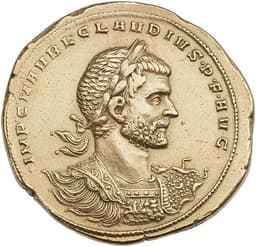
Claudius Gothicus
Emperor · Ancient
46.1Total

Julius Caesar
General · Ancient
82.8Total
Basic Information
Born
214
-100
Died
270
-44
Era
Ancient
Ancient
Nationality
Roman Empire
Roman Republic
Occupation
Emperor
General
Civilization
Western
Western
Score Comparison
Military (10%)
70.0
88.0
Political (20%)
27.9
78.0
Influence (20%)
47.1
85.0
Legacy (20%)
41.7
82.0
Leadership (15%)
45.0
80.0
Strategy (15%)
60.0
85.0
TOTAL
46.1
82.8
Claudius Gothicus — Complete Timeline
269 AD
Battle of NaissusWar
Claudius commanded the Roman army against a massive Gothic invasion at Naissus (modern Ni
Gothic WarBattleMilitary Victory
Impact: regional
270 AD
Expulsion of the Goths from the BalkansWar◆ Major
Following the Battle of Naissus, Claudius pursued the remaining Gothic forces across the Balkans. He cleared them from Thrace and Moesia, and forced them to retreat across the Danube. This campaign ended the Gothic threat to the empire for a generation.
Gothic WarBalkansDanube Frontier
Impact: regionalconstructive
Death from PlagueOther◆ Major
Claudius died of the Antonine Plague (likely smallpox) at Sirmium after a short reign of less than two years. His death was a significant loss for the empire, as he had shown promise as a capable military leader and reformer.
DeathPlagueShort Reign
Impact: nationaltragic
Julius Caesar — Complete Timeline
58 BC
Gallic WarsWar◆ Major
Caesar, as proconsul of Gaul, launched a series of campaigns that conquered all of Gaul (modern France, Belgium, and parts of Switzerland). He fought numerous battles, including against the Helvetii, the Belgae, and the Gallic chieftain Vercingetorix. The wars brought immense wealth and a loyal army to Caesar.
Gallic WarsConquestRoman Expansion
Impact: regional
49 BC
Crossing the RubiconPolitical Action◆ Major
Caesar led Legio XIII across the Rubicon River into Italy, defying the Roman Senate's order to disband his army. This act triggered a civil war against Pompey and the Optimates, ultimately leading to Caesar's dictatorship and the end of the Roman Republic.
Roman Civil WarEnd of RepublicPower Struggle
Impact: global
48 BC
Battle of PharsalusWar◆ Major
Caesar's outnumbered army defeated the larger forces of Pompey the Great at Pharsalus in Greece. Caesar's tactical use of a reserve line to counter Pompey's cavalry charge proved decisive. Pompey fled to Egypt, where he was assassinated, leaving Caesar as the undisputed master of the Roman world.
Roman Civil WarBattleDecisive Victory
Impact: regional
44 BC
Appointment as Dictator for LifePolitical Action◆ Major
The Roman Senate appointed Caesar dictator perpetuo (dictator for life), granting him unprecedented personal power. This move concentrated military, legislative, and judicial authority in one person, effectively ending the Roman Republic's traditional system of checks and balances and alarming many senators.
DictatorshipEnd of RepublicPower Consolidation
Impact: regionaldestructive
Assassination on the Ides of MarchPolitical Action◆ Major
A group of Roman senators, led by Marcus Junius Brutus and Gaius Cassius Longinus, stabbed Caesar to death at a meeting of the Senate in the Theatre of Pompey. The assassination was intended to restore the Republic, but instead triggered another civil war that led to the rise of the Roman Empire.
AssassinationRoman PoliticsEnd of Republic
Impact: globaldestructive
Expert Analysis
claudius-gothicus-vs-julius-caesar
# The Gambler and the Steadfast: Caesar and Claudius Gothicus
On a January morning in 49 BCE, Julius Caesar stood at the banks of the Rubicon, a small river that marked the boundary between his province of Gaul and Italy proper. To cross with his army was treason; to turn back was political oblivion. He hesitated, then uttered a phrase that would echo through millennia: *“Alea iacta est”* — the die is cast. Four centuries later, in the summer of 269 CE, another Roman commander, Claudius, faced a very different kind of gamble. Outside the walls of Naissus, a horde of Goths, perhaps 100,000 strong, threatened to overrun the Balkans. Claudius had no choice but to fight. There was no river to cross, no political theater — only the grim arithmetic of survival. Two men, two crises, two Romes. One would transform the world; the other would save it, then vanish into the shadows of history.
Origins
Julius Caesar was born into the patrician Julian clan in 100 BCE, a time when the Roman Republic was already cracking under the weight of its own ambition. His family claimed descent from the goddess Venus, but they were politically marginal, and his father died when Caesar was sixteen. He grew up in a Rome of street violence, senatorial corruption, and civil wars — a world where a man could rise only by daring everything. His uncle by marriage was Gaius Marius, the populist general who had reformed the army and defied the Senate. Caesar absorbed that lesson early: power came from soldiers, not senators.
Claudius Gothicus, born in 214 CE, entered a very different Rome. The empire was in the throes of the Crisis of the Third Century — a fifty-year nightmare of barbarian invasions, plague, economic collapse, and usurper emperors who ruled for months before being murdered. Claudius was likely from Illyria (modern Balkans), of humble origins, possibly a soldier who rose through the ranks. His world was not the marble forum of Cicero and Pompey, but the mud and blood of frontier camps. He had no divine ancestry, no political inheritance — only his sword and the desperate loyalty of his legions.
Rise to Power
Caesar’s path was a masterclass in calculated risk. He borrowed fortunes to fund political bribes, allied with the wealthy Crassus and the popular Pompey in the First Triumvirate, and then used his governorship of Gaul to build a personal army and a reputation. He invaded Britain, bridged the Rhine, and slaughtered a million Gauls. When the Senate ordered him to disband his army, he refused — and crossed the Rubicon. By 48 BCE, he had defeated Pompey at Pharsalus, chased him to Egypt, and emerged as the undisputed master of Rome.
Claudius’s rise was less dramatic but no less remarkable. He served under the emperor Gallienus, who had reigned for fifteen years — an eternity in the crisis-ridden third century. In 268, when Gallienus was murdered by his own officers, Claudius was proclaimed emperor by the army. He had not plotted or schemed; he was simply the best man left standing. His challenge was not to conquer the world, but to keep it from collapsing entirely.
Leadership & Governance
Caesar ruled as a dictator in all but name. He reformed the calendar, granted citizenship to provincials, launched massive building projects, and packed the Senate with his supporters. His military genius was breathtaking: he wrote his own commentaries, outmaneuvered numerically superior enemies, and inspired legendary loyalty in his troops. Yet his political wisdom was flawed. He pardoned his enemies, but they did not forgive him. He centralized power, but he did not build a durable system. His rule was a brilliant improvisation, not a blueprint.
Claudius governed for less than two years. He had no time for grand reforms. His priority was survival. He defeated the Goths at Naissus in 269, then pursued them across the Balkans, clearing them from Roman territory. He also fought the Alamanni along the Danube. His military approach was defensive, methodical, and brutal — a stark contrast to Caesar’s sweeping offensives. Politically, he stabilized the empire by simply staying alive and keeping the army loyal. He did not remake Rome; he held it together.
Triumph & Tragedy
Caesar’s greatest moment was his triumph over Gaul, celebrated in Rome with a parade that lasted days, displaying captive kings and mountains of gold. His most devastating failure was his assassination on the Ides of March, 44 BCE, stabbed by senators he had pardoned. He had conquered the world, but he could not conquer the hatred of his peers.
Claudius’s triumph was the Battle of Naissus, where his outnumbered army annihilated the Gothic horde. The victory earned him the title “Gothicus” and saved the Balkans from devastation. His tragedy came soon after: he died of the Antonine Plague in 270, at Sirmium, after a reign of less than two years. He was not murdered by enemies, but felled by a disease that cared nothing for his victories.
Character & Destiny
Caesar was a gambler who believed in his own star. He was generous, ruthless, charismatic, and vain. He pardoned Brutus and Cassius, then was shocked when they killed him. His character drove him to take risks that no one else would dare — and it ultimately destroyed him. He could not imagine a world where his luck ran out.
Claudius was a survivor, not a visionary. He was competent, disciplined, and unglamorous. He did not seek glory; he sought order. His character was shaped by the crisis of his age: he had no room for grand gestures, only grim necessities. He died before his luck could run out — and perhaps that was his greatest gift to Rome.
Legacy
Caesar’s legacy is immeasurable. His name became a title — Kaiser, Tsar — and his actions ended the Republic, birthing the Empire. His writings are still read, his tactics still studied. He is remembered as a titan, a genius, a tyrant, a martyr. His assassination did not restore the Republic; it merely paved the way for Augustus.
Claudius Gothicus is remembered, if at all, as a footnote. His victory at Naissus bought the empire a generation of breathing room. His death from plague, so anticlimactic, has left him in the shadows of Diocletian and Constantine, who would later reform and transform Rome. Yet without Claudius, there might have been no empire left to save.
Conclusion
History rewards the bold and forgets the steadfast. Caesar gambled everything and won, then lost everything and became immortal. Claudius played it safe, held the line, and died forgotten. But which was the better leader? The one who remade the world and left it bleeding, or the one who held it together and passed it on? Perhaps the answer lies in the question itself. We remember Caesar because his story is more dramatic. But we owe our survival to men like Claudius — the ones who do not cross the Rubicon, but stand firm at Naissus.
Rankings
🥇
Julius CaesarLeader
Mil: 88.0Pol: 78.0Inf: 85.0
82.8
🥈
Claudius Gothicus
Mil: 70.0Pol: 27.9Inf: 47.1
46.1
+36.7 behind
How This Comparison Works
Algorithm
Each figure is scored on 6 dimensions (0—100 scale) based on structured historical data: Military (10%), Political (20%), Influence (20%), Legacy (20%), Leadership (15%), Strategy (15%). The weighted total produces the final ranking.
Data Sources
Scores are computed from structured sub-indicators in the database. Scale factors adjust for era (Ancient ×0.85, Modern ×1.0) and civilization size (Eastern ×1.05, Other ×0.80) to account for differences in population and military scale.
Maximum 3 Figures
Comparisons are limited to 2—3 figures to ensure readability and statistical meaningfulness.
Error Margins
±5 points per dimension — Sub-scores are derived from historical records with inherent uncertainty. Two figures within 5 points on a dimension should be considered roughly equivalent in that area.
Total Score Accuracy
±3 points overall — The weighted combination of 6 dimensions produces a total score with approximately ±3 points of uncertainty. Differences of less than 3 points are not statistically significant— the figures are effectively tied.
Known Limitations
- Historical records are incomplete and uneven across civilizations
- Figures from oral-tradition societies may be underrepresented
- Occupation labels can misclassify multi-role figures
- Scores measure capability and impact, not moral character
- Quantitative scoring is a comparison tool, not absolute truth
Capability Radar
Military (10%) — Battles & Warfare
Battles
65
95
Win Rate
70
92
Expansion
30
97
Political (20%) — Governance & Reform
Reform
20
90
Diplomacy
25
85
Economy
20
82
Influence (20%) — Cultural & Global Reach
Cultural
20
88
Global
20
94
Legacy (20%) — Historical Impact
Historical
40
95
Longevity
30
96
Leadership (15%) — Power & Stability
Tenure
30
75
Stability
25
60
Strategy (15%) — Tactics & Innovation
Strategy
55
94
Tactics
60
96
Reform
20
88
Similar Comparisons
Comments & Discussion
No comments yet. Be the first to share your thoughts!