Loading...
Armando Calderon Sol vs Habib Bourguiba
Habib Bourguiba leads by 13.9 pts · 2 figures compared
…

Armando Calderon Sol
Politician · Modern
50.5Total
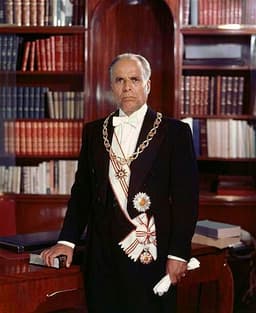
Habib Bourguiba
Politician · Modern
64.4Total
Basic Information
Born
1948
1903
Died
—
2000
Era
Modern
Modern
Nationality
El Salvador
Tunisia
Occupation
Politician
Politician
Civilization
Western
Middle Eastern
Score Comparison
Military (10%)
49.8
39.9
Political (20%)
61.3
82.0
Influence (20%)
47.1
68.0
Legacy (20%)
41.7
55.0
Leadership (15%)
65.7
80.0
Strategy (15%)
43.1
53.8
TOTAL
50.5
64.4
Armando Calderon Sol — Complete Timeline
1992 AD
Signing of the Chapultepec Peace AccordsPolitical Action
As President of El Salvador, Armando Calder
Peace ProcessCivil WarDemobilization
Impact: nationalconstructive
1995 AD
Implementation of the National Reconstruction PlanReform◆ Major
Following the peace accords, Calder
Post-War ReconstructionInfrastructureReintegration
Impact: nationalconstructive
1998 AD
Privatization of the telecommunications sectorReform◆ Major
Calderón Sol's administration privatized the state-owned telecommunications company ANTEL, selling it to a consortium led by France Telecom. The sale generated revenue for the government but led to increased prices and criticism from labor unions.
PrivatizationTelecommunicationsEconomic Reform
Impact: nationalconstructive
Habib Bourguiba — Complete Timeline
1956 AD
Code of Personal StatusReform◆ Major
Bourguiba enacted the Code of Personal Status, a progressive family law that abolished polygamy, established legal minimum age for marriage, and granted women rights to divorce and custody. This reform was unprecedented in the Arab world and modernized Tunisian society.
Women's RightsLegal ReformSocial Change
Impact: nationalprogressive
Tunisian IndependencePolitical Action
Habib Bourguiba led Tunisia to independence from France through a combination of political negotiation and nationalist pressure. He became the first Prime Minister of independent Tunisia, ending 75 years of French protectorate rule.
IndependenceDecolonizationNationalism
Impact: nationalconstructive
1957 AD
Proclamation of the RepublicPolitical Action◆ Major
Bourguiba abolished the Tunisian monarchy and proclaimed the Republic of Tunisia, with himself as President. This move consolidated his power and established a presidential system that would dominate Tunisian politics for decades.
RepublicConstitutional ChangePresidency
Impact: national
1961 AD
Bizerte CrisisWar◆ Major
Bourguiba demanded the evacuation of the French naval base at Bizerte. When negotiations failed, Tunisian forces blockaded the base, leading to a violent confrontation with French troops. The crisis resulted in hundreds of Tunisian casualties and strained Franco-Tunisian relations.
ConflictDecolonizationBizerte
Impact: regionaltragic
1987 AD
Removal from PowerPolitical Action◆ Major
Prime Minister Zine El Abidine Ben Ali removed Bourguiba from office in a bloodless coup, citing his failing health and inability to govern. Bourguiba was placed under house arrest, ending his 30-year presidency and his role as Tunisia's founding father.
CoupSuccessionBen Ali
Impact: nationaltragic
Expert Analysis
Origins
Armando Calderón Sol was born on June 24, 1948, in San Salvador, El Salvador, into a middle-class family. He studied law at the University of El Salvador and later earned a degree in business administration. His early career included work as a lawyer and businessman, with no significant political background until he joined the Nationalist Republican Alliance (ARENA) party in the 1980s. In contrast, Habib Bourguiba was born on August 3, 1903, in Monastir, Tunisia, then a French protectorate. He came from a modest family and pursued education in Tunis and later in Paris, where he studied law and political science. Bourguiba's early exposure to French colonialism shaped his nationalist fervor, leading him to found the Neo Destour party in 1934.
Rise to Power
Calderón Sol rose to prominence within ARENA, a right-wing party founded by Roberto D'Aubuisson. He served as a deputy in the Legislative Assembly and later as mayor of San Salvador. In 1994, he was elected President of El Salvador, succeeding Alfredo Cristiani. His presidency was defined by the implementation of the Chapultepec Peace Accords, signed in 1992, which ended the 12-year civil war. Bourguiba's rise was more protracted and confrontational. He led the Tunisian nationalist movement through decades of political activism, imprisonment, and exile. He negotiated with France, leveraging the Algerian War and international pressure. Tunisia gained independence on March 20, 1956, and Bourguiba became Prime Minister. He abolished the monarchy on July 25, 1957, proclaiming the republic and assuming the presidency.
Leadership & Governance
Calderón Sol's governance focused on post-war reconstruction and neoliberal economic reforms. He privatized state-owned enterprises, including the telecommunications company ANTEL, sold to France Telecom in 1998. His administration implemented the National Reconstruction Plan to rebuild infrastructure and reintegrate former combatants. However, his policies faced criticism for increasing inequality and failing to address root causes of the conflict. Bourguiba's leadership was authoritarian but progressive. He enacted the Code of Personal Status in 1956, which abolished polygamy, set a minimum marriage age, and granted women legal rights—unprecedented in the Arab world. He promoted secularism, education, and women's rights, but suppressed political opposition, ruling with a single-party system until his removal in 1987.
Triumph & Tragedy
Calderón Sol's greatest success was overseeing the peace process that ended a brutal civil war, with the Chapultepec Accords leading to demobilization of guerrilla forces and political integration. His tragedy was the incomplete transformation of Salvadoran society; crime and inequality persisted, and his privatization efforts were marred by corruption allegations. Bourguiba's triumphs include leading Tunisia to independence and implementing progressive reforms that modernized the country. His tragedy was the Bizerte Crisis in 1961, where a confrontation with France over a naval base resulted in hundreds of Tunisian deaths. Additionally, his later years saw declining health and authoritarian tendencies, culminating in a bloodless coup by Prime Minister Zine El Abidine Ben Ali in 1987.
Character & Destiny
Calderón Sol was pragmatic and technocratic, focused on stability and economic liberalization. His character as a consensus-builder enabled the peace process, but his lack of visionary zeal limited his impact. He scored 65.7 in leadership but only 41.7 in legacy, reflecting his role as a transitional figure. Bourguiba was charismatic, determined, and often uncompromising. His political acumen scored 82.0, and his leadership 80.0, but his strategy scored 53.8, indicating occasional missteps like the Bizerte Crisis. His destiny was to be ousted in a coup, yet his legacy as the "Supreme Warrior" endures.
Legacy
Calderón Sol's legacy is tied to the peace accords that ended El Salvador's civil war, but his economic policies have been controversial. The privatization of ANTEL and other state assets did not lead to widespread prosperity. His total score of 50.5 reflects a leader who managed a transition but did not fundamentally transform his country. Bourguiba's legacy is more profound: he is revered as the father of modern Tunisia, with his reforms in women's rights and education shaping the nation's identity. His influence score of 68.0 and legacy of 55.0 indicate a lasting impact, despite the authoritarian turn. The score gap of 13.9 points underscores Bourguiba's greater impact.
Conclusion
Habib Bourguiba had a greater impact than Armando Calderón Sol. Bourguiba's political score of 82.0 versus Calderón Sol's 61.3, and his total score of 64.4 versus 50.5, reflect his role as a nation-builder who transformed Tunisia from a French colony into a modern state with progressive values. Calderón Sol, while successful in ending a war, did not reshape El Salvador's fundamental structures. The data supports Bourguiba as the more influential figure, with lasting changes in law, society, and national identity.
Rankings
🥇
Habib BourguibaLeader
Mil: 39.9Pol: 82.0Inf: 68.0
64.4
🥈
Armando Calderon Sol
Mil: 49.8Pol: 61.3Inf: 47.1
50.5
+13.9 behind
How This Comparison Works
Algorithm
Each figure is scored on 6 dimensions (0—100 scale) based on structured historical data: Military (10%), Political (20%), Influence (20%), Legacy (20%), Leadership (15%), Strategy (15%). The weighted total produces the final ranking.
Data Sources
Scores are computed from structured sub-indicators in the database. Scale factors adjust for era (Ancient ×0.85, Modern ×1.0) and civilization size (Eastern ×1.05, Other ×0.80) to account for differences in population and military scale.
Maximum 3 Figures
Comparisons are limited to 2—3 figures to ensure readability and statistical meaningfulness.
Error Margins
±5 points per dimension — Sub-scores are derived from historical records with inherent uncertainty. Two figures within 5 points on a dimension should be considered roughly equivalent in that area.
Total Score Accuracy
±3 points overall — The weighted combination of 6 dimensions produces a total score with approximately ±3 points of uncertainty. Differences of less than 3 points are not statistically significant— the figures are effectively tied.
Known Limitations
- Historical records are incomplete and uneven across civilizations
- Figures from oral-tradition societies may be underrepresented
- Occupation labels can misclassify multi-role figures
- Scores measure capability and impact, not moral character
- Quantitative scoring is a comparison tool, not absolute truth
Capability Radar
Military (10%) — Battles & Warfare
Battles
28
5
Win Rate
32
5
Expansion
35
5
Political (20%) — Governance & Reform
Reform
40
90
Diplomacy
50
85
Economy
40
75
Influence (20%) — Cultural & Global Reach
Cultural
10
70
Global
10
65
Legacy (20%) — Historical Impact
Historical
30
75
Longevity
20
65
Leadership (15%) — Power & Stability
Tenure
30
85
Stability
35
70
Strategy (15%) — Tactics & Innovation
Strategy
37
5
Tactics
43
5
Reform
44
10
Similar Comparisons
Comments & Discussion
No comments yet. Be the first to share your thoughts!