Loading...
Askar Akayev vs Habib Bourguiba
Habib Bourguiba leads by 20.9 pts · 2 figures compared
…

Askar Akayev
Politician · Modern
43.5Total
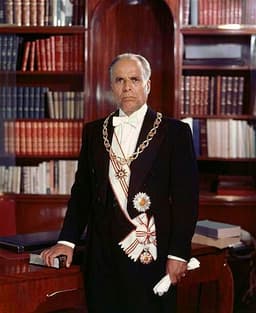
Habib Bourguiba
Politician · Modern
64.4Total
Basic Information
Born
1944
1903
Died
—
2000
Era
Modern
Modern
Nationality
Kyrgyzstan
Tunisia
Occupation
Politician
Politician
Civilization
Eastern
Middle Eastern
Score Comparison
Military (10%)
17.5
39.9
Political (20%)
43.7
82.0
Influence (20%)
49.4
68.0
Legacy (20%)
40.0
55.0
Leadership (15%)
64.0
80.0
Strategy (15%)
32.5
53.8
TOTAL
43.5
64.4
Askar Akayev — Complete Timeline
1991 AD
Elected First President of KyrgyzstanPolitical Action◆ Major
Askar Akayev was elected as the first president of independent Kyrgyzstan after the dissolution of the Soviet Union. He was initially seen as a reformer, promoting democratic reforms and market economics. His early presidency was marked by openness and relative political freedom.
IndependenceDemocratic ReformPost-Soviet Transition
Impact: nationalconstructive
1993 AD
Introduced Democratic ReformsReform◆ Major
Akayev oversaw the adoption of a new constitution that established a parliamentary system with a strong presidency. He implemented economic liberalization, including privatization and land reform. Kyrgyzstan became known as an 'island of democracy' in Central Asia during this period.
Constitutional ReformEconomic LiberalizationDemocracy
Impact: nationalconstructive
2005 AD
Overthrown in the Tulip RevolutionPolitical Action◆ Major
Following disputed parliamentary elections in February 2005, mass protests erupted across Kyrgyzstan. The protests, known as the Tulip Revolution, forced Akayev to flee the country and resign. He was succeeded by Kurmanbek Bakiyev. The revolution was part of the Color Revolution wave in post-Soviet states.
RevolutionRegime ChangeColor Revolution
Impact: nationaldestructive
Exiled to RussiaPolitical Action
After being overthrown, Akayev fled to Russia where he was granted asylum. He settled in Moscow and worked as a professor at Moscow State University. His exile marked the end of his political career, and he remained in Russia for the rest of his life.
ExilePolitical AsylumPost-Presidency
Impact: nationaltragic
Habib Bourguiba — Complete Timeline
1956 AD
Code of Personal StatusReform◆ Major
Bourguiba enacted the Code of Personal Status, a progressive family law that abolished polygamy, established legal minimum age for marriage, and granted women rights to divorce and custody. This reform was unprecedented in the Arab world and modernized Tunisian society.
Women's RightsLegal ReformSocial Change
Impact: nationalprogressive
Tunisian IndependencePolitical Action
Habib Bourguiba led Tunisia to independence from France through a combination of political negotiation and nationalist pressure. He became the first Prime Minister of independent Tunisia, ending 75 years of French protectorate rule.
IndependenceDecolonizationNationalism
Impact: nationalconstructive
1957 AD
Proclamation of the RepublicPolitical Action◆ Major
Bourguiba abolished the Tunisian monarchy and proclaimed the Republic of Tunisia, with himself as President. This move consolidated his power and established a presidential system that would dominate Tunisian politics for decades.
RepublicConstitutional ChangePresidency
Impact: national
1961 AD
Bizerte CrisisWar◆ Major
Bourguiba demanded the evacuation of the French naval base at Bizerte. When negotiations failed, Tunisian forces blockaded the base, leading to a violent confrontation with French troops. The crisis resulted in hundreds of Tunisian casualties and strained Franco-Tunisian relations.
ConflictDecolonizationBizerte
Impact: regionaltragic
1987 AD
Removal from PowerPolitical Action◆ Major
Prime Minister Zine El Abidine Ben Ali removed Bourguiba from office in a bloodless coup, citing his failing health and inability to govern. Bourguiba was placed under house arrest, ending his 30-year presidency and his role as Tunisia's founding father.
CoupSuccessionBen Ali
Impact: nationaltragic
Expert Analysis
Origins
Askar Akayev was born on November 10, 1944, in Kyzyl-Bayrak, a village in the Kyrgyz SSR. His parents were collective farm workers. He excelled in academics, studying engineering and economics at the Leningrad Institute of Precision Mechanics and Optics. He later earned a doctorate in economics and became a professor, serving as vice president of the Kyrgyz Academy of Sciences. His background was technocratic, not political.
Habib Bourguiba was born on August 3, 1903, in Monastir, Tunisia, then a French protectorate. His father was a former army officer. Bourguiba studied at the Sadiki College and later at the University of Paris, where he earned a law degree. He was influenced by French republican ideals and became a journalist and activist for Tunisian independence. His early life was marked by nationalism and legal training.
Rise to Power
Akayev rose to prominence in 1990 when he was elected president of the Kyrgyz SSR by the Supreme Soviet. He was a compromise candidate, not a hardline communist. After the Soviet Union dissolved in 1991, he was elected unopposed as the first president of independent Kyrgyzstan. His early popularity stemmed from his reformist image and opposition to the 1991 coup attempt.
Bourguiba's rise was through the nationalist movement. He founded the Neo Destour party in 1934 and led Tunisia's independence struggle. He was imprisoned multiple times by French authorities. In 1954, negotiations with France led to internal autonomy, and on March 20, 1956, Tunisia gained full independence. Bourguiba became Prime Minister, then President after abolishing the monarchy on July 25, 1957.
Leadership & Governance
Akayev initially pursued democratic reforms: he introduced a new constitution in 1993 that guaranteed human rights and a multiparty system. He implemented economic liberalization, privatizing state enterprises and encouraging foreign investment. However, by the late 1990s, he cracked down on opposition, manipulated elections, and allowed corruption to flourish. His rule became increasingly authoritarian, with his family controlling key sectors.
Bourguiba's governance was characterized by strong centralization and state-led modernization. He enacted the Code of Personal Status in 1956, a landmark reform that abolished polygamy, required divorce by court, and gave women equal rights in education and employment. He promoted secularism, free education, and healthcare. However, he also suppressed political dissent, banned opposition parties, and established a one-party state. His rule was paternalistic and authoritarian.
Triumph & Tragedy
Akayev's triumph was overseeing Kyrgyzstan's peaceful transition from Soviet republic to independent state. He initially gained international praise for democratic reforms. His tragedy was the Tulip Revolution in 2005. After disputed parliamentary elections, massive protests forced him to flee to Russia. He was unable to manage the political crisis and lost power without a fight. His legacy was tarnished by corruption and authoritarian drift.
Bourguiba's greatest triumph was leading Tunisia to independence and enacting progressive social reforms that transformed Tunisian society. His Code of Personal Status remains one of the most progressive in the Arab world. His tragedy was the Bizerte Crisis in 1961, where a confrontation with France over the naval base led to dozens of Tunisian deaths. Also, his later years were marked by declining health, cult of personality, and a coup by his prime minister, Zine El Abidine Ben Ali, in 1987.
Character & Destiny
Akayev was a cautious, academic figure who initially sought reform but lacked the resolve to maintain it. He was more comfortable with theoretical economics than with the rough-and-tumble of politics. His indecisiveness and tolerance of corruption undermined his rule. He scored 32.5 in strategy, reflecting his poor handling of the 2005 crisis.
Bourguiba was charismatic, determined, and visionary. He was known as the 'Supreme Warrior' for his role in independence. He was pragmatic, willing to negotiate with France, but also authoritarian in consolidating power. His leadership score of 80.0 reflects his ability to drive change. However, his refusal to step down led to his overthrow.
Legacy
Akayev's legacy is mixed. He is remembered as Kyrgyzstan's first president who started democratic reforms but ended as a corrupt autocrat. The Tulip Revolution set a precedent for popular uprisings in Central Asia, but his rule did not leave lasting institutions. He scored 40.0 in legacy.
Bourguiba's legacy is profound. He is considered the founder of modern Tunisia. His reforms, especially on women's rights, have had a lasting impact. Tunisia remains the most secular and progressive country in the Arab world. However, his authoritarian methods also set a pattern that his successors followed. He scored 55.0 in legacy.
Conclusion
Habib Bourguiba had a greater impact than Askar Akayev. His total score of 64.4 versus Akayev's 43.5 reflects his higher political acumen, leadership, and influence. Bourguiba transformed Tunisia from a French colony into a modern, relatively stable nation with progressive laws. Akayev, while initially promising, failed to build sustainable democratic institutions and was ousted by a revolution. Bourguiba's reforms endure; Akayev's did not. Thus, Bourguiba is the more consequential leader.
Rankings
🥇
Habib BourguibaLeader
Mil: 39.9Pol: 82.0Inf: 68.0
64.4
🥈
Askar Akayev
Mil: 17.5Pol: 43.7Inf: 49.4
43.5
+20.9 behind
How This Comparison Works
Algorithm
Each figure is scored on 6 dimensions (0—100 scale) based on structured historical data: Military (10%), Political (20%), Influence (20%), Legacy (20%), Leadership (15%), Strategy (15%). The weighted total produces the final ranking.
Data Sources
Scores are computed from structured sub-indicators in the database. Scale factors adjust for era (Ancient ×0.85, Modern ×1.0) and civilization size (Eastern ×1.05, Other ×0.80) to account for differences in population and military scale.
Maximum 3 Figures
Comparisons are limited to 2—3 figures to ensure readability and statistical meaningfulness.
Error Margins
±5 points per dimension — Sub-scores are derived from historical records with inherent uncertainty. Two figures within 5 points on a dimension should be considered roughly equivalent in that area.
Total Score Accuracy
±3 points overall — The weighted combination of 6 dimensions produces a total score with approximately ±3 points of uncertainty. Differences of less than 3 points are not statistically significant— the figures are effectively tied.
Known Limitations
- Historical records are incomplete and uneven across civilizations
- Figures from oral-tradition societies may be underrepresented
- Occupation labels can misclassify multi-role figures
- Scores measure capability and impact, not moral character
- Quantitative scoring is a comparison tool, not absolute truth
Capability Radar
Military (10%) — Battles & Warfare
Battles
12
5
Win Rate
17
5
Expansion
19
5
Political (20%) — Governance & Reform
Reform
40
90
Diplomacy
35
85
Economy
30
75
Influence (20%) — Cultural & Global Reach
Cultural
20
70
Global
15
65
Legacy (20%) — Historical Impact
Historical
25
75
Longevity
15
65
Leadership (15%) — Power & Stability
Tenure
55
85
Stability
20
70
Strategy (15%) — Tactics & Innovation
Strategy
24
5
Tactics
25
5
Reform
30
10
Similar Comparisons
Comments & Discussion
No comments yet. Be the first to share your thoughts!