Loading...
Arnulf of Carinthia vs Julius Caesar
Julius Caesar leads by 31.7 pts · 2 figures compared
…
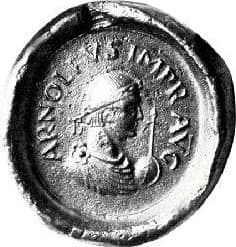
Arnulf of Carinthia
Emperor · Medieval
51.1Total

Julius Caesar
General · Ancient
82.8Total
Basic Information
Born
850
-100
Died
899
-44
Era
Medieval
Ancient
Nationality
East Francia
Roman Republic
Occupation
Emperor
General
Civilization
Western
Western
Score Comparison
Military (10%)
20.0
88.0
Political (20%)
46.6
78.0
Influence (20%)
53.3
85.0
Legacy (20%)
46.7
82.0
Leadership (15%)
74.0
80.0
Strategy (15%)
60.0
85.0
TOTAL
51.1
82.8
Arnulf of Carinthia — Complete Timeline
887 AD
Deposition of Charles the FatPolitical Action
Arnulf played a key role in the deposition of his uncle, Charles the Fat, in 887. As the illegitimate son of Carloman, Arnulf was elected King of East Francia by the nobles, ending the unified Carolingian rule and establishing his own dynasty.
DepositionAccessionEast Francia
Impact: regional
891 AD
Battle of the Dyle (891)War◆ Major
Arnulf of Carinthia led an East Frankish army to victory against Viking raiders at the Battle of the Dyle in present-day Belgium. This victory halted Viking incursions into East Francia and demonstrated Arnulf's military capability, boosting his prestige.
BattleVikingsVictory
Impact: regionalconstructive
892 AD
Campaign against the MagyarsWar◆ Major
Arnulf allied with the Magyars (Hungarians) against the Moravian Empire, inviting them into Central Europe. This decision backfired, as the Magyars later turned on East Francia, launching devastating raids. Arnulf's short-term strategy had long-term negative consequences.
AllianceMagyarsRaids
Impact: regionaldestructive
896 AD
Imperial Coronation (896)Cultural◆ Major
Arnulf was crowned Holy Roman Emperor by Pope Formosus on February 22, 896, in Rome. He had marched into Italy to support the pope against rival factions. His coronation was brief, as he suffered a stroke soon after and returned to East Francia.
CoronationEmperorItaly
Impact: regional
899 AD
Death of Arnulf of CarinthiaOther
Arnulf died on December 8, 899, likely from a stroke. He was succeeded by his young son, Louis the Child, whose weak rule led to further fragmentation and vulnerability to Magyar attacks. Arnulf's reign was marked by military successes but also strategic errors.
DeathSuccessionDecline
Impact: regionaltragic
Julius Caesar — Complete Timeline
58 BC
Gallic WarsWar◆ Major
Caesar, as proconsul of Gaul, launched a series of campaigns that conquered all of Gaul (modern France, Belgium, and parts of Switzerland). He fought numerous battles, including against the Helvetii, the Belgae, and the Gallic chieftain Vercingetorix. The wars brought immense wealth and a loyal army to Caesar.
Gallic WarsConquestRoman Expansion
Impact: regional
49 BC
Crossing the RubiconPolitical Action◆ Major
Caesar led Legio XIII across the Rubicon River into Italy, defying the Roman Senate's order to disband his army. This act triggered a civil war against Pompey and the Optimates, ultimately leading to Caesar's dictatorship and the end of the Roman Republic.
Roman Civil WarEnd of RepublicPower Struggle
Impact: global
48 BC
Battle of PharsalusWar◆ Major
Caesar's outnumbered army defeated the larger forces of Pompey the Great at Pharsalus in Greece. Caesar's tactical use of a reserve line to counter Pompey's cavalry charge proved decisive. Pompey fled to Egypt, where he was assassinated, leaving Caesar as the undisputed master of the Roman world.
Roman Civil WarBattleDecisive Victory
Impact: regional
44 BC
Appointment as Dictator for LifePolitical Action◆ Major
The Roman Senate appointed Caesar dictator perpetuo (dictator for life), granting him unprecedented personal power. This move concentrated military, legislative, and judicial authority in one person, effectively ending the Roman Republic's traditional system of checks and balances and alarming many senators.
DictatorshipEnd of RepublicPower Consolidation
Impact: regionaldestructive
Assassination on the Ides of MarchPolitical Action◆ Major
A group of Roman senators, led by Marcus Junius Brutus and Gaius Cassius Longinus, stabbed Caesar to death at a meeting of the Senate in the Theatre of Pompey. The assassination was intended to restore the Republic, but instead triggered another civil war that led to the rise of the Roman Empire.
AssassinationRoman PoliticsEnd of Republic
Impact: globaldestructive
Expert Analysis
arnulf-of-carinthia-vs-julius-caesar
# The Crossroads of Power: Julius Caesar and Arnulf of Carinthia
On the Ides of March, 44 BCE, a dictator fell beneath the knives of senators who feared his ambition. In December 899, a king who had worn the imperial crown just three years earlier died of a stroke, leaving his realm to a child. Both men—Julius Caesar and Arnulf of Carinthia—stood at the pinnacle of their worlds, yet their names evoke vastly different echoes. Why does one remain an eternal symbol of power and tragedy, while the other is a footnote in medieval chronicles? The answer lies not in the accidents of fate, but in the soil from which they grew, the paths they walked, and the storms they chose to ride—or were crushed by.
Origins
Caesar was born into the twilight of the Roman Republic, a world of senatorial intrigue, civil wars, and the relentless expansion of a Mediterranean empire. His patrician family, the Julii, claimed descent from the goddess Venus, but their political fortunes had waned. His father died when he was sixteen, and young Gaius inherited a name, a debt, and a burning ambition. He grew up in a Rome where men like Marius and Sulla had shown that military glory could rewrite the constitution, and where the old aristocratic order was cracking under the weight of its own corruption.
Arnulf of Carinthia, born in 850, entered a very different world—the fragmented, post-Carolingian landscape of East Francia. He was the illegitimate son of Carloman, king of Bavaria, a stain of birth that would shadow him. The Carolingian Empire, once united under Charlemagne, was dissolving into squabbling kingdoms, with Vikings raiding from the north, Magyars pressing from the east, and the papacy in Rome a pawn of local Italian nobles. Arnulf’s world was one of survival, not glory—where a man’s claim to power rested on swords and oaths, not on divine ancestry or republican institutions.
Rise to Power
Caesar’s ascent was a masterclass in calculated risk. He climbed the Roman political ladder—quaestor, aedile, praetor—but his true springboard was the governorship of Gaul. From 58 to 50 BCE, he led a series of campaigns that subdued the entire region, amassing a loyal army and staggering wealth. The crossing of the Rubicon in 49 BCE was the decisive gamble: a Roman general marching on Rome itself, defying the Senate and triggering a civil war. Caesar won, and by 45 BCE he was dictator for life, the undisputed master of the Roman world.
Arnulf’s path was narrower and more turbulent. In 887, he helped depose his uncle, the hapless Emperor Charles the Fat, who had proven incapable of defending the realm. Arnulf was then elected King of East Francia—not by divine right, but by the consent of powerful nobles who saw him as a strong hand. His coronation as Holy Roman Emperor in 896 was a late-life achievement, secured only after he marched into Italy to support Pope Formosus against rival factions. Unlike Caesar, Arnulf never conquered a continent; he seized a crown that was already crumbling.
Leadership & Governance
As a ruler, Caesar was a revolutionary reformer. He restructured the Roman calendar, redistributed land to veterans, reformed provincial administration, and centralized authority in his own hands. His military genius was legendary—tactical brilliance at Alesia, strategic audacity at Pharsalus—but his political wisdom was equally sharp. He knew that power must be seen as well as wielded, and he cultivated an image of clemency, pardoning former enemies even as he crushed the old order.
Arnulf’s governance was reactive, not visionary. His greatest military success came at the Battle of the Dyle in 891, where he crushed a Viking raiding army in present-day Belgium. But his most consequential decision was an alliance with the Magyars—the same nomadic horsemen who would later ravage Europe. He invited them into Central Europe to fight the Moravian Empire, a short-term expedient that opened a Pandora’s box of future invasions. Arnulf ruled through personal loyalty and feudal bonds, not through institutions or reforms. He held his kingdom together, but he did not transform it.
Triumph & Tragedy
Caesar’s greatest triumph was the conquest of Gaul—a feat that doubled Rome’s territory and made him a living legend. His tragedy was the Ides of March: the assassination by senators who saw him as a tyrant, and the civil wars that followed, which destroyed the Republic he had supposedly saved. In his final moments, he reportedly asked his friend Brutus, “Et tu, Brute?”—a question that has echoed through history.
Arnulf’s triumph was the imperial coronation of 896, a moment when the illegitimate son of a Bavarian king knelt before the pope and rose as successor to Charlemagne. His tragedy was the aftermath: he died three years later, and his son, Louis the Child, was a boy of six. The kingdom descended into chaos, and the Magyars—the very allies Arnulf had summoned—began their devastating raids into Germany. The Carolingian line flickered out in East Francia, and with it, the dream of a unified Christian empire.
Character & Destiny
Caesar was a man of relentless ambition, intellectual curiosity, and cold calculation. He wrote his own commentaries, pardoned his enemies, and slept with his rivals’ wives—all while planning the conquest of Parthia. His personality was a forge that shaped events; he did not merely react to history, he bent it to his will. His assassination was the price of that ambition, but his name became synonymous with imperial power.
Arnulf was a survivor, not a visionary. He fought Vikings, deposed an emperor, and secured a crown, but his decisions were always defensive, aimed at holding the line. He allied with Magyars because he needed allies; he marched to Rome because he needed legitimacy. His character was shaped by illegitimacy and a fractured world, where trust was scarce and tomorrow uncertain. He did not shape destiny—he rode it, and it broke him.
Legacy
Caesar’s legacy is immortal. His name became a title—Kaiser, Tsar—and his reforms laid the foundation for the Roman Empire that would endure for centuries. His writings are studied in military academies, his life dramatized in plays and films, his death a cautionary tale about power and betrayal. He scored 83.3 overall, a testament to his enduring influence across military, political, and cultural spheres.
Arnulf’s legacy is faint. He held the line against Vikings, but his alliance with the Magyars unleashed a plague. His imperial coronation was a flicker, not a flame. His overall score of 64.7 reflects a ruler who was competent but not transformative. He is remembered, if at all, as a Carolingian king who tried to hold the center while the empire dissolved around him.
Conclusion
Standing at the crossroads of history, Caesar and Arnulf faced the same elemental question: how to seize power and hold it. Caesar chose to expand, reform, and risk everything; Arnulf chose to defend, ally, and endure. One remade the world; the other was remade by it. Their divergent fates remind us that greatness is not merely a matter of talent or timing, but of the scale of one’s ambition and the depth of one’s vision. Caesar’s tragedy was that he reached too high; Arnulf’s tragedy was that he could not reach higher. In the end, history remembers not just what we do, but how far we dare to go.
Rankings
🥇
Julius CaesarLeader
Mil: 88.0Pol: 78.0Inf: 85.0
82.8
🥈
Arnulf of Carinthia
Mil: 20.0Pol: 46.6Inf: 53.3
51.1
+31.7 behind
How This Comparison Works
Algorithm
Each figure is scored on 6 dimensions (0—100 scale) based on structured historical data: Military (10%), Political (20%), Influence (20%), Legacy (20%), Leadership (15%), Strategy (15%). The weighted total produces the final ranking.
Data Sources
Scores are computed from structured sub-indicators in the database. Scale factors adjust for era (Ancient ×0.85, Modern ×1.0) and civilization size (Eastern ×1.05, Other ×0.80) to account for differences in population and military scale.
Maximum 3 Figures
Comparisons are limited to 2—3 figures to ensure readability and statistical meaningfulness.
Error Margins
±5 points per dimension — Sub-scores are derived from historical records with inherent uncertainty. Two figures within 5 points on a dimension should be considered roughly equivalent in that area.
Total Score Accuracy
±3 points overall — The weighted combination of 6 dimensions produces a total score with approximately ±3 points of uncertainty. Differences of less than 3 points are not statistically significant— the figures are effectively tied.
Known Limitations
- Historical records are incomplete and uneven across civilizations
- Figures from oral-tradition societies may be underrepresented
- Occupation labels can misclassify multi-role figures
- Scores measure capability and impact, not moral character
- Quantitative scoring is a comparison tool, not absolute truth
Capability Radar
Military (10%) — Battles & Warfare
Battles
45
95
Win Rate
40
92
Expansion
40
97
Political (20%) — Governance & Reform
Reform
35
90
Diplomacy
55
85
Economy
40
82
Influence (20%) — Cultural & Global Reach
Cultural
30
88
Global
30
94
Legacy (20%) — Historical Impact
Historical
45
95
Longevity
35
96
Leadership (15%) — Power & Stability
Tenure
60
75
Stability
45
60
Strategy (15%) — Tactics & Innovation
Strategy
55
94
Tactics
50
96
Reform
30
88
Similar Comparisons
Comments & Discussion
WARGENIUS6/17/2026
Caesar's campaigns were textbook brilliance—he conquered Gaul with calculated logistics and political savvy. Arnulf? He won one major battle against the Vikings at Leuven and then called it a career. You can't compare a general who redefined military strategy across multiple theaters to a footnote king who barely held East Francia together.
旧梦罗马6/17/2026
恺撒和阿尔努夫放在一起比,就像拿屠龙刀跟水果刀比杀伤力。恺撒围困阿莱西亚,十万高卢人围城都挡不住。阿尔努夫这辈子打过最漂亮的仗是顶住诺曼人,连意大利都没站住脚。这比较本身就是在贬低罗马史的分量。
REALMCrafter6/17/2026
As a medievalist, I'd argue Arnulf actually accomplished more relative to his circumstances. He stabilized a dying Carolingian dynasty against Magyar and Viking invasions with no institutional support. Caesar inherited a functioning Republic with legions at his back. Arnulf's 891 campaign at Leuven took initiative, while Caesar's Gallic Wars were brilliantly executed but fought against culturally inferior foes.
笔记黑匣6/17/2026
说阿尔努夫比恺撒重要,那得有选择性失忆症。恺撒留下的《高卢战记》本身就是历史坐标,阿尔努夫连自己亲笔信都没几封留下来。历史影响力从来不是靠运气,是看谁用文字给后世盖了墙。一个中世纪地方王,凭什么跟改写世界史的人并肩?
Historian1506/17/2026
The stats are clear: Caesar conquered 800+ cities, fought 50+ major battles, and reshaped Roman governance. Arnulf ruled 8 years and left zero administrative reforms. If we're measuring by objective impact, Caesar wins in every category—military, political, cultural. Arnulf is a regional curiosity, not a historical heavyweight.