Loading...
This comparison has not been analyzed yet.
One-time AI generation (~1 minute). Scores and timeline are already available below.
Arsinoe IV of Egypt vs Ptolemy V Epiphanes
Ptolemy V Epiphanes leads by 1.1 pts · 2 figures compared
…
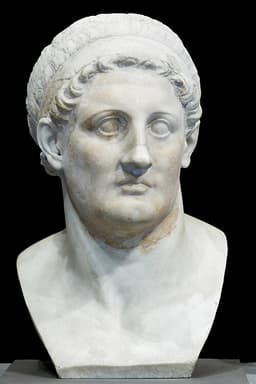
Arsinoe IV of Egypt
Emperor · Ancient
40.7Total

Ptolemy V Epiphanes
Emperor · Ancient
41.8Total
Basic Information
Born
-68
-210
Died
-41
-180
Era
Ancient
Ancient
Nationality
Ptolemaic Egypt
Ptolemaic Kingdom
Occupation
Emperor
Emperor
Civilization
Middle Eastern
Middle Eastern
Score Comparison
Military (10%)
36.0
10.2
Political (20%)
40.8
29.3
Influence (20%)
42.4
54.9
Legacy (20%)
32.5
52.0
Leadership (15%)
45.0
34.6
Strategy (15%)
54.9
45.0
TOTAL
40.7
41.8
Arsinoe IV of Egypt — Complete Timeline
48 BC
Role in the Alexandrian WarWar◆ Major
Arsinoe IV escaped from the royal palace during the Alexandrian War between Julius Caesar and Ptolemy XIII. She joined the Egyptian army opposing Caesar and was proclaimed queen by the forces of Achillas.
Alexandrian WarPtolemaic Dynasty
Impact: regional
Command of the Egyptian armyWar◆ Major
Arsinoe IV, with her advisor Ganymedes, took command of the Egyptian forces besieging Caesar in Alexandria. She organized the defense and directed military operations against the Romans, prolonging the conflict.
Alexandrian WarMilitary Command
Impact: regional
47 BC
Capture and exile to the Temple of ArtemisPolitical Action◆ Major
After Caesar's victory in the Alexandrian War, Arsinoe IV was captured and taken to Rome. She was paraded in Caesar's triumph but spared execution; instead, she was exiled to the Temple of Artemis at Ephesus.
ExileRoman Triumph
Impact: regionaltragic
41 BC
Execution by Mark AntonyPolitical Action◆ Major
At the request of Cleopatra VII, Mark Antony ordered the execution of Arsinoe IV at the Temple of Artemis in Ephesus. Her death removed a rival claimant to the Ptolemaic throne and eliminated a threat to Cleopatra's rule.
ExecutionPtolemaic DynastyCleopatra
Impact: regionaltragic
Ptolemy V Epiphanes — Complete Timeline
198 BC
Loss of Coele-Syria to the SeleucidsWar◆ Major
Ptolemy V lost the province of Coele-Syria to the Seleucid king Antiochus III after the Battle of Panium. This defeat marked the end of Ptolemaic control over the region and significantly reduced the kingdom's territory and influence.
Territorial LossSeleucid WarDecline
Impact: regionaltragic
196 BC
Inscription of the Rosetta StoneCultural
The Rosetta Stone was inscribed with a decree from the Council of Priests at Memphis, praising Ptolemy V. The text was written in hieroglyphic, demotic, and Greek scripts, later enabling the decipherment of Egyptian hieroglyphs by Jean-Fran
Rosetta StoneDeciphermentEgyptology
Impact: globalconstructive
193 BC
Marriage to Cleopatra I SyraPolitical Action
Ptolemy V married Cleopatra I, daughter of Antiochus III, as part of a peace treaty ending the Fifth Syrian War. The marriage temporarily stabilized relations between the Ptolemaic and Seleucid kingdoms, but Cleopatra later acted as regent for their son.
Diplomatic MarriagePeace TreatySeleucid Alliance
Impact: regionalconstructive
186 BC
Suppression of the Egyptian RevoltWar◆ Major
Ptolemy V's forces finally crushed the native Egyptian revolt that had begun under Ptolemy IV. The rebel leader Ankhmakis was captured and executed, restoring Ptolemaic control over Upper Egypt but at the cost of further alienating the Egyptian population.
Native RevoltSuppressionUpper Egypt
Impact: nationaldestructive
This comparison has not been analyzed yet.
One-time AI generation (~1 minute). Scores and timeline are already available below.
Rankings
🥇
Ptolemy V EpiphanesLeader
Mil: 10.2Pol: 29.3Inf: 54.9
41.8
🥈
Arsinoe IV of Egypt
Mil: 36.0Pol: 40.8Inf: 42.4
40.7
+1.1 behind
How This Comparison Works
Algorithm
Each figure is scored on 6 dimensions (0—100 scale) based on structured historical data: Military (10%), Political (20%), Influence (20%), Legacy (20%), Leadership (15%), Strategy (15%). The weighted total produces the final ranking.
Data Sources
Scores are computed from structured sub-indicators in the database. Scale factors adjust for era (Ancient ×0.85, Modern ×1.0) and civilization size (Eastern ×1.05, Other ×0.80) to account for differences in population and military scale.
Maximum 3 Figures
Comparisons are limited to 2—3 figures to ensure readability and statistical meaningfulness.
Error Margins
±5 points per dimension — Sub-scores are derived from historical records with inherent uncertainty. Two figures within 5 points on a dimension should be considered roughly equivalent in that area.
Total Score Accuracy
±3 points overall — The weighted combination of 6 dimensions produces a total score with approximately ±3 points of uncertainty. Differences of less than 3 points are not statistically significant— the figures are effectively tied.
Known Limitations
- Historical records are incomplete and uneven across civilizations
- Figures from oral-tradition societies may be underrepresented
- Occupation labels can misclassify multi-role figures
- Scores measure capability and impact, not moral character
- Quantitative scoring is a comparison tool, not absolute truth
Capability Radar
Military (10%) — Battles & Warfare
Battles
40
5
Win Rate
40
5
Expansion
43
5
Political (20%) — Governance & Reform
Reform
0
10
Diplomacy
10
20
Economy
0
10
Influence (20%) — Cultural & Global Reach
Cultural
5
40
Global
5
50
Legacy (20%) — Historical Impact
Historical
10
60
Longevity
5
70
Leadership (15%) — Power & Stability
Tenure
5
30
Stability
0
10
Strategy (15%) — Tactics & Innovation
Strategy
44
5
Tactics
52
5
Reform
54
5
Similar Comparisons
Comments & Discussion
No comments yet. Be the first to share your thoughts!