Loading...
Arsinoe IV of Egypt vs Napoleon Bonaparte
Napoleon Bonaparte leads by 30.2 pts · 2 figures compared
…
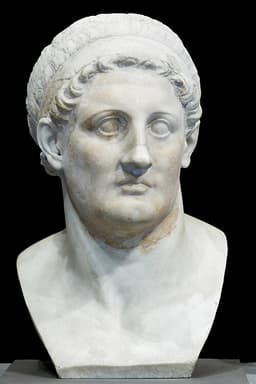
Arsinoe IV of Egypt
Emperor · Ancient
40.7Total

Napoleon Bonaparte
General · Modern
70.9Total
Basic Information
Born
-68
1769
Died
-41
1821
Era
Ancient
Modern
Nationality
Ptolemaic Egypt
France
Occupation
Emperor
General
Civilization
Middle Eastern
Western
Score Comparison
Military (10%)
36.0
94.0
Political (20%)
40.8
72.0
Influence (20%)
42.4
40.0
Legacy (20%)
32.5
80.0
Leadership (15%)
45.0
78.0
Strategy (15%)
54.9
90.0
TOTAL
40.7
70.9
Arsinoe IV of Egypt — Complete Timeline
48 BC
Role in the Alexandrian WarWar◆ Major
Arsinoe IV escaped from the royal palace during the Alexandrian War between Julius Caesar and Ptolemy XIII. She joined the Egyptian army opposing Caesar and was proclaimed queen by the forces of Achillas.
Alexandrian WarPtolemaic Dynasty
Impact: regional
Command of the Egyptian armyWar◆ Major
Arsinoe IV, with her advisor Ganymedes, took command of the Egyptian forces besieging Caesar in Alexandria. She organized the defense and directed military operations against the Romans, prolonging the conflict.
Alexandrian WarMilitary Command
Impact: regional
47 BC
Capture and exile to the Temple of ArtemisPolitical Action◆ Major
After Caesar's victory in the Alexandrian War, Arsinoe IV was captured and taken to Rome. She was paraded in Caesar's triumph but spared execution; instead, she was exiled to the Temple of Artemis at Ephesus.
ExileRoman Triumph
Impact: regionaltragic
41 BC
Execution by Mark AntonyPolitical Action◆ Major
At the request of Cleopatra VII, Mark Antony ordered the execution of Arsinoe IV at the Temple of Artemis in Ephesus. Her death removed a rival claimant to the Ptolemaic throne and eliminated a threat to Cleopatra's rule.
ExecutionPtolemaic DynastyCleopatra
Impact: regionaltragic
Napoleon Bonaparte — Complete Timeline
1799 AD
Coup of 18 BrumaireOther◆ Major
Napoleon Bonaparte, with support from his brother Lucien and key political figures, overthrew the Directory in a bloodless coup. He established the Consulate with himself as First Consul, effectively becoming the ruler of France. This event ended the French Revolution's most unstable period.
French RevolutionCoupRise to Power
Impact: regional
1804 AD
Promulgation of the Napoleonic CodeOther◆ Major
Napoleon enacted the Civil Code of the French, known as the Napoleonic Code, a comprehensive set of laws that replaced the fragmented feudal legal systems. The code established legal equality, protected property rights, and secularized law. It became the basis for legal systems in many European and world countries.
Legal ReformNapoleonic CodeCivil Law
Impact: globalconstructive
1805 AD
Battle of AusterlitzWar◆ Major
Napoleon's Grande Arm
Napoleonic WarsBattleDecisive Victory
Impact: global
1812 AD
Invasion of RussiaWar◆ Major
Napoleon led the Grande Arm
Napoleonic WarsInvasionDisaster
Impact: globaldestructive
1815 AD
Battle of WaterlooWar◆ Major
Napoleon's French army was defeated by the combined forces of the Duke of Wellington's Anglo-Allied army and Gebhard Leberecht von Bl
Napoleonic WarsBattleFinal Defeat
Impact: globaldestructive
Expert Analysis
arsinoe-iv-of-egypt-vs-napoleon-bonaparte
# The Conqueror and the Forgotten Queen
In the summer of 47 BC, a teenage princess was dragged through the streets of Rome in golden chains, a trophy for Julius Caesar’s triumph. Less than two thousand miles away and eighteen centuries later, a young artillery officer from Corsica would stand before the same city’s ancient ruins, dreaming of an empire that would dwarf Caesar’s own. Arsinoe IV of Egypt and Napoleon Bonaparte never met, never could have met, yet their lives pose a haunting question: why do some figures reshape the world while others vanish into its footnotes? The answer lies not in talent alone, but in the brutal alchemy of timing, circumstance, and the unforgiving logic of power.
Origins
Arsinoe IV was born around 68 BC into the murderous house of Ptolemy, a Greek dynasty ruling Egypt. Her father, Ptolemy XII, left a kingdom rotten with court intrigue, where siblings killed siblings as casually as they changed advisors. She grew up watching Cleopatra, her older sister, manipulate Rome’s mightiest men. This was a world where a woman’s survival depended on her ability to read the shifting winds of power—and to strike before the wind changed.
Napoleon, by contrast, was born in 1769 on Corsica, an island only recently conquered by France. His family were minor nobles, poor and resentful of French rule. He spoke Italian before French, and his childhood was shaped by the humiliations of a conquered people. Yet the French Revolution, which began when he was twenty, shattered the old order and opened paths that had been sealed for centuries. A Corsican outsider could now rise through merit, not birth. The Revolution gave him a stage; his genius gave him the script.
Rise to Power
Arsinoe’s rise was a desperate gamble. In 48 BC, as Julius Caesar arrived in Alexandria to mediate the civil war between Cleopatra and their brother Ptolemy XIII, Arsinoe escaped the palace. She joined the Egyptian army, and with her advisor Ganymedes, took command of the forces besieging Caesar in the city. For a few months, she was the military leader of Egypt, organizing defenses that nearly killed the most powerful man in the world. But she was a teenager in a man’s game, and her army fractured. When Caesar broke the siege, Arsinoe was captured, paraded in his triumph, and exiled to the Temple of Artemis in Ephesus—alive, but finished.
Napoleon’s ascent was a masterclass in seizing opportunity. In 1793, at age twenty-four, he drove the British out of Toulon with a daring artillery plan. By 1796, he commanded the Army of Italy, where his lightning campaigns humiliated the Austrians. Each victory fed the next. He was not just a general; he was a political entrepreneur, using military glory as currency to buy influence. The coup of 18 Brumaire in 1799 made him First Consul. By 1804, he crowned himself Emperor. Where Arsinoe had only desperation, Napoleon had a revolution that had already broken the old rules.
Leadership & Governance
Arsinoe’s leadership was tactical, not strategic. She could organize a siege but not a kingdom. Her command of the Egyptian army showed courage and intelligence, but she lacked the political base to sustain power. She was a rebel without a state, a queen without a treasury. Her governance, if she had any, was the governance of a camp—temporary, brittle, dependent on the loyalty of a single general.
Napoleon, for all his flaws, understood that war and politics were two sides of the same coin. He reformed French law through the Napoleonic Code, creating a uniform legal system that ended feudalism and enshrined meritocracy. He established the Bank of France, stabilized the currency, and built schools, roads, and canals. His military genius—rated 94 in strategy—was matched by a political shrewdness that allowed him to turn conquered states into allied kingdoms. He did not just win battles; he built institutions.
Yet the same ambition that lifted him also blinded him. He invaded Russia in 1812 with 600,000 men and returned with fewer than 100,000. He refused peace offers when his empire was still intact. His political score of 75 reflects a man who could govern but could not restrain himself.
Triumph & Tragedy
Arsinoe’s greatest moment—commanding the siege of Caesar—is also her tragedy. She came closer than almost anyone to killing Caesar before the Ides of March, but her victory was stolen, her name erased. In 41 BC, at Cleopatra’s request, Mark Antony had her dragged from the Temple of Artemis and executed. She was twenty-seven. Her body was thrown into the sea. The world moved on.
Napoleon’s triumph was Austerlitz in 1805, where he destroyed the Russian and Austrian armies in a single day. His tragedy was Waterloo in 1815, a battle he should have won but lost through a combination of bad luck, stubborn subordinates, and his own overreach. He died in exile on Saint Helena in 1821, a prisoner of the British, his empire dissolved. But he died knowing he had changed Europe forever.
Character & Destiny
Arsinoe was brave, intelligent, and utterly alone. She had no network, no patron, no ideology to rally behind. She was a Ptolemaic princess in a world where Rome had already decided Egypt’s fate. Her personality—proud, defiant, unwilling to submit—sealed her doom. She could not bend, so she broke.
Napoleon was also proud and defiant, but he had the fortune of timing. He arrived when the old order was collapsing and the new one had not yet hardened. His character—restless, ambitious, relentless—was perfectly suited to an era of chaos. He created his own destiny because the world around him was still molten. Arsinoe lived in a world already cast in iron.
Legacy
Arsinoe’s legacy is almost invisible. She appears in a few ancient texts, a footnote in Cleopatra’s story. Her scores—43.9 total—reflect a life cut short, a potential unrealized. She is remembered, if at all, as a victim, not a force.
Napoleon’s legacy is everywhere. The Napoleonic Code shapes the legal systems of dozens of countries. His military tactics are still studied. His influence score of 82 places him among the most consequential figures in history. He is remembered as both a liberator and a tyrant, a genius and a cautionary tale.
Conclusion
Standing at the Temple of Artemis in Ephesus, where Arsinoe was murdered, one feels only silence. Standing at the Arc de Triomphe in Paris, one feels the weight of a man who bent a century to his will. The difference between them is not talent—both were gifted. It is not courage—both were brave. The difference is the stage. Arsinoe was born into a world that had no room for her ambition. Napoleon was born into a world that demanded it. History is not always just. But it is always telling.
Rankings
🥇
Napoleon BonaparteLeader
Mil: 94.0Pol: 72.0Inf: 40.0
70.9
🥈
Arsinoe IV of Egypt
Mil: 36.0Pol: 40.8Inf: 42.4
40.7
+30.2 behind
How This Comparison Works
Algorithm
Each figure is scored on 6 dimensions (0—100 scale) based on structured historical data: Military (10%), Political (20%), Influence (20%), Legacy (20%), Leadership (15%), Strategy (15%). The weighted total produces the final ranking.
Data Sources
Scores are computed from structured sub-indicators in the database. Scale factors adjust for era (Ancient ×0.85, Modern ×1.0) and civilization size (Eastern ×1.05, Other ×0.80) to account for differences in population and military scale.
Maximum 3 Figures
Comparisons are limited to 2—3 figures to ensure readability and statistical meaningfulness.
Error Margins
±5 points per dimension — Sub-scores are derived from historical records with inherent uncertainty. Two figures within 5 points on a dimension should be considered roughly equivalent in that area.
Total Score Accuracy
±3 points overall — The weighted combination of 6 dimensions produces a total score with approximately ±3 points of uncertainty. Differences of less than 3 points are not statistically significant— the figures are effectively tied.
Known Limitations
- Historical records are incomplete and uneven across civilizations
- Figures from oral-tradition societies may be underrepresented
- Occupation labels can misclassify multi-role figures
- Scores measure capability and impact, not moral character
- Quantitative scoring is a comparison tool, not absolute truth
Capability Radar
Military (10%) — Battles & Warfare
Battles
40
95
Win Rate
40
90
Expansion
43
95
Political (20%) — Governance & Reform
Reform
0
95
Diplomacy
10
80
Economy
0
85
Influence (20%) — Cultural & Global Reach
Cultural
5
85
Global
5
90
Legacy (20%) — Historical Impact
Historical
10
95
Longevity
5
90
Leadership (15%) — Power & Stability
Tenure
5
85
Stability
0
70
Strategy (15%) — Tactics & Innovation
Strategy
44
95
Tactics
52
98
Reform
54
92
Similar Comparisons
Comments & Discussion
TheSpartanStrategist6/17/2026
The real difference here isn’t talent but institutional support. Napoleon had a revolutionary military machine with standardized artillery, centralized logistics, and a meritocratic officer corps. Arsinoe IV commanded fragmented Egyptian forces against Roman legions backed by an empire-spanning supply chain. Put Napoleon in her sandals against Caesar’s veterans, and he’d be just another footnote—the revolution’s tactics needed revolutionary infrastructure. History remembers winners with systems,
数据侦探6/17/2026
你们都在谈命运,却忽略了数据可比性问题。Arsinoe IV 的“失败”纯粹是样本偏差——我们只记录了她两次政变未遂,却有多少类似规模的叛乱根本未被史书记载?拿破仑失败的战役(如入侵俄国)也被选择性遗忘。拿两个不平等的样本仓促比较,结论站不住脚。需要控制变量才配谈“为什么”。
Caesar'sGhost6/17/2026
Hold your horses, classicists. The core comparison is about opportunity cost, not military genius. Arsinoe IV led a coalition against Caesar during the Alexandrian War—an event that nearly killed Rome’s greatest general. If she’d won, the entire Roman timeline shifts. Napoleon’s victories were impressive, but he never faced an existential threat to his civilization’s core. She was one battle away from rewriting history. That’s not a footnote—that’s a cliffhanger.
野史厨6/17/2026
拿破仑厉害在他懂得给自己写剧本。他搞了多少宣传战役?从埃及远征的“科学考察”到《拿破仑法典》的伟光正包装。而 Arsinoe IV 的对手是更会搞公关的克娄巴特拉——罗马史书全是赢家写的。要是让拿破仑活在托勒密宫廷,他也会被写成“那个叛乱的妹妹”。传播学才是真正的权力,不是剑。
RevolutionaryAntithesis6/17/2026
Every defense of Arsinoe IV reeks of romanticism. She lost because she made worse strategic decisions—pointing her loyal general Ganymedes at open battle instead of exploiting Caesar’s supply crisis through a prolonged siege. Napoleon’s brilliance was recognizing that battles are won by logistics and timing, not desperation. He would have starved Caesar out. She tried to storm the lighthouse. That’s not circumstance—that’s a choice.