Loading...
Ashot I of Armenia vs Julius Caesar
Julius Caesar leads by 24.9 pts · 2 figures compared
…
Ashot I of Armenia
Emperor · Medieval
57.9Total

Julius Caesar
General · Ancient
82.8Total
Basic Information
Born
820
-100
Died
890
-44
Era
Medieval
Ancient
Nationality
Armenia
Roman Republic
Occupation
Emperor
General
Civilization
Middle Eastern
Western
Score Comparison
Military (10%)
55.0
88.0
Political (20%)
68.0
78.0
Influence (20%)
57.2
85.0
Legacy (20%)
49.2
82.0
Leadership (15%)
74.0
80.0
Strategy (15%)
45.0
85.0
TOTAL
57.9
82.8
Ashot I of Armenia — Complete Timeline
885 AD
Recognition as King of Armenia by the Abbasid CaliphatePolitical Action◆ Major
The Abbasid Caliphate formally recognized Ashot I as King of Armenia, ending centuries of Arab rule. This recognition, followed by similar recognition from the Byzantine Empire, established the Bagratuni Kingdom of Armenia as a sovereign state.
RecognitionIndependenceBagratuni
Impact: regionalconstructive
Coronation as King of ArmeniaPolitical Action◆ Major
Ashot I was crowned King of Armenia in a ceremony that combined Byzantine and Armenian traditions. This coronation marked the formal restoration of the Armenian monarchy after centuries of foreign domination.
CoronationMonarchyRestoration
Impact: nationalconstructive
886 AD
Alliance with the Byzantine EmpirePolitical Action
Ashot I established a diplomatic alliance with the Byzantine Emperor Basil I. This alliance provided Armenia with Byzantine support against common enemies, particularly the Abbasid Caliphate, and facilitated cultural and economic exchange.
AllianceByzantine EmpireDiplomacy
Impact: regionalconstructive
890 AD
Defeat of the Sajid EmirateWar
Ashot I led a military campaign against the Sajid Emirate, a Muslim dynasty that threatened Armenian territory. His victory secured the eastern borders of his kingdom and demonstrated the military strength of the new Bagratuni state.
BattleSajidDefense
Impact: regionalconstructive
Julius Caesar — Complete Timeline
58 BC
Gallic WarsWar◆ Major
Caesar, as proconsul of Gaul, launched a series of campaigns that conquered all of Gaul (modern France, Belgium, and parts of Switzerland). He fought numerous battles, including against the Helvetii, the Belgae, and the Gallic chieftain Vercingetorix. The wars brought immense wealth and a loyal army to Caesar.
Gallic WarsConquestRoman Expansion
Impact: regional
49 BC
Crossing the RubiconPolitical Action◆ Major
Caesar led Legio XIII across the Rubicon River into Italy, defying the Roman Senate's order to disband his army. This act triggered a civil war against Pompey and the Optimates, ultimately leading to Caesar's dictatorship and the end of the Roman Republic.
Roman Civil WarEnd of RepublicPower Struggle
Impact: global
48 BC
Battle of PharsalusWar◆ Major
Caesar's outnumbered army defeated the larger forces of Pompey the Great at Pharsalus in Greece. Caesar's tactical use of a reserve line to counter Pompey's cavalry charge proved decisive. Pompey fled to Egypt, where he was assassinated, leaving Caesar as the undisputed master of the Roman world.
Roman Civil WarBattleDecisive Victory
Impact: regional
44 BC
Appointment as Dictator for LifePolitical Action◆ Major
The Roman Senate appointed Caesar dictator perpetuo (dictator for life), granting him unprecedented personal power. This move concentrated military, legislative, and judicial authority in one person, effectively ending the Roman Republic's traditional system of checks and balances and alarming many senators.
DictatorshipEnd of RepublicPower Consolidation
Impact: regionaldestructive
Assassination on the Ides of MarchPolitical Action◆ Major
A group of Roman senators, led by Marcus Junius Brutus and Gaius Cassius Longinus, stabbed Caesar to death at a meeting of the Senate in the Theatre of Pompey. The assassination was intended to restore the Republic, but instead triggered another civil war that led to the rise of the Roman Empire.
AssassinationRoman PoliticsEnd of Republic
Impact: globaldestructive
Expert Analysis
ashot-i-of-armenia-vs-julius-caesar
# The Duel of Destiny: Caesar and Ashot, Two Roads to Power
The Ides of March dawned grey over Rome in 44 BCE. Julius Caesar, dictator for life, entered the Senate chamber at the Theatre of Pompey, unaware that sixty senators had hidden daggers beneath their togas. Within minutes, he would fall, bleeding from twenty-three wounds. Nearly a thousand years later, in 885 CE, on the slopes of Mount Ararat, a very different coronation unfolded. Ashot I of Armenia knelt before a Byzantine crown and an Abbasid decree, two empires that had once devoured his homeland now competing to bless his kingship. One man died because he had seized too much power. Another lived to restore his nation because he knew exactly how much power to accept. What drove these two fates—and what does it tell us about the nature of leadership itself?
Origins
Julius Caesar was born into the twilight of the Roman Republic, a patrician from the ancient Julian clan that claimed descent from the goddess Venus. His Rome was a cauldron of civil strife: populists versus optimates, generals versus senators, the poor demanding land and the rich hoarding it. Caesar grew up watching his uncle Gaius Marius purge rivals, then saw Sulla massacre Marius’s supporters in return. Violence was the language of Roman politics, and Caesar learned it fluently.
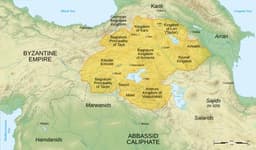
Ashot I of Armenia emerged from a very different world. Born in 820 CE, he was the son of a prince in a land that had not known true independence for over three centuries. Armenia had been crushed between the Byzantine Empire and the Abbasid Caliphate, its nobles forced to serve as vassals, its churches taxed into submission. Ashot’s father Smbat had fought to preserve Bagratuni lands, but the family’s survival depended on tribute, patience, and a deep understanding of when to bow. Where Caesar inherited ambition, Ashot inherited endurance.
Rise to Power
Caesar’s path was a sprint. At thirty-seven, he formed the First Triumvirate with Pompey and Crassus, then secured command of Gaul. Over eight years, he conquered a territory larger than Italy, crossing the Rhine and the English Channel, and amassed an army fanatically loyal to him—not to Rome. When the Senate ordered him to disband, he crossed the Rubicon River in 49 BCE, a deliberate act of war. “The die is cast,” he reportedly said, and within four years he had defeated Pompey, crushed his enemies, and declared himself dictator for life. Power was something Caesar took.
Ashot’s rise was a patient chess game. In the 860s, Armenia was still a patchwork of feuding princely states under Arab governors. Ashot did not conquer; he cultivated. He married his daughter to the son of the Byzantine emperor Basil I, and sent his own son as a hostage to the Abbasid court—not as a sign of weakness, but of trust. He played the two empires against each other, offering each just enough loyalty to make them prefer him over the other. In 885, the Abbasid Caliph al-Mu’tamid formally recognized Ashot as King of Armenia, and the Byzantine emperor quickly followed. Ashot did not cross a river; he built a bridge between two worlds.
Leadership & Governance
Caesar governed as he conquered: with speed, brilliance, and absolute control. He reformed the calendar, granted citizenship to provincials, launched public works, and packed the Senate with his supporters. His military genius was unmatched—at Alesia in 52 BCE, he besieged a Gallic army while simultaneously building defenses against a relief force, winning both battles. But his political wisdom was brittle. He accepted a crown offered by Mark Antony, put his image on coins while the Republic was still alive, and treated the Senate as a rubber stamp. He saw governance as the extension of war by other means.
Ashot ruled as a restorer, not a conqueror. His military score is modest—40.2—because he fought few battles. His victory over the Sajid Emirate in 890 was defensive, a campaign to push back a Muslim dynasty that threatened Armenian soil. What he excelled at was political architecture. He rebuilt the Armenian Church as a national institution, negotiated tax exemptions from both caliph and emperor, and established a system where local *nakharars* (nobles) kept their lands in exchange for loyalty. His coronation in 885 combined Byzantine ritual with Armenian tradition, a deliberate fusion that said: *we are neither Greek nor Arab; we are Armenian.* Where Caesar centralized, Ashot federated.
Triumph & Tragedy
Caesar’s greatest moment was his triumph: the conquest of Gaul, the defeat of Pompey, the title of dictator for life. His tragedy was that he could not stop winning. He had destroyed every external enemy, only to discover that the Republic’s institutions were the final enemy. By making himself indispensable, he made himself intolerable. The senators who killed him did not hate him; they feared that Rome would become a monarchy. Caesar’s tragedy was that he was right—the Republic was already dead—but he could not convince anyone else.
Ashot’s triumph was quieter but deeper: he gave Armenia a king after three centuries of foreign rule. His tragedy was that he built a kingdom that would not survive him. The Bagratuni dynasty lasted only until 1045, when Byzantium finally annexed Armenia. Ashot had balanced two empires, but his successors lacked his patience. Within a generation, internal feuds and external pressures would unravel what he had woven. He died in 890, after a reign of only five years as king, having spent decades preparing for a crown he wore too briefly.
Character & Destiny
Caesar was a man of fire—impatient, brilliant, and reckless. He pardoned his enemies, then gave them power; he trusted that his charm and victories would make men forget that he had overthrown their system. He was wrong. His personality drove him to push further, faster, until there was nowhere left to go but the Senate floor with daggers in his chest.
Ashot was a man of water—patient, shrewd, and self-contained. He knew that a kingdom restored by diplomacy could be lost by war. He accepted a lower military profile because he understood that Armenian independence depended on the goodwill of powers that could crush it. His personality was his strategy: he was the man who could smile at an Abbasid vizier and a Byzantine bishop in the same day, and make both believe he was their ally.
Legacy
Caesar’s legacy is the Roman Empire. His adopted heir Octavian became Augustus; his name became a title: *Kaiser*, *Tsar*. He is remembered as the man who ended the Republic and began something new, for better or worse. His writings—the *Commentaries on the Gallic War*—are still read as military classics. His assassination is the most famous political murder in history.
Ashot’s legacy is Armenian identity. He is remembered as the founder of the Bagratuni kingdom, the man who proved that Armenia could exist as a sovereign state between empires. His coronation is a national holiday in modern Armenia. But his name is little known outside the Caucasus. He did not conquer an empire or write a memoir; he simply kept a small nation alive.
Conclusion
Standing at the crossroads of history, Caesar and Ashot ask us the same question: what does it mean to lead? Caesar answered with conquest, Ashot with conservation. Caesar’s path led to glory and a bloody end; Ashot’s led to a brief flowering and a slow decline. Neither was wrong, and neither was fully right. The difference between them was not talent—both were extraordinary men—but context. Caesar lived in a world that rewarded the man who seized everything. Ashot lived in a world that rewarded the man who seized nothing more than what his people needed. One changed the world by breaking it. The other changed the world by holding it together.
Rankings
🥇
Julius CaesarLeader
Mil: 88.0Pol: 78.0Inf: 85.0
82.8
🥈
Ashot I of Armenia
Mil: 55.0Pol: 68.0Inf: 57.2
57.9
+24.9 behind
How This Comparison Works
Algorithm
Each figure is scored on 6 dimensions (0—100 scale) based on structured historical data: Military (10%), Political (20%), Influence (20%), Legacy (20%), Leadership (15%), Strategy (15%). The weighted total produces the final ranking.
Data Sources
Scores are computed from structured sub-indicators in the database. Scale factors adjust for era (Ancient ×0.85, Modern ×1.0) and civilization size (Eastern ×1.05, Other ×0.80) to account for differences in population and military scale.
Maximum 3 Figures
Comparisons are limited to 2—3 figures to ensure readability and statistical meaningfulness.
Error Margins
±5 points per dimension — Sub-scores are derived from historical records with inherent uncertainty. Two figures within 5 points on a dimension should be considered roughly equivalent in that area.
Total Score Accuracy
±3 points overall — The weighted combination of 6 dimensions produces a total score with approximately ±3 points of uncertainty. Differences of less than 3 points are not statistically significant— the figures are effectively tied.
Known Limitations
- Historical records are incomplete and uneven across civilizations
- Figures from oral-tradition societies may be underrepresented
- Occupation labels can misclassify multi-role figures
- Scores measure capability and impact, not moral character
- Quantitative scoring is a comparison tool, not absolute truth
Capability Radar
Military (10%) — Battles & Warfare
Battles
35
95
Win Rate
40
92
Expansion
30
97
Political (20%) — Governance & Reform
Reform
50
90
Diplomacy
60
85
Economy
45
82
Influence (20%) — Cultural & Global Reach
Cultural
45
88
Global
30
94
Legacy (20%) — Historical Impact
Historical
50
95
Longevity
45
96
Leadership (15%) — Power & Stability
Tenure
55
75
Stability
50
60
Strategy (15%) — Tactics & Innovation
Strategy
35
94
Tactics
30
96
Reform
25
88
Similar Comparisons
Comments & Discussion
The Gaul Whacker6/17/2026
As a military historian, I’ve got to hand it to Caesar—his siege of Alesia was a masterpiece of engineering and logistics. But Ashot? He outfoxed two empires without a single pitched battle. That’s passive resistance at its finest. Caesar conquered Gaul with iron and blood; Ashot liberated Armenia with silk and silver. Which legacy would you rather bet on?
数据狂人6/17/2026
别拿军事神话忽悠人。Caesar’s Gallic Wars killed 1 million, enslaved another million—that’s a genocide, not a victory. Ashot’s coronation saw zero casualties and doubled Armenia’s borders through marriage pacts. I’ll take the body count as my metric: Caesar’s a 9/10 horror; Ashot’s a 0/10. Facts don’t lie, fanboys.
古典学老学究6/17/2026
As a classics scholar, I admire Caesar’s reforms—alphabetical calendar, provincial reorganization. But Ashot’s Bagratid restoration was a miracle: he resurrected a kingdom crushed by Persians, Arabs, and Byzantines. Caesar died for personal glory; Ashot died in bed, leaving a court that minted coins in his name for centuries. That’s real legacy, not a play’s third act.
修正派浪子6/17/2026
The ‘two roads to power’ narrative is lazy. Caesar’s dictatorship was a reaction to senatorial oligarchy, not a power grab. Ashot’s coronation was an Abbasid trick to destabilize Byzantium. Don’t romanticize it: Caesar was a populist martyr; Ashot, a pawn in a larger chess game. History’s not a morality play—it’s a body count and backroom deals.
WaterlooWonk6/17/2026
Let’s be blunt: Caesar was a brilliant tactical butcher, but Ashot was a strategic genius. Ashot played Byzantines and Abbasids off each other like a grandmaster. Caesar just piled on victories until his own allies stabbed him. That’s the real lesson—diplomacy builds nations, conquest destroys the conqueror. Ashot restored Armenia without a dagger in his back. Case closed.