Loading...
Askia Ishaq I vs Edward III
Edward III leads by 8.1 pts · 2 figures compared
…

Askia Ishaq I
Emperor · Medieval
54.2Total
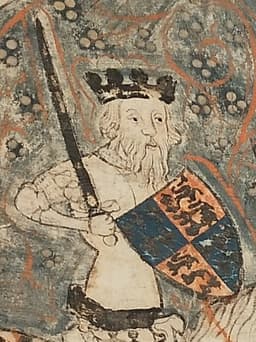
Edward III
Emperor · Medieval
62.3Total
Basic Information
Born
1500
1312
Died
1549
1377
Era
Medieval
Medieval
Nationality
Songhai Empire
England
Occupation
Emperor
Emperor
Civilization
Other
Western
Score Comparison
Military (10%)
72.5
72.0
Political (20%)
48.0
59.3
Influence (20%)
54.9
68.0
Legacy (20%)
45.0
40.0
Leadership (15%)
65.0
80.0
Strategy (15%)
50.0
72.0
TOTAL
54.2
62.3
Askia Ishaq I — Complete Timeline
1539 AD
Accession as Askia of SonghaiPolitical Action◆ Major
Askia Ishaq I seized power by deposing his brother, Askia Ismail. His reign was characterized by effective but harsh rule, maintaining the territorial integrity of the Songhai Empire through military force and strict administration.
SuccessionCoup
Impact: national
1549 AD
Death of Askia Ishaq IOther◆ Major
Askia Ishaq I died, ending his reign of approximately 10 years. His death led to a succession struggle, eventually resulting in the accession of his brother, Askia Daoud, who would become the longest-reigning Songhai ruler.
DeathSuccession
Impact: national
Edward III — Complete Timeline
1337 AD
Claimed the French ThronePolitical Action
Edward III formally claimed the French crown through his mother Isabella, daughter of Philip IV of France, rejecting the Salic law that barred female succession. This claim initiated the Hundred Years' War between England and France.
Hundred Years' WarSuccession CrisisDynastic Claim
Impact: regional
1346 AD
Battle of CrécyWar◆ Major
Edward III's English army defeated a larger French force at Cr
Hundred Years' WarBattleLongbow
Impact: regional
1347 AD
Siege of CalaisWar◆ Major
Edward III besieged the French port of Calais for nearly a year, forcing its surrender. The city became an English enclave for over two centuries, serving as a strategic base for English operations in France.
Hundred Years' WarSiegeCalais
Impact: regional
1356 AD
Battle of PoitiersWar◆ Major
Edward III's son, Edward the Black Prince, led English forces to victory at Poitiers, capturing King John II of France. This triumph followed Cr
Hundred Years' WarBattleCapture of King John
Impact: regional
1360 AD
Treaty of BrétignyPolitical Action◆ Major
Edward III signed the Treaty of Br
TreatyHundred Years' WarTerritorial Gains
Impact: regional
Expert Analysis
Origins
Askia Ishaq I, born around the early 16th century, was a member of the Askia dynasty of the Songhai Empire. He was the son of Askia Mohammad I, the great empire builder. Little is known of his early life, but he was likely raised in the royal court of Gao, immersed in the political and military traditions of the empire. His path to power came through a coup against his brother, Askia Ismail, whom he deposed in 1539. Ishaq's reign was marked by effective but ruthless governance, maintaining the empire's territorial integrity through force.
Edward III, born on 13 November 1312 at Windsor Castle, was the son of Edward II and Isabella of France. His childhood was turbulent: his father's weak rule led to a coup by Isabella and her lover Roger Mortimer, who forced Edward II to abdicate in 1327. Edward III was crowned at age 14, but real power rested with his mother and Mortimer until 1330, when Edward seized control and executed Mortimer. This early experience of political instability shaped his later assertiveness.
Rise to Power
Askia Ishaq I seized the throne in 1539 by overthrowing his brother Askia Ismail, who had ruled for only two years. Ishaq's coup was likely supported by military factions within the empire. He consolidated power by eliminating rivals and imposing harsh discipline. His reign lasted approximately ten years (1539–1549), during which he maintained the borders of the Songhai Empire through military campaigns and repressive governance.
Edward III's rise was more gradual and institutional. After taking control from Mortimer in 1330, he began consolidating his authority. His major turning point came in 1337 when he claimed the French throne through his mother, Isabella, rejecting the Salic law that excluded female inheritance. This claim initiated the Hundred Years' War (1337–1453). His early military successes, such as the naval victory at Sluys in 1340, solidified his reputation and provided him with the resources to pursue his ambitions.
Leadership & Governance
Askia Ishaq I ruled through fear and centralized control. He maintained the administrative structure established by his father, but his cruelty alienated many. He executed perceived enemies, including members of his own family. His governance was effective in the short term, as the empire remained stable and prosperous, but it lacked the institutional support that could have ensured a smooth succession. His score in Political (48.0) reflects his inability to build lasting political structures.
Edward III was a charismatic and strategic leader who fostered loyalty among his nobles. He created the Order of the Garter in 1348, binding key supporters to his cause. He was also a hands-on commander, personally leading campaigns. His governance included effective management of parliament, which granted him taxes for war. His Political score of 59.3 and Leadership score of 80.0 indicate his ability to inspire and organize. However, his later years saw a decline in health and a loss of momentum in the war.
Triumph & Tragedy
Askia Ishaq I's greatest success was maintaining the Songhai Empire's territorial integrity during his reign. He repelled external threats and suppressed internal revolts. However, his greatest failure was his inability to secure a stable succession. His death in 1549 triggered a power struggle that weakened the empire, eventually contributing to its collapse under Moroccan invasion in 1591. His cruelty also sowed dissent, undermining long-term stability.
Edward III's triumphs include the victories at Crécy (1346) and the capture of Calais (1347), which gave England a foothold in France. The Treaty of Brétigny (1360) secured extensive territories in Aquitaine. However, his later years were marred by the failure to capitalize on these gains. The war resumed after his death, and his son Richard II faced difficulties. Edward's claim to the French throne, while bold, ultimately led to centuries of conflict without a permanent resolution. His Legacy score of 40.0 reflects this mixed outcome.
Character & Destiny
Askia Ishaq I was a ruthless pragmatist. His cruelty was a tool for control, but it also isolated him. He trusted few and was ultimately unable to build a dynasty that would outlast him. His death led to a succession crisis, and his branch of the Askia dynasty soon fell from power. His character of harshness without diplomacy limited his long-term impact.
Edward III was ambitious, chivalrous, and politically astute. He embodied the medieval ideal of a warrior-king. His decision to claim the French throne was driven by both personal pride and dynastic ambition. However, his later years showed a decline in energy and judgment, as he became dependent on his son John of Gaunt. His fate was to see the war he started become a generational conflict that outlasted him.
Legacy
Askia Ishaq I left a legacy of strong, if tyrannical, rule. The Songhai Empire under him was a major West African power, but his harsh methods contributed to its eventual fragmentation. He is remembered as a cruel figure in Songhai history, overshadowed by his father's achievements. His influence score of 54.9 reflects limited global impact.
Edward III's legacy is more profound. He transformed England into a military power, expanded its territories, and set the stage for the Hundred Years' War. His military innovations, especially the use of the longbow, changed warfare. The Order of the Garter remains a prestigious institution. However, his overreach also led to financial strain and eventual loss of French territories. His total score of 62.3 surpasses Ishaq's 54.2, reflecting greater overall impact.
Conclusion
Edward III had a greater impact than Askia Ishaq I. While Ishaq maintained his empire through fear, Edward shaped the course of European history through war, diplomacy, and institutional innovation. Edward's military score (72.0) is slightly below Ishaq's (72.5), but his leadership (80.0 vs 65.0) and political acumen (59.3 vs 48.0) were superior. The 8.1-point total score gap is justified by Edward's enduring influence on England and France, whereas Ishaq's reign was a brief episode in the decline of Songhai. Edward III's actions launched a conflict that defined medieval Europe, while Ishaq's rule left little beyond a cautionary tale of tyranny.
Rankings
🥇
Edward IIILeader
Mil: 72.0Pol: 59.3Inf: 68.0
62.3
🥈
Askia Ishaq I
Mil: 72.5Pol: 48.0Inf: 54.9
54.2
+8.1 behind
How This Comparison Works
Algorithm
Each figure is scored on 6 dimensions (0—100 scale) based on structured historical data: Military (10%), Political (20%), Influence (20%), Legacy (20%), Leadership (15%), Strategy (15%). The weighted total produces the final ranking.
Data Sources
Scores are computed from structured sub-indicators in the database. Scale factors adjust for era (Ancient ×0.85, Modern ×1.0) and civilization size (Eastern ×1.05, Other ×0.80) to account for differences in population and military scale.
Maximum 3 Figures
Comparisons are limited to 2—3 figures to ensure readability and statistical meaningfulness.
Error Margins
±5 points per dimension — Sub-scores are derived from historical records with inherent uncertainty. Two figures within 5 points on a dimension should be considered roughly equivalent in that area.
Total Score Accuracy
±3 points overall — The weighted combination of 6 dimensions produces a total score with approximately ±3 points of uncertainty. Differences of less than 3 points are not statistically significant— the figures are effectively tied.
Known Limitations
- Historical records are incomplete and uneven across civilizations
- Figures from oral-tradition societies may be underrepresented
- Occupation labels can misclassify multi-role figures
- Scores measure capability and impact, not moral character
- Quantitative scoring is a comparison tool, not absolute truth
Capability Radar
Military (10%) — Battles & Warfare
Battles
65
85
Win Rate
60
80
Expansion
55
85
Political (20%) — Governance & Reform
Reform
45
70
Diplomacy
40
75
Economy
50
80
Influence (20%) — Cultural & Global Reach
Cultural
40
65
Global
30
70
Legacy (20%) — Historical Impact
Historical
45
80
Longevity
35
75
Leadership (15%) — Power & Stability
Tenure
70
85
Stability
30
70
Strategy (15%) — Tactics & Innovation
Strategy
60
90
Tactics
55
85
Reform
50
75
Similar Comparisons
Comments & Discussion
No comments yet. Be the first to share your thoughts!