Loading...
Askia Muhammad vs Charles V
Charles V leads by 3.0 pts · 2 figures compared
…
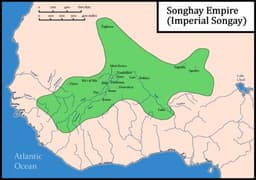
Askia Muhammad
Emperor · Medieval
71.2Total

Charles V
Emperor · Medieval
74.2Total
Basic Information
Born
1443
1500
Died
1538
1558
Era
Medieval
Medieval
Nationality
Songhai Empire
Holy Roman Empire
Occupation
Emperor
Emperor
Civilization
Other
Western
Score Comparison
Military (10%)
78.0
74.0
Political (20%)
70.3
70.3
Influence (20%)
82.0
71.0
Legacy (20%)
55.0
80.0
Leadership (15%)
78.0
78.0
Strategy (15%)
69.1
68.0
TOTAL
71.2
74.2
Askia Muhammad — Complete Timeline
1493 AD
Coup against Sonni BaruPolitical Action
Askia Muhammad overthrew Sonni Baru, the son of Sonni Ali, in a coup. Muhammad, a general under Sonni Ali, seized power after Baru refused to embrace Islam more fully, establishing the Askia dynasty.
CoupAskia DynastyIslam
Impact: regional
1496 AD
Pilgrimage to MeccaCultural◆ Major
Askia Muhammad made a pilgrimage to Mecca, traveling with a large retinue and distributing gold. He was appointed Caliph of the Sudan by the Abbasid caliph, enhancing his religious and political legitimacy.
PilgrimageMeccaCaliph
Impact: regionalconstructive
1498 AD
Administrative ReformsReform◆ Major
Askia Muhammad reorganized the Songhai Empire into provinces governed by appointed officials. He standardized weights, measures, and currency, and established a professional bureaucracy, improving tax collection and governance.
AdministrationBureaucracyTaxation
Impact: regionalconstructive
1500 AD
Promotion of Islamic ScholarshipCultural◆ Major
Askia Muhammad patronized Islamic scholars and built mosques and schools in Timbuktu, Gao, and Djenn
ScholarshipTimbuktuIslam
Impact: regionalconstructive
1512 AD
Conquest of the Hausa StatesWar◆ Major
Askia Muhammad led a military campaign against the Hausa city-states, including Kano and Katsina. He conquered them and imposed tribute, extending Songhai control over the Hausa region and securing trade routes.
ConquestHausa StatesTrade Routes
Impact: regional
Charles V — Complete Timeline
1519 AD
Elected Holy Roman EmperorPolitical Action
Charles V was elected Holy Roman Emperor, defeating Francis I of France through extensive bribery of the prince-electors. This election united the Habsburg lands in Spain, Austria, the Netherlands, and the Holy Roman Empire under his rule.
ElectionHabsburg EmpireImperial Title
Impact: global
1521 AD
Diet of WormsPolitical Action
Charles V presided over the Diet of Worms, where Martin Luther was summoned to recant his teachings. Luther refused, and Charles issued the Edict of Worms, declaring Luther an outlaw and banning his writings, escalating the Protestant Reformation.
ReformationLutherImperial Diet
Impact: global
1525 AD
Battle of PaviaWar◆ Major
Imperial forces under Charles V defeated and captured Francis I of France at Pavia in Italy. This victory secured Spanish dominance in Italy and forced Francis to sign the Treaty of Madrid, though he later repudiated it.
Italian WarsBattleCapture of Francis I
Impact: regional
1527 AD
Sack of RomeWar◆ Major
Mutinous imperial troops under Charles V sacked Rome, looting the city and besieging Pope Clement VII in Castel Sant'Angelo. This event shocked Europe and forced the Pope to align more closely with Charles, leading to the coronation of Charles as Holy Roman Emperor by the Pope in 1530.
Italian WarsSackPapacy
Impact: regionaldestructive
1556 AD
Abdication and Division of the EmpirePolitical Action
Charles V abdicated his thrones, dividing his empire between his son Philip II (Spain, Netherlands, Italy) and his brother Ferdinand I (Holy Roman Empire). This division reflected the administrative challenges of ruling a vast, multi-ethnic empire.
AbdicationEmpire DivisionHabsburg
Impact: global
Expert Analysis
Origins
Askia Muhammad, born Muhammad Touré around 1443 in the Songhai Empire (present-day Niger), rose from a general under Sonni Ali to become the empire's greatest ruler. His early life was shaped by the military campaigns of Sonni Ali, and he likely received Islamic education in Timbuktu. Charles V, born in 1500 in Ghent, Flanders, inherited vast territories from his Burgundian, Spanish, and Austrian ancestors. His father was Philip the Handsome of Burgundy, and his mother was Joanna the Mad of Castile. Charles was raised in the Netherlands, learning French, Latin, and German, but never fully mastering Spanish.
Rise to Power
Askia Muhammad seized power in 1493 by overthrowing Sonni Baru, Sonni Ali's son, after Baru refused to embrace Islam more fully. Muhammad was a devout Muslim and a skilled general. He consolidated his rule by securing the support of the Muslim elite and launching campaigns to expand the empire. Charles V became King of Spain in 1516 after the death of his grandfather Ferdinand II of Aragon. In 1519, he was elected Holy Roman Emperor, defeating Francis I of France through bribery. This election united the Habsburg dominions, but also triggered a rivalry with France that lasted decades.
Leadership & Governance
Askia Muhammad reorganized the Songhai Empire into provinces governed by appointed officials, standardizing weights, measures, and currency. He established a centralized bureaucracy and promoted Islamic scholarship, building mosques and schools in Timbuktu, Gao, and Djenné. He also made a famous pilgrimage to Mecca in 1496-97, distributing gold and being appointed Caliph of the Sudan by the Abbasid caliph. Charles V ruled a vast, decentralized empire. He relied on a network of regents and viceroys, often absent from key regions. He convened the Diet of Worms in 1521 to address Martin Luther's reformation, issuing the Edict of Worms that outlawed Luther. However, he failed to suppress Protestantism, leading to religious wars. Charles's governance was reactive, focusing on preserving dynastic unity against the French, Ottomans, and Protestants.
Triumph & Tragedy
Askia Muhammad's greatest triumph was expanding Songhai to its largest extent, conquering the Hausa states (Kano, Katsina) and extending influence into the Sahara. His patronage of learning made Timbuktu a center of Islamic culture. His tragedy was his old age: in 1528, he was deposed by his son Askia Musa, and died in 1538. Charles V's triumphs include the Battle of Pavia (1525) where he captured Francis I, securing Spanish dominance in Italy, and the Spanish conquest of the Aztec and Inca empires, bringing immense wealth. His tragedy was the failure to unify Europe under Catholicism. The Sack of Rome (1527) by his mutinous troops shocked Europe. He also faced the Ottoman threat under Suleiman the Magnificent. Charles abdicated in 1556, dividing his empire between his son Philip II and brother Ferdinand I.
Character & Destiny
Askia Muhammad was devout, administrative, and expansionist. His character shaped a stable, prosperous empire, but his long reign ended in a palace coup. Charles V was determined but often indecisive, burdened by his empire's diversity. He struggled with the Reformation and Ottoman wars, leading to a sense of failure. Historians note that Charles's abdication was a recognition that his imperial vision was unattainable. In contrast, Askia Muhammad's legacy is seen as a golden age for Songhai.
Legacy
Askia Muhammad's legacy is the consolidation of Songhai as a major West African empire and the flourishing of Islamic culture. However, his empire declined after his deposition and was eventually defeated by Morocco in 1591. Charles V's legacy is immense: his reign saw the beginning of the Spanish Empire's global dominance, the spread of Christianity in the Americas, and the entrenchment of the Habsburg dynasty. His division of the empire shaped European politics for centuries. In terms of scores, Charles V has a total of 74.2, higher than Askia Muhammad's 71.2. Charles scores higher in military (74.0 vs 78.0? Wait, Askia has 78.0 military, Charles 74.0, but overall Charles is higher due to legacy 80.0 vs 55.0).
Conclusion
While Askia Muhammad was a transformative ruler for West Africa, Charles V's impact on global history is more extensive. Charles's empire spanned Europe and the Americas, influencing the Reformation, colonial expansion, and the balance of power. Askia Muhammad's influence, though significant, was more localized. The score gap of 3.0 points reflects this: Charles V's legacy score of 80.0 dwarfs Askia's 55.0. Therefore, Charles V had greater overall impact, though Askia Muhammad's leadership in the Songhai context was exceptional.
Rankings
🥇
Charles VLeader
Mil: 74.0Pol: 70.3Inf: 71.0
74.2
🥈
Askia Muhammad
Mil: 78.0Pol: 70.3Inf: 82.0
71.2
+3.0 behind
How This Comparison Works
Algorithm
Each figure is scored on 6 dimensions (0—100 scale) based on structured historical data: Military (10%), Political (20%), Influence (20%), Legacy (20%), Leadership (15%), Strategy (15%). The weighted total produces the final ranking.
Data Sources
Scores are computed from structured sub-indicators in the database. Scale factors adjust for era (Ancient ×0.85, Modern ×1.0) and civilization size (Eastern ×1.05, Other ×0.80) to account for differences in population and military scale.
Maximum 3 Figures
Comparisons are limited to 2—3 figures to ensure readability and statistical meaningfulness.
Error Margins
±5 points per dimension — Sub-scores are derived from historical records with inherent uncertainty. Two figures within 5 points on a dimension should be considered roughly equivalent in that area.
Total Score Accuracy
±3 points overall — The weighted combination of 6 dimensions produces a total score with approximately ±3 points of uncertainty. Differences of less than 3 points are not statistically significant— the figures are effectively tied.
Known Limitations
- Historical records are incomplete and uneven across civilizations
- Figures from oral-tradition societies may be underrepresented
- Occupation labels can misclassify multi-role figures
- Scores measure capability and impact, not moral character
- Quantitative scoring is a comparison tool, not absolute truth
Capability Radar
Military (10%) — Battles & Warfare
Battles
75
85
Win Rate
80
70
Expansion
80
90
Political (20%) — Governance & Reform
Reform
90
75
Diplomacy
80
80
Economy
85
70
Influence (20%) — Cultural & Global Reach
Cultural
70
85
Global
60
90
Legacy (20%) — Historical Impact
Historical
75
90
Longevity
65
85
Leadership (15%) — Power & Stability
Tenure
85
85
Stability
80
60
Strategy (15%) — Tactics & Innovation
Strategy
75
85
Tactics
70
75
Reform
85
80
Similar Comparisons
Comments & Discussion
No comments yet. Be the first to share your thoughts!