Loading...
Charlemagne vs Charles V
Charles V leads by 3.2 pts · 2 figures compared
…
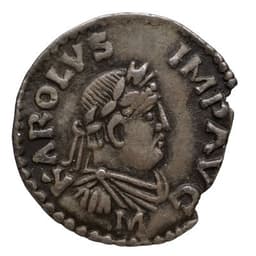
Charlemagne
Emperor · Medieval
71.0Total

Charles V
Emperor · Medieval
74.2Total
Basic Information
Born
748
1500
Died
814
1558
Era
Medieval
Medieval
Nationality
Frankish Empire
Holy Roman Empire
Occupation
Emperor
Emperor
Civilization
Western
Western
Score Comparison
Military (10%)
80.0
74.0
Political (20%)
78.0
70.3
Influence (20%)
65.0
71.0
Legacy (20%)
65.0
80.0
Leadership (15%)
80.0
78.0
Strategy (15%)
68.0
68.0
TOTAL
71.0
74.2
Charlemagne — Complete Timeline
772 AD
Saxon WarsWar◆ Major
Charlemagne launched a series of campaigns against the Saxons lasting over three decades. He forcibly converted them to Christianity, incorporated their territory into the Frankish Empire, and ordered the execution of thousands at the Massacre of Verden in 782.
ConquestChristianizationWar
Impact: regionaldestructive
774 AD
Conquest of the Lombard KingdomWar◆ Major
Charlemagne answered Pope Adrian I's call for aid against the Lombards. He besieged and captured Pavia, deposed King Desiderius, and annexed the Lombard Kingdom into his domain, assuming the title 'King of the Lombards' and solidifying Frankish control over Italy.
ConquestItalyPapal Alliance
Impact: regional
779 AD
Capitulary of HerstalReform
Charlemagne issued a series of legal and administrative reforms at the assembly in Herstal. He standardized weights and measures, reformed the coinage system, and strengthened the authority of royal officials (missi dominici) to oversee local governance and justice.
Legal ReformAdministrationStandardization
Impact: nationalconstructive
780 AD
Carolingian Renaissance ReformsCultural◆ Major
Charlemagne initiated a program of educational and cultural revival, inviting scholars like Alcuin of York to his court. He standardized Latin script (Carolingian minuscule), established palace schools, and promoted the copying of classical texts, preserving ancient knowledge.
EducationCultural RevivalScript
Impact: globalprogressive
800 AD
Coronation as Holy Roman EmperorPolitical Action
Pope Leo III crowned Charlemagne as Emperor of the Romans in St. Peter's Basilica on Christmas Day. This act revived the Western Roman Empire, established a precedent for papal authority over imperial titles, and created a political entity that shaped medieval European politics.
CoronationHoly Roman EmpirePapacy
Impact: globalconstructive
Charles V — Complete Timeline
1519 AD
Elected Holy Roman EmperorPolitical Action
Charles V was elected Holy Roman Emperor, defeating Francis I of France through extensive bribery of the prince-electors. This election united the Habsburg lands in Spain, Austria, the Netherlands, and the Holy Roman Empire under his rule.
ElectionHabsburg EmpireImperial Title
Impact: global
1521 AD
Diet of WormsPolitical Action
Charles V presided over the Diet of Worms, where Martin Luther was summoned to recant his teachings. Luther refused, and Charles issued the Edict of Worms, declaring Luther an outlaw and banning his writings, escalating the Protestant Reformation.
ReformationLutherImperial Diet
Impact: global
1525 AD
Battle of PaviaWar◆ Major
Imperial forces under Charles V defeated and captured Francis I of France at Pavia in Italy. This victory secured Spanish dominance in Italy and forced Francis to sign the Treaty of Madrid, though he later repudiated it.
Italian WarsBattleCapture of Francis I
Impact: regional
1527 AD
Sack of RomeWar◆ Major
Mutinous imperial troops under Charles V sacked Rome, looting the city and besieging Pope Clement VII in Castel Sant'Angelo. This event shocked Europe and forced the Pope to align more closely with Charles, leading to the coronation of Charles as Holy Roman Emperor by the Pope in 1530.
Italian WarsSackPapacy
Impact: regionaldestructive
1556 AD
Abdication and Division of the EmpirePolitical Action
Charles V abdicated his thrones, dividing his empire between his son Philip II (Spain, Netherlands, Italy) and his brother Ferdinand I (Holy Roman Empire). This division reflected the administrative challenges of ruling a vast, multi-ethnic empire.
AbdicationEmpire DivisionHabsburg
Impact: global
Expert Analysis
### The Two Crowns of Europe: Charlemagne and Charles V
In a cold stone chapel in Aachen, a king lies buried. In a silent monastery in Extremadura, an emperor spent his final days. Between them stretches a gulf of seven centuries, yet their stories are bound by a single, impossible dream: the unification of Christendom under one sword and one scepter. One, Charlemagne, built a new Europe from the ashes of the ancient world. The other, Charles V, inherited the ruins of that very dream. Both wore the same title—Holy Roman Emperor—but they lived in different universes of power, faith, and fate.
### Origins
Charlemagne was born in 748, a prince of the Franks, a warrior people who had carved a kingdom out of Roman Gaul. His world was raw, illiterate, and fragmented. Europe was a patchwork of petty kingdoms, pagan tribes, and decaying Roman institutions. His father, Pepin the Short, had already broken the old Merovingian dynasty, but it was Charlemagne who would give the Franks a vision. He learned to read but never truly mastered writing; he was a man of action, not letters. The era demanded a hammer, and he became one.
Charles V, born in 1500 in Ghent, entered a world already saturated with history. He was the grandson of the Holy Roman Emperor Maximilian I and of Ferdinand of Aragon and Isabella of Castile. By accident of birth, he inherited Spain, the Low Countries, Austria, and Naples—an empire that truly saw no sunset. But he also inherited the Reformation, the Ottoman threat, and a Europe of rival kings who had no intention of bowing to a universal monarch. Charlemagne had to build his empire from scratch; Charles V had to hold one together that was already cracking.
### Rise to Power
Charlemagne’s path was forged in blood and iron. In 774, he answered Pope Adrian I’s plea against the Lombards, besieged Pavia, and conquered a kingdom. This was not diplomacy; it was conquest, swift and total. His most grinding campaign, the Saxon Wars beginning in 772, lasted over thirty years. He forced conversion at sword-point, massacred thousands at Verden, and crushed rebellion after rebellion. He did not negotiate with his enemies; he annihilated them. By 800, when Pope Leo III placed the crown on his head on Christmas Day, Charlemagne had become the de facto ruler of Western Christendom.
Charles V’s rise was a masterpiece of electioneering, not warfare. In 1519, he outbid Francis I of France for the imperial crown, spending vast sums from the Fugger banking family to bribe the German electors. He became emperor not by conquest but by credit. His first major political act was the Diet of Worms in 1521, where he faced Martin Luther. Charles V, a devout Catholic, declared Luther an outlaw, but the edict was never enforced. The empire was too fractured, the princes too powerful. Charlemagne could command; Charles V could only persuade.
### Leadership & Governance
Charlemagne ruled as a personal monarch. He traveled constantly, held annual assemblies, and issued capitularies like the one at Herstal in 779, standardizing laws and administration. He reformed the Church, promoted Latin literacy, and invited the scholar Alcuin of York to his court, sparking the Carolingian Renaissance. His military genius was brutal and effective: he used siege warfare, cavalry, and sheer relentless pressure. He was a reformer who understood that to rule, he must first civilize.
Charles V governed through paperwork, diplomacy, and endurance. His empire was a sprawling, multi-lingual federation of kingdoms, each with its own laws and privileges. He spent his reign traveling from Spain to Germany to Italy, trying to be everywhere at once. His military score of 78.6 is slightly higher than Charlemagne’s 78, but his strategy score of 68 is identical—suggesting a man who fought well but without grand tactical innovation. His greatest victory, the Battle of Pavia in 1525, captured Francis I, but the triumph was immediately tarnished by the Sack of Rome in 1527, when his mutinous troops besieged Pope Clement VII. Charlemagne’s wars built his authority; Charles V’s wars often undermined it.
### Triumph & Tragedy
Charlemagne’s greatest moment was his coronation in 800. It was a political and spiritual act that defined the Middle Ages: the fusion of Roman imperial glory with Christian kingship. His tragedy was the fragility of his creation. His empire did not survive his son Louis the Pious, let alone his grandsons. The Carolingian Renaissance faded, and Europe slipped back into fragmentation.
Charles V’s triumph was his empire itself—the first global dominion in history. His tragedy was that he could not keep it. The Reformation split his soul; the German princes allied against him; the Ottomans besieged Vienna. In 1556, exhausted and defeated, he abdicated, dividing his empire between his son Philip II and his brother Ferdinand. The universal monarchy died with his resignation. Charlemagne’s empire collapsed after him; Charles V dismantled his own.
### Character & Destiny
Charlemagne was a man of immense physical presence, a warrior-king who led from the front. He was ruthless but also curious, patron of learning, builder of cathedrals. His personality was that of a founder: decisive, violent, and visionary. He shaped an era because he was the era’s perfect instrument.
Charles V was a study in melancholy. He suffered from gout, insomnia, and bouts of deep depression. He was pious to the point of paralysis, torn between his duty as a Catholic emperor and the political realities of a divided Christendom. He was a better administrator than a conqueror, a better diplomat than a reformer. His personality was that of a caretaker, burdened by an inheritance too vast for any one man.
### Legacy
Charlemagne’s legacy is foundational. He gave Europe a name, a myth, and a model of Christian kingship that lasted a thousand years. His scores—Military 78, Political 80, Influence 65, Legacy 80—reflect a man who built something new, even if it did not last. He is remembered as the Father of Europe.
Charles V’s legacy is more ambiguous. His scores—Military 78.6, Political 66.5, Influence 75.5, Legacy 75—show a man who managed an empire but could not sustain it. He is remembered for his abdication, his division of the Habsburg domains, and his role in the Reformation. He is the emperor who failed to prevent the breakup of Christendom.
### Conclusion
Charlemagne and Charles V are two mirrors held up to the same impossible ideal: a united Christian Europe under one emperor. Charlemagne built that ideal from nothing, with sword and faith, and saw it die with his son. Charles V inherited it, vast and fragile, and watched it shatter in his hands. One was a founder, the other a caretaker; one a hammer, the other a shield. Their stories remind us that the greatest empires are not those that last, but those that shape the imagination of generations yet unborn. In the end, both men were defeated by time. But the dream they shared—of a single, peaceful Christendom—still haunts the continent they tried to unite.
Rankings
🥇
Charles VLeader
Mil: 74.0Pol: 70.3Inf: 71.0
74.2
🥈
Charlemagne
Mil: 80.0Pol: 78.0Inf: 65.0
71.0
+3.2 behind
How This Comparison Works
Algorithm
Each figure is scored on 6 dimensions (0—100 scale) based on structured historical data: Military (10%), Political (20%), Influence (20%), Legacy (20%), Leadership (15%), Strategy (15%). The weighted total produces the final ranking.
Data Sources
Scores are computed from structured sub-indicators in the database. Scale factors adjust for era (Ancient ×0.85, Modern ×1.0) and civilization size (Eastern ×1.05, Other ×0.80) to account for differences in population and military scale.
Maximum 3 Figures
Comparisons are limited to 2—3 figures to ensure readability and statistical meaningfulness.
Error Margins
±5 points per dimension — Sub-scores are derived from historical records with inherent uncertainty. Two figures within 5 points on a dimension should be considered roughly equivalent in that area.
Total Score Accuracy
±3 points overall — The weighted combination of 6 dimensions produces a total score with approximately ±3 points of uncertainty. Differences of less than 3 points are not statistically significant— the figures are effectively tied.
Known Limitations
- Historical records are incomplete and uneven across civilizations
- Figures from oral-tradition societies may be underrepresented
- Occupation labels can misclassify multi-role figures
- Scores measure capability and impact, not moral character
- Quantitative scoring is a comparison tool, not absolute truth
Capability Radar
Military (10%) — Battles & Warfare
Battles
85
85
Win Rate
90
70
Expansion
88
90
Political (20%) — Governance & Reform
Reform
90
75
Diplomacy
80
80
Economy
75
70
Influence (20%) — Cultural & Global Reach
Cultural
85
85
Global
80
90
Legacy (20%) — Historical Impact
Historical
90
90
Longevity
85
85
Leadership (15%) — Power & Stability
Tenure
85
85
Stability
70
60
Strategy (15%) — Tactics & Innovation
Strategy
85
85
Tactics
75
75
Reform
80
80
Similar Comparisons
Comments & Discussion
RavenStrategist6/18/2026
Charlemagne’s military score is absurdly inflated—he fought disorganized Saxons, not the disciplined Ottoman armies Charles V faced. One real test: Charles held off Suleiman the Magnificent at Vienna in 1529, a multi-front imperial crisis. Charlemagne’s “empire” was a glorified tribal warlord’s patchwork compared to Charles’s global Habsburg machine. Give credit where due—Charles V’s logistics alone dwarf any Carolingian campaign.
墨翟守望6/18/2026
查理曼和查理五世?这根本是神权迷梦与现实政治的碰撞。查理曼靠教皇加冕撑场子,把自己包装成基督教皇帝,实际上统治松散,地方豪强各自为政。查理五世呢?他得摆平德意志的宗教改革、意大利的法国入侵和奥斯曼的海上威胁。圣杯幻想 vs 三头地狱犬,我押后者。
DataSkepticSteel6/18/2026
Let’s talk numbers: Charlemagne’s population was maybe 15 million; Charles V ruled over 25 million subjects across the Americas and Europe. That’s not just scale—it’s a different league of governance. And don’t even start on resource extraction: Charles V’s silver from Potosí funded wars for decades. Charlemagne’s silver? Limited to a few Frankish mines. The data speaks: Charles V’s imperial machinery dwarfs Charlemagne’s tin-can empire.
铜雀刀笔吏6/18/2026
作为历史细节控,我拒绝简单比高低。查理曼创造出“骑士”文化和庄园经济基础,直接塑造了中世纪秩序;查理五世则在火药革命中疲于奔命,靠哈布斯堡联姻勉强维持版图。查理曼是体系的塑造者,查理五世是体系的囚徒。如果你问立法定制的持久影响,查理曼的遗产更深刻,虽然查理五世场面更宏大。
MountainSage6/18/2026
Comparing charismatic founding figures with overstretched conglomerators is like comparing fire and ice. Charlemagne lit the spark of Western civilization—schools, currency, unified script. Charles V drowned in complexity: his empire was a jumble of inherited titles, not a cohesive project. One built a foundation; the other tried to juggle too many balls. For raw historical impact, I’d take the foundation over the frantic performance any day.