Loading...
Asparukh of Bulgaria vs Li Chun
Li Chun leads by 6.4 pts · 2 figures compared
…
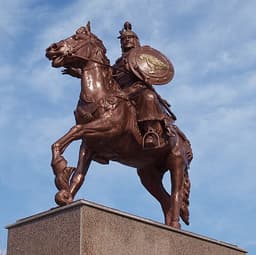
Asparukh of Bulgaria
Emperor · Medieval
55.2Total

Li Chun
Emperor · Medieval
61.6Total
Basic Information
Born
640
778
Died
701
820
Era
Medieval
Medieval
Nationality
Bulgaria
China
Occupation
Emperor
Emperor
Civilization
Western
Eastern
Score Comparison
Military (10%)
61.7
60.0
Political (20%)
53.8
70.0
Influence (20%)
55.0
61.0
Legacy (20%)
55.0
52.0
Leadership (15%)
53.2
68.0
Strategy (15%)
55.0
66.3
TOTAL
55.2
61.6
Asparukh of Bulgaria — Complete Timeline
680 AD
Battle of OngalWar◆ Major
Asparukh's Bulgar forces defeated the Byzantine army of Emperor Constantine IV at the Battle of Ongal in the Danube delta. This victory allowed the Bulgars to settle permanently south of the Danube and establish their state.
BattleByzantine-Bulgar WarsFounding
Impact: regional
681 AD
Founding of the First Bulgarian EmpirePolitical Action
Asparukh led the Bulgar tribes across the Danube River and established the First Bulgarian Empire in the territory of modern-day Bulgaria. He defeated Byzantine forces and secured recognition of the new state through a treaty with Emperor Constantine IV.
FoundingBulgarian EmpireMigration
Impact: regionalconstructive
Treaty with the Byzantine Empire (681)Political Action◆ Major
Asparukh negotiated a peace treaty with the Byzantine Empire that recognized the First Bulgarian Empire as an independent state. The treaty also established a tribute payment from Byzantium to Bulgaria.
TreatyByzantine-Bulgar RelationsFounding
Impact: regionalconstructive
Li Chun — Complete Timeline
806 AD
Yuanhe Restoration CampaignsWar◆ Major
Li Chun launched a series of military campaigns to reassert central control over rebellious fanzhen. He defeated the warlords of Sichuan, Zhenhai, and other provinces, reducing their autonomy and restoring imperial authority.
Yuanhe RestorationFanzhen SuppressionMilitary Campaigns
Impact: nationalconstructive
812 AD
Defeat of the Fanzhen of ZhaoyiWar◆ Major
Li Chun's forces defeated the powerful Zhaoyi fanzhen, whose military governor had rebelled. This victory was a major achievement of the Yuanhe Restoration, demonstrating the Tang court's renewed military strength.
Yuanhe RestorationZhaoyiMilitary Victory
Impact: nationalconstructive
819 AD
Submission of the Fanzhen of ChengdePolitical Action◆ Major
After a long campaign, the Chengde fanzhen submitted to central authority. This was the last major fanzhen to be brought under control during Li Chun's reign, marking the peak of the Yuanhe Restoration.
Yuanhe RestorationChengdeSubmission
Impact: nationalconstructive
820 AD
Death of Li ChunOther
Li Chun died in 820, possibly poisoned by eunuchs. His death ended the Yuanhe Restoration, and subsequent emperors were unable to maintain the central authority he had reestablished.
DeathYuanhe Restoration EndEunuch Power
Impact: nationaltragic
Expert Analysis
Origins
Asparukh was born around 640 AD, a prince of the Dulo clan, which led the Bulgar tribes of the Pontic steppes. The Bulgars were a Turkic semi-nomadic confederation, and Asparukh’s father, Khan Kubrat, had ruled the Old Great Bulgaria before its disintegration under Khazar pressure. Asparukh inherited a fragmented people and the urgent need to find a new homeland. In contrast, Li Chun was born in 778 AD as the eldest son of Emperor Dezong of the Tang dynasty. He grew up in the imperial palace of Chang’an, immersed in Confucian education and court politics. His early life was marked by the erosion of central authority as regional military governors (fanzhen) held de facto power, a situation that would define his reign.
Rise to Power
Asparukh rose by leading his Bulgar horde westward across the Dnieper and Dniester rivers, eventually reaching the Danube delta in the 670s. He fortified a camp at Ongal, a marshy area protected by the Danube and the Black Sea. In 680, the Byzantine Emperor Constantine IV launched a campaign to expel the Bulgars. Asparukh’s forces, using the terrain to their advantage, ambushed the Byzantine army at the Battle of Ongal. The Byzantines suffered a decisive defeat, forcing Constantine IV to retreat. This victory allowed Asparukh to expand into Moesia and Thrace. Li Chun’s rise was more conventional: he became emperor in 805 at age 27 after his father’s death. Unlike Asparukh, he inherited a throne but a weakened one. His early reign focused on consolidating power and preparing for war against the rebellious fanzhen. He appointed capable officials like Pei Du and Li Guangyan, and built a loyal army.
Leadership & Governance
Asparukh’s leadership was that of a tribal warlord turned state-builder. He integrated Bulgar warrior elites with the Slavic population, creating a dual administrative structure that preserved Bulgar military dominance while adopting Slavic language and customs. His military strategy scored 61.7, reflecting his tactical acumen at Ongal, but his political score of 53.8 indicates the challenges of governing a newly formed multi-ethnic state. Li Chun, with a political score of 70.0, was a more systematic reformer. He implemented the Yuanhe Restoration, a series of policies to centralize tax collection, curtail eunuch power, and reassert imperial control. His leadership score of 68.0 shows his ability to coordinate large-scale campaigns. However, his reliance on eunuchs for palace administration ultimately undermined his reforms.
Triumph & Tragedy
Asparukh’s greatest triumph was the founding of the First Bulgarian Empire and the 681 treaty with Byzantium, which recognized Bulgaria as a sovereign state. This treaty marked the first time a Byzantine emperor formally acknowledged a barbarian kingdom on European soil. His failure was the unfinished integration of Bulgars and Slavs, which led to internal strife after his death in 700 AD. Li Chun’s triumphs included the defeat of the Zhaoyi, Zhenhai, and Chengde fanzhen, restoring central authority over most of the empire. His Yuanhe Restoration briefly reversed the Tang decline. His tragedy was his death in 820, possibly poisoned by eunuchs, which ended the restoration. Subsequent emperors failed to maintain control, and the Tang dynasty entered irreversible decline. Li Chun’s total score of 61.6 surpasses Asparukh’s 55.2, reflecting his more comprehensive political and strategic achievements.
Character & Destiny
Asparukh was a pragmatic leader who adapted steppe warfare to a settled context. His decision to cross the Danube and establish a permanent state showed long-term vision. However, his character was that of a conqueror, not a bureaucrat, which limited his ability to create lasting institutions. Li Chun was determined and ruthless, executing officials who opposed him. He was deeply influenced by Confucian ideals of centralization, but his trust in eunuchs proved fatal. Historians note that his early death robbed the Tang of a resolute reformer. Asparukh died in battle against the Khazars, a fitting end for a warrior. Li Chun’s assassination in the palace shows the fragility of his political gains.
Legacy
Asparukh’s legacy is foundational: the First Bulgarian Empire lasted until 1018 and shaped the Slavic and Orthodox Christian identity of the Balkans. The Bulgarian state he founded eventually adopted Christianity and Cyrillic script, influencing the entire region. His military score of 61.7 and influence score of 55.0 reflect his role as a state founder. Li Chun’s legacy is more ambiguous. The Yuanhe Restoration is often cited as the last Tang revival, but its effects were temporary. His military score of 60.0 and influence score of 61.0 show his impact on Chinese history, but his legacy score of 52.0 indicates that his achievements did not endure. In comparison, Asparukh’s empire lasted for centuries, while Li Chun’s restoration collapsed within a generation.
Conclusion
While Li Chun scored higher overall (61.6 vs 55.2), Asparukh’s impact was more enduring. Li Chun’s Yuanhe Restoration was a remarkable political and military achievement, but it failed to reverse the structural decay of the Tang. Asparukh, despite lower scores in political and strategy, created a state that survived for over 300 years and shaped the cultural and religious landscape of southeastern Europe. The data supports that Asparukh had a greater historical impact because his founding act had long-term consequences, whereas Li Chun’s reforms were a temporary halt to decline. In the contest between a state founder and a restorer, the founder wins on legacy.
Rankings
🥇
Li ChunLeader
Mil: 60.0Pol: 70.0Inf: 61.0
61.6
🥈
Asparukh of Bulgaria
Mil: 61.7Pol: 53.8Inf: 55.0
55.2
+6.4 behind
How This Comparison Works
Algorithm
Each figure is scored on 6 dimensions (0—100 scale) based on structured historical data: Military (10%), Political (20%), Influence (20%), Legacy (20%), Leadership (15%), Strategy (15%). The weighted total produces the final ranking.
Data Sources
Scores are computed from structured sub-indicators in the database. Scale factors adjust for era (Ancient ×0.85, Modern ×1.0) and civilization size (Eastern ×1.05, Other ×0.80) to account for differences in population and military scale.
Maximum 3 Figures
Comparisons are limited to 2—3 figures to ensure readability and statistical meaningfulness.
Error Margins
±5 points per dimension — Sub-scores are derived from historical records with inherent uncertainty. Two figures within 5 points on a dimension should be considered roughly equivalent in that area.
Total Score Accuracy
±3 points overall — The weighted combination of 6 dimensions produces a total score with approximately ±3 points of uncertainty. Differences of less than 3 points are not statistically significant— the figures are effectively tied.
Known Limitations
- Historical records are incomplete and uneven across civilizations
- Figures from oral-tradition societies may be underrepresented
- Occupation labels can misclassify multi-role figures
- Scores measure capability and impact, not moral character
- Quantitative scoring is a comparison tool, not absolute truth
Capability Radar
Military (10%) — Battles & Warfare
Battles
65
70
Win Rate
70
75
Expansion
70
65
Political (20%) — Governance & Reform
Reform
65
85
Diplomacy
70
70
Economy
55
75
Influence (20%) — Cultural & Global Reach
Cultural
65
55
Global
55
50
Legacy (20%) — Historical Impact
Historical
70
70
Longevity
75
60
Leadership (15%) — Power & Stability
Tenure
60
60
Stability
60
65
Strategy (15%) — Tactics & Innovation
Strategy
75
70
Tactics
60
65
Reform
55
80
Similar Comparisons
Comments & Discussion
No comments yet. Be the first to share your thoughts!