Loading...
Asparukh of Bulgaria vs Qin Shi Huang
Qin Shi Huang leads by 30.0 pts · 2 figures compared
…
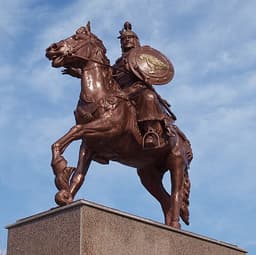
Asparukh of Bulgaria
Emperor · Medieval
55.2Total
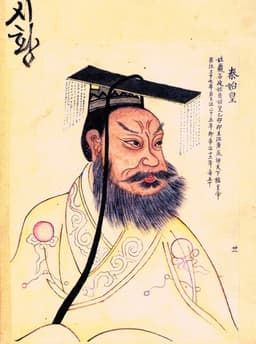
Qin Shi Huang
Emperor · Ancient
85.2Total
Basic Information
Born
640
-259
Died
701
-210
Era
Medieval
Ancient
Nationality
Bulgaria
China
Occupation
Emperor
Emperor
Civilization
Western
Eastern
Score Comparison
Military (10%)
61.7
80.0
Political (20%)
53.8
90.0
Influence (20%)
55.0
85.0
Legacy (20%)
55.0
90.0
Leadership (15%)
53.2
78.0
Strategy (15%)
55.0
82.0
TOTAL
55.2
85.2
Asparukh of Bulgaria — Complete Timeline
680 AD
Battle of OngalWar◆ Major
Asparukh's Bulgar forces defeated the Byzantine army of Emperor Constantine IV at the Battle of Ongal in the Danube delta. This victory allowed the Bulgars to settle permanently south of the Danube and establish their state.
BattleByzantine-Bulgar WarsFounding
Impact: regional
681 AD
Founding of the First Bulgarian EmpirePolitical Action
Asparukh led the Bulgar tribes across the Danube River and established the First Bulgarian Empire in the territory of modern-day Bulgaria. He defeated Byzantine forces and secured recognition of the new state through a treaty with Emperor Constantine IV.
FoundingBulgarian EmpireMigration
Impact: regionalconstructive
Treaty with the Byzantine Empire (681)Political Action◆ Major
Asparukh negotiated a peace treaty with the Byzantine Empire that recognized the First Bulgarian Empire as an independent state. The treaty also established a tribute payment from Byzantium to Bulgaria.
TreatyByzantine-Bulgar RelationsFounding
Impact: regionalconstructive
Qin Shi Huang — Complete Timeline
246 BC
Construction of the Mausoleum and Terracotta ArmyOther◆ Major
Qin Shi Huang commissioned a vast mausoleum complex near Xi'an, guarded by thousands of life-sized terracotta soldiers, horses, and chariots. The project employed hundreds of thousands of workers and reflected his obsession with immortality and imperial power.
Impact: global
230 BC
Conquest of the Six Warring StatesWar
From 230 to 221 BCE, Ying Zheng led the Qin state in a series of campaigns that conquered the Han, Zhao, Wei, Chu, Yan, and Qi states. This unified China under a single ruler for the first time, ending the Warring States period.
Impact: global
221 BC
Standardization of Writing, Currency, and MeasurementsReform◆ Major
Qin Shi Huang ordered the standardization of Chinese script, currency, and weights and measures across the unified empire. This facilitated administration, trade, and cultural integration, laying a foundation for future dynasties.
Impact: globalconstructive
Proclamation of the Qin DynastyPolitical Action
After conquering the last independent state, Ying Zheng declared himself Shi Huangdi (First Emperor), founding the Qin Dynasty. He adopted a new title to signify his supreme authority and initiated centralized imperial rule.
Impact: global
214 BC
Initiation of the Great Wall ConstructionOther◆ Major
Qin Shi Huang ordered the connection and extension of existing northern fortifications to create a unified defensive wall against nomadic Xiongnu raids. This project involved massive conscripted labor and became the precursor to the later Great Wall.
Impact: regional
213 BC
Burning of Books and Burying of ScholarsPolitical Action◆ Major
On the advice of Li Si, Qin Shi Huang ordered the burning of historical records and philosophical texts not aligned with Legalist doctrine. He also had 460 Confucian scholars buried alive to suppress dissent and consolidate ideological control.
Impact: nationaldestructive
Expert Analysis
asparukh-of-bulgaria-vs-qin-shi-huang
# The First Emperor and the Khan Who Crossed the Danube
On opposite ends of the Eurasian landmass, two men emerged from the chaos of their times to forge nations that would define entire civilizations. One was a Chinese prince who crushed six kingdoms under his chariot wheels; the other was a Bulgar chieftain who led his people across a great river into the heart of Europe. Qin Shi Huang and Asparukh of Bulgaria never met, never knew of each other's existence, yet both faced the same fundamental question: How does a ruler transform a scattered people into a lasting state? Their answers—and their fates—could not have been more different.
Origins
Ying Zheng was born in 259 BC into the ruthless world of the Warring States period, where seven Chinese kingdoms had been locked in a bloody struggle for supremacy for over two centuries. His father was a Qin prince who had been held hostage in the state of Zhao, and young Zheng spent his earliest years in an enemy court, learning the lessons of danger and deception before he could speak. When he returned to Qin at age nine to inherit the throne, he found himself surrounded by eunuchs, regents, and scheming ministers who saw a boy-king as a useful puppet.
Asparukh, born around AD 640, came from a very different world—the vast grasslands north of the Black Sea, where the Bulgar tribes roamed with their herds. He was the son of Khan Kubrat, who had united the Bulgars into a confederation called Old Great Bulgaria. But when Kubrat died, his empire shattered under pressure from the Khazars, a rising power from the east. Asparukh's brothers led their followers in different directions; one went up the Volga, another into the Caucasus. Asparukh chose the west, toward the Danube and the Byzantine Empire.
Rise to Power
Qin Shi Huang's path to supremacy was methodical and brutal. From 230 to 221 BC, he unleashed his generals in a series of campaigns that consumed the six rival states one by one: Han fell first, then Zhao, then Wei. The conquest of Chu required over 600,000 Qin soldiers. By the time Qi surrendered in 221 BC, Ying Zheng had accomplished what no Chinese ruler had done before: total unification. He proclaimed himself Shi Huangdi, the First Emperor, and declared that his dynasty would last "ten thousand generations."
Asparukh's rise was more precarious. In AD 680, he led his Bulgar warriors—perhaps no more than twenty thousand people in total—across the Danube Delta into Byzantine territory. Emperor Constantine IV, fresh from breaking the Arab siege of Constantinople, marched north with a massive army to crush these barbarian intruders. But Asparukh chose his ground carefully. At the Battle of Ongal, in the marshes and forests of the Danube estuary, his mounted archers ambushed the Byzantine infantry, and the imperial army broke and fled. In 681, Constantine IV signed a treaty recognizing the First Bulgarian Empire as an independent state.
Leadership & Governance
Here the two rulers diverged most sharply. Qin Shi Huang governed through terror and total control. On the advice of his chancellor Li Si, he ordered the burning of all historical records and philosophical texts not aligned with Legalist doctrine, and buried 460 scholars alive for criticizing his rule. He standardized writing, currency, and measurements across his empire—a monumental achievement that made China administratively coherent for the first time. But he also conscripted hundreds of thousands of laborers to build his mausoleum, guarded by the life-sized terracotta army, and to connect the northern fortifications into what would become the Great Wall. The cost in human life was staggering.
Asparukh governed through alliance and integration. He did not impose Bulgar culture on the Slavic tribes already living in the Balkans; instead, he merged the two peoples into a single state, with the Bulgars providing military leadership and the Slavs supplying agricultural production and local administration. He adopted the title of Khan and ruled through tribal councils. His treaty with Byzantium in 681 was a diplomatic masterstroke—it gave his fledgling empire legitimacy and breathing room to grow.
Triumph & Tragedy
Qin Shi Huang's greatest triumph was the unification itself, but it proved hollow. He became obsessed with immortality, sending expeditions to find the elixir of life and consuming mercury potions that may have hastened his death. When he died in 210 BC during an imperial tour, his body was transported back to the capital in a wagon of salted fish to disguise the smell of decay. Within three years, his dynasty collapsed in rebellion, destroyed by the very harshness of his rule.
Asparukh's triumph was survival and foundation. He died in battle around AD 701, fighting the Khazars on the eastern frontier of his new realm. But the state he founded endured for over three centuries, until 1018, and would evolve into the medieval Bulgarian Empire that rivaled Byzantium itself.
Character & Destiny
Qin Shi Huang was a man of immense vision and immense cruelty, driven by a paranoid fear of death and betrayal. He believed that absolute control would guarantee eternal rule, but his methods sowed the seeds of destruction. He left no trusted successors, no balance of power, no tradition of governance that could survive his iron grip. His empire was an extension of his own will—and when that will vanished, so did the empire.
Asparukh was a pragmatist. He understood that a small warrior band could not rule a conquered population by force alone. He blended, adapted, and compromised. He did not seek immortality; he sought stability. His personality is harder to discern from the fragmentary records, but the evidence of his actions suggests a leader who knew when to fight and when to negotiate.
Legacy
Qin Shi Huang's legacy is paradoxical. His dynasty lasted only fifteen years, yet the administrative system he created—centralized bureaucracy, standardized script, unified measurements—became the template for every Chinese dynasty that followed. The Great Wall, the Terracotta Army, the very name "China" (from Qin)—all flow from his brief, terrible reign. He is remembered as both a unifier and a tyrant, the man who made China possible and the monster who nearly destroyed it.
Asparukh's legacy is the Bulgarian nation itself. The First Bulgarian Empire he founded gave rise to the Cyrillic alphabet, the Bulgarian Orthodox Church, and a distinct Slavic-Bulgar identity that survives today. He is celebrated as the founder of the state, a figure of national pride rather than controversy.
Conclusion
Standing at the edge of the Danube or pacing the walls of Xianyang, these two founders faced the same abyss: how to make permanence out of chaos. Qin Shi Huang tried to freeze time through force and fear, and his empire shattered like ice. Asparukh built with living materials—alliances, integration, patience—and his creation outlasted him by centuries. Perhaps the deepest lesson of their contrasting fates is this: The most enduring foundations are not carved in stone, but woven into the fabric of human relationships. The First Emperor built a monument to himself; the Bulgar Khan built a home for his people. History remembers both, but it is Asparukh's children who still remember his name.
Rankings
🥇
Qin Shi HuangLeader
Mil: 80.0Pol: 90.0Inf: 85.0
85.2
🥈
Asparukh of Bulgaria
Mil: 61.7Pol: 53.8Inf: 55.0
55.2
+30.0 behind
How This Comparison Works
Algorithm
Each figure is scored on 6 dimensions (0—100 scale) based on structured historical data: Military (10%), Political (20%), Influence (20%), Legacy (20%), Leadership (15%), Strategy (15%). The weighted total produces the final ranking.
Data Sources
Scores are computed from structured sub-indicators in the database. Scale factors adjust for era (Ancient ×0.85, Modern ×1.0) and civilization size (Eastern ×1.05, Other ×0.80) to account for differences in population and military scale.
Maximum 3 Figures
Comparisons are limited to 2—3 figures to ensure readability and statistical meaningfulness.
Error Margins
±5 points per dimension — Sub-scores are derived from historical records with inherent uncertainty. Two figures within 5 points on a dimension should be considered roughly equivalent in that area.
Total Score Accuracy
±3 points overall — The weighted combination of 6 dimensions produces a total score with approximately ±3 points of uncertainty. Differences of less than 3 points are not statistically significant— the figures are effectively tied.
Known Limitations
- Historical records are incomplete and uneven across civilizations
- Figures from oral-tradition societies may be underrepresented
- Occupation labels can misclassify multi-role figures
- Scores measure capability and impact, not moral character
- Quantitative scoring is a comparison tool, not absolute truth
Capability Radar
Military (10%) — Battles & Warfare
Battles
65
85
Win Rate
70
90
Expansion
70
90
Political (20%) — Governance & Reform
Reform
65
95
Diplomacy
70
75
Economy
55
90
Influence (20%) — Cultural & Global Reach
Cultural
65
95
Global
55
85
Legacy (20%) — Historical Impact
Historical
70
95
Longevity
75
95
Leadership (15%) — Power & Stability
Tenure
60
70
Stability
60
65
Strategy (15%) — Tactics & Innovation
Strategy
75
85
Tactics
60
80
Reform
55
95
Similar Comparisons
Comments & Discussion
THE_DANUBE_DEBUNKER6/17/2026
Stop romanticizing river crossings. Asparukh's Danube crossing in 681 wasn't some epic founding moment—it was a desperate tactical move after the Khazars smashed his daddy Kubrat's federation. He got lucky that the Byzantine army was distracted fighting Arabs. Compare that to Qin Shi Huang, who systematically annihilated six kingdoms over a decade with actual strategy. One was a refugee with a spear; the other was a conqueror with a plan.|
渡河拆桥帝6/17/2026
说白了吧,阿斯帕鲁赫就是个捡漏的,他爸库布拉特汗那点家底早被可萨人打没了。过多瑙河纯粹是保命,哪像秦始皇实打实地打垮六国?你说681年保加尔建国威风,那是拜占庭正忙着打阿拉伯人没空理他。论统一天下的本事,一个逃难头子也配和千古一帝比?