Loading...
Asparukh of Bulgaria vs Napoleon Bonaparte
Napoleon Bonaparte leads by 15.7 pts · 2 figures compared
…
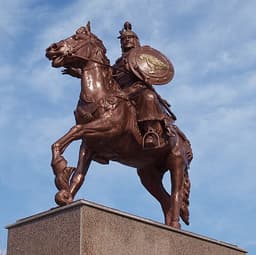
Asparukh of Bulgaria
Emperor · Medieval
55.2Total

Napoleon Bonaparte
General · Modern
70.9Total
Basic Information
Born
640
1769
Died
701
1821
Era
Medieval
Modern
Nationality
Bulgaria
France
Occupation
Emperor
General
Civilization
Western
Western
Score Comparison
Military (10%)
61.7
94.0
Political (20%)
53.8
72.0
Influence (20%)
55.0
40.0
Legacy (20%)
55.0
80.0
Leadership (15%)
53.2
78.0
Strategy (15%)
55.0
90.0
TOTAL
55.2
70.9
Asparukh of Bulgaria — Complete Timeline
680 AD
Battle of OngalWar◆ Major
Asparukh's Bulgar forces defeated the Byzantine army of Emperor Constantine IV at the Battle of Ongal in the Danube delta. This victory allowed the Bulgars to settle permanently south of the Danube and establish their state.
BattleByzantine-Bulgar WarsFounding
Impact: regional
681 AD
Founding of the First Bulgarian EmpirePolitical Action
Asparukh led the Bulgar tribes across the Danube River and established the First Bulgarian Empire in the territory of modern-day Bulgaria. He defeated Byzantine forces and secured recognition of the new state through a treaty with Emperor Constantine IV.
FoundingBulgarian EmpireMigration
Impact: regionalconstructive
Treaty with the Byzantine Empire (681)Political Action◆ Major
Asparukh negotiated a peace treaty with the Byzantine Empire that recognized the First Bulgarian Empire as an independent state. The treaty also established a tribute payment from Byzantium to Bulgaria.
TreatyByzantine-Bulgar RelationsFounding
Impact: regionalconstructive
Napoleon Bonaparte — Complete Timeline
1799 AD
Coup of 18 BrumaireOther◆ Major
Napoleon Bonaparte, with support from his brother Lucien and key political figures, overthrew the Directory in a bloodless coup. He established the Consulate with himself as First Consul, effectively becoming the ruler of France. This event ended the French Revolution's most unstable period.
French RevolutionCoupRise to Power
Impact: regional
1804 AD
Promulgation of the Napoleonic CodeOther◆ Major
Napoleon enacted the Civil Code of the French, known as the Napoleonic Code, a comprehensive set of laws that replaced the fragmented feudal legal systems. The code established legal equality, protected property rights, and secularized law. It became the basis for legal systems in many European and world countries.
Legal ReformNapoleonic CodeCivil Law
Impact: globalconstructive
1805 AD
Battle of AusterlitzWar◆ Major
Napoleon's Grande Arm
Napoleonic WarsBattleDecisive Victory
Impact: global
1812 AD
Invasion of RussiaWar◆ Major
Napoleon led the Grande Arm
Napoleonic WarsInvasionDisaster
Impact: globaldestructive
1815 AD
Battle of WaterlooWar◆ Major
Napoleon's French army was defeated by the combined forces of the Duke of Wellington's Anglo-Allied army and Gebhard Leberecht von Bl
Napoleonic WarsBattleFinal Defeat
Impact: globaldestructive
Expert Analysis
asparukh-of-bulgaria-vs-napoleon-bonaparte
# The Emperor and the Khan: Two Founders of Empires
On a June morning in 1815, Napoleon Bonaparte watched the rain-soaked fields of Waterloo and saw his world collapse. Four hundred miles to the south, a different scene had unfolded eleven centuries earlier: a Bulgar khan named Asparukh led his horsemen through the Danube delta, facing the might of the Byzantine Empire. One man would become the most famous conqueror in European history; the other would found a nation that outlasted his own bones by more than a thousand years. What separates a legend from a founder?
Origins
Napoleon Bonaparte was born in 1769 on the island of Corsica, a place that had only recently become French. His family was minor nobility, poor enough to resent the mainland but ambitious enough to send their son to French military schools. There, young Napoleon devoured the works of Caesar and Alexander, learned artillery mathematics, and felt the sting of being mocked as a provincial outsider. The French Revolution erupted when he was twenty, tearing down the old order and creating a world where a Corsican lieutenant could become emperor—if he had the nerve.
Asparukh of Bulgaria came from a world far removed from Enlightenment Europe. Born around 640, he was a prince of the Bulgars, a Turkic people who had migrated from the steppes north of the Black Sea. His father, Khan Kubrat, had united the Bulgar tribes into a confederation called Old Great Bulgaria, but after Kubrat’s death, the confederation shattered under pressure from the Khazars. Asparukh led one fragment of his people westward, searching not for glory but for survival. His education was not in books but in horsemanship, archery, and the harsh calculus of nomadic politics.
Rise to Power
Napoleon’s ascent was a masterpiece of timing and self-invention. In 1793, at age twenty-four, he drove the British from Toulon with a brilliant artillery plan, earning promotion to brigadier general. By 1796 he commanded the Army of Italy, where he transformed starving soldiers into a conquering force, winning battle after battle against the Austrians. His 1798 Egyptian campaign was a disaster strategically but a triumph of propaganda—he returned to France a hero. In 1799, he staged a coup and made himself First Consul. By 1804, he crowned himself Emperor in Notre Dame, taking the crown from the Pope’s hands and placing it on his own head.
Asparukh’s path was slower and more precarious. Around 680, he led his Bulgar horde across the Danube River into the Balkans, a region long claimed by the Byzantine Empire. The Byzantines under Emperor Constantine IV sent a massive army to crush these newcomers. Asparukh chose his ground carefully: the Ongal, a marshy, fortified region in the Danube delta where the Byzantines could not deploy their superior numbers effectively. In 680, at the Battle of Ongal, the Bulgar horsemen routed the imperial army. Constantine IV fled, wounded and humiliated. The next year, Asparukh negotiated a treaty that recognized his state as an independent entity—the First Bulgarian Empire.
Leadership & Governance
Napoleon ruled through sheer force of will and a genius for organization. He reformed French law with the Napoleonic Code, which established equality before the law and protected property rights. He created a centralized education system, a modern banking system, and an efficient bureaucracy. On the battlefield, he was unmatched: his speed, his use of artillery, his ability to concentrate forces at the decisive point won him Austerlitz, Jena, and Friedland. His score of 93 in strategy reflects a mind that could calculate the movements of hundreds of thousands of men across a continent.
Asparukh governed differently, blending steppe traditions with Balkan realities. He established a capital at Pliska, a fortified camp that would grow into a city. He integrated the local Slavic population into his state, creating a hybrid Bulgar-Slavic society that would eventually speak Slavic and adopt Christianity. His leadership score of 84.8 suggests a commander who inspired loyalty not through charisma but through demonstrated competence. He did not conquer for conquest’s sake; he built a state that could endure.
Triumph & Tragedy
Napoleon’s greatest moment came on December 2, 1805, at Austerlitz, where he destroyed the combined armies of Russia and Austria. It was his masterpiece, a battle so perfect that it is still studied in military academies. His greatest failure followed a decade later: the invasion of Russia in 1812. He marched with 600,000 men into a frozen wasteland and emerged with fewer than 100,000. The disaster broke his aura of invincibility. Exiled to Elba, he escaped and returned for a hundred days, only to meet final defeat at Waterloo in 1815. He died in exile on Saint Helena in 1821, a prisoner of the British.
Asparukh’s triumph was the founding itself. He created a state that would endure for over three centuries, until 1018. His tragedy was the unknown: he died in battle against the Khazars around 701, fighting a war that history barely records. We do not know how he fell, only that he fell defending what he built. His son Tervel would go on to lead Bulgaria to even greater heights.
Character & Destiny
Napoleon was driven by an insatiable hunger for glory. “I live only for posterity,” he once said, and he meant it. He could not stop—he could not consolidate his gains, could not make peace, could not share power. His ambition was both his engine and his destruction. He believed he was a man of destiny, and for a time, he was right.
Asparukh was more pragmatic. He did not seek to conquer the world; he sought to create a home for his people. His decisions—choosing the Ongal, negotiating the treaty, integrating the Slavs—were cautious, strategic, and long-sighted. He understood that empires are built not in a single battle but over generations.
Legacy
Napoleon’s legacy is enormous but ambiguous. The Napoleonic Code influences legal systems across Europe and the world. His military innovations shaped warfare for a century. But his name is also synonymous with megalomania and ruin. His total score of 82.4 reflects a figure of immense talent whose flaws were as large as his gifts.
Asparukh’s legacy is quieter but deeper. He is revered as the founder of Bulgaria, a nation that still exists today. His treaty of 681 is celebrated as the birth of the country. He did not change the world as Napoleon did, but he created something that outlasted him by thirteen centuries.
Conclusion
Standing at the edge of the Danube, watching his people cross into an unknown land, Asparukh could not have imagined a Corsican artillery officer who would one day conquer Europe. Yet both men faced the same question: How do you build something that lasts? Napoleon built a monument to himself, and it crumbled in his lifetime. Asparukh built a nation, and it endures. Perhaps the deepest difference between them is not in talent or ambition, but in what they chose to love. One loved glory; the other loved his people. History remembers both, but it is Asparukh’s descendants who still sing his name.
Rankings
🥇
Napoleon BonaparteLeader
Mil: 94.0Pol: 72.0Inf: 40.0
70.9
🥈
Asparukh of Bulgaria
Mil: 61.7Pol: 53.8Inf: 55.0
55.2
+15.7 behind
How This Comparison Works
Algorithm
Each figure is scored on 6 dimensions (0—100 scale) based on structured historical data: Military (10%), Political (20%), Influence (20%), Legacy (20%), Leadership (15%), Strategy (15%). The weighted total produces the final ranking.
Data Sources
Scores are computed from structured sub-indicators in the database. Scale factors adjust for era (Ancient ×0.85, Modern ×1.0) and civilization size (Eastern ×1.05, Other ×0.80) to account for differences in population and military scale.
Maximum 3 Figures
Comparisons are limited to 2—3 figures to ensure readability and statistical meaningfulness.
Error Margins
±5 points per dimension — Sub-scores are derived from historical records with inherent uncertainty. Two figures within 5 points on a dimension should be considered roughly equivalent in that area.
Total Score Accuracy
±3 points overall — The weighted combination of 6 dimensions produces a total score with approximately ±3 points of uncertainty. Differences of less than 3 points are not statistically significant— the figures are effectively tied.
Known Limitations
- Historical records are incomplete and uneven across civilizations
- Figures from oral-tradition societies may be underrepresented
- Occupation labels can misclassify multi-role figures
- Scores measure capability and impact, not moral character
- Quantitative scoring is a comparison tool, not absolute truth
Capability Radar
Military (10%) — Battles & Warfare
Battles
65
95
Win Rate
70
90
Expansion
70
95
Political (20%) — Governance & Reform
Reform
65
95
Diplomacy
70
80
Economy
55
85
Influence (20%) — Cultural & Global Reach
Cultural
65
85
Global
55
90
Legacy (20%) — Historical Impact
Historical
70
95
Longevity
75
90
Leadership (15%) — Power & Stability
Tenure
60
85
Stability
60
70
Strategy (15%) — Tactics & Innovation
Strategy
75
95
Tactics
60
98
Reform
55
92
Similar Comparisons
Comments & Discussion
No comments yet. Be the first to share your thoughts!