Loading...
This comparison has not been analyzed yet.
One-time AI generation (~1 minute). Scores and timeline are already available below.
Attila the Hun vs King Jangsu
King Jangsu leads by 9.7 pts · 2 figures compared
…

Attila the Hun
Emperor · Ancient
50.1Total
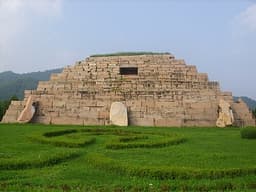
King Jangsu
Emperor · Ancient
59.8Total
Basic Information
Born
406
394
Died
453
491
Era
Ancient
Ancient
Nationality
Hunnic Empire
Korea
Occupation
Emperor
Emperor
Civilization
Western
Eastern
Score Comparison
Military (10%)
77.5
60.0
Political (20%)
35.0
59.3
Influence (20%)
52.5
56.4
Legacy (20%)
49.2
50.0
Leadership (15%)
30.0
78.0
Strategy (15%)
72.0
66.3
TOTAL
50.1
59.8
Attila the Hun — Complete Timeline
441 AD
Invasion of the BalkansWar◆ Major
Attila launched a major invasion of the Eastern Roman Empire, crossing the Danube and sacking cities in the Balkans. The Romans were forced to pay tribute and cede territory. This established Attila as a major threat to Rome.
Hunnic InvasionsEastern Roman EmpireBarbarian
Impact: regionaldestructive
451 AD
Battle of the Catalaunian PlainsWar
Attila's Huns fought a coalition of Romans and Visigoths led by Aetius and Theodoric I in Gaul. The battle was indecisive but halted Attila's advance into Gaul. Theodoric was killed. Attila withdrew from Gaul.
BattleRoman-Gothic AllianceHuns
Impact: regional
452 AD
Invasion of ItalyWar◆ Major
Attila invaded Italy, sacking Aquileia and other cities. He forced the Roman emperor Valentinian III to flee Ravenna. The invasion was stopped by a delegation led by Pope Leo I, who negotiated Attila's withdrawal.
ItalyPope Leo IHunnic Invasions
Impact: regionaldestructive
453 AD
Death of AttilaOther
Attila died suddenly on his wedding night to a Germanic princess named Ildico. The cause was likely a hemorrhage or alcohol poisoning. His death led to the rapid disintegration of the Hunnic Empire.
DeathHunnic EmpireCollapse
Impact: regional
King Jangsu — Complete Timeline
413 AD
Ascended to the Throne of GoguryeoPolitical Action◆ Major
Jangsu became king of Goguryeo upon the death of his father, Gwanggaeto the Great. He inherited a vast empire and continued its development.
AccessionGoguryeoKorea
Impact: regional
427 AD
Moved Capital to PyongyangPolitical Action
Jangsu moved the Goguryeo capital from Gungnae (Ji'an) to Pyongyang. This strategic relocation strengthened control over the Korean Peninsula and facilitated trade and diplomacy.
Capital MovePyongyangGoguryeo
Impact: regionalconstructive
435 AD
Established Diplomatic Relations with ChinaPolitical Action◆ Major
Jangsu sent envoys to the Northern Wei dynasty in China, establishing formal diplomatic relations. This helped secure Goguryeo's borders and facilitated cultural exchange.
DiplomacyChinaGoguryeo
Impact: regionalconstructive
475 AD
Defended Against Chinese InvasionsWar◆ Major
Jangsu successfully repelled invasions by the Northern Wei dynasty, maintaining Goguryeo's territorial integrity. His military leadership preserved the kingdom's independence.
DefenseGoguryeoNorthern Wei
Impact: regionalconstructive
491 AD
Died After Long ReignOther◆ Major
Jangsu died at the age of 97, after a reign of approximately 78 years, one of the longest in world history. His rule stabilized and expanded Goguryeo's power.
Long ReignGoguryeoKorea
Impact: regional
This comparison has not been analyzed yet.
One-time AI generation (~1 minute). Scores and timeline are already available below.
Rankings
🥇
King JangsuLeader
Mil: 60.0Pol: 59.3Inf: 56.4
59.8
🥈
Attila the Hun
Mil: 77.5Pol: 35.0Inf: 52.5
50.1
+9.7 behind
How This Comparison Works
Algorithm
Each figure is scored on 6 dimensions (0—100 scale) based on structured historical data: Military (10%), Political (20%), Influence (20%), Legacy (20%), Leadership (15%), Strategy (15%). The weighted total produces the final ranking.
Data Sources
Scores are computed from structured sub-indicators in the database. Scale factors adjust for era (Ancient ×0.85, Modern ×1.0) and civilization size (Eastern ×1.05, Other ×0.80) to account for differences in population and military scale.
Maximum 3 Figures
Comparisons are limited to 2—3 figures to ensure readability and statistical meaningfulness.
Error Margins
±5 points per dimension — Sub-scores are derived from historical records with inherent uncertainty. Two figures within 5 points on a dimension should be considered roughly equivalent in that area.
Total Score Accuracy
±3 points overall — The weighted combination of 6 dimensions produces a total score with approximately ±3 points of uncertainty. Differences of less than 3 points are not statistically significant— the figures are effectively tied.
Known Limitations
- Historical records are incomplete and uneven across civilizations
- Figures from oral-tradition societies may be underrepresented
- Occupation labels can misclassify multi-role figures
- Scores measure capability and impact, not moral character
- Quantitative scoring is a comparison tool, not absolute truth
Capability Radar
Military (10%) — Battles & Warfare
Battles
75
60
Win Rate
70
65
Expansion
85
75
Political (20%) — Governance & Reform
Reform
40
70
Diplomacy
55
80
Economy
30
75
Influence (20%) — Cultural & Global Reach
Cultural
60
55
Global
65
45
Legacy (20%) — Historical Impact
Historical
75
60
Longevity
70
65
Leadership (15%) — Power & Stability
Tenure
65
95
Stability
35
85
Strategy (15%) — Tactics & Innovation
Strategy
80
70
Tactics
85
55
Reform
60
50
Similar Comparisons
Comments & Discussion
No comments yet. Be the first to share your thoughts!