Loading...
Augustus vs Emperor Wen of Sui
Augustus leads by 5.6 pts · 2 figures compared
…

Augustus
Emperor · Ancient
85.9Total
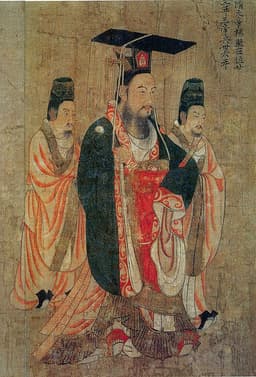
Emperor Wen of Sui
Emperor · Medieval
80.3Total
Basic Information
Born
63
541
Died
—
604
Era
Ancient
Medieval
Nationality
Roman Empire
China
Occupation
Emperor
Emperor
Civilization
Western
Eastern
Score Comparison
Military (10%)
72.0
76.0
Political (20%)
90.0
75.0
Influence (20%)
88.0
88.0
Legacy (20%)
90.0
80.0
Leadership (15%)
88.0
80.0
Strategy (15%)
75.0
75.0
TOTAL
85.9
80.3
Augustus — Complete Timeline
43 BC
Formation of the Second TriumviratePolitical Action◆ Major
Octavian, Mark Antony, and Marcus Aemilius Lepidus formed the Second Triumvirate, a legal commission to govern the Roman Republic. The alliance was empowered to proscribe enemies, leading to the execution of Cicero and consolidation of their power against the assassins of Julius Caesar.
Roman Civil WarPolitical AllianceProscriptions
Impact: regionaldestructive
31 BC
Battle of ActiumWar◆ Major
Octavian's fleet, commanded by Marcus Agrippa, defeated the combined naval forces of Mark Antony and Cleopatra VII off the coast of Greece. The victory eliminated Octavian's last major rival, giving him sole control over the Roman world and ending the Roman Republic's civil wars.
Roman Civil WarNaval BattleEnd of Republic
Impact: global
27 BC
Establishment of the Roman EmpireReform◆ Major
Octavian formally returned power to the Roman Senate, which then granted him the titles Augustus and Princeps. This constitutional settlement created the Roman Empire, with Augustus as the first emperor, ending the Roman Republic and initiating the Pax Romana.
Roman EmpireConstitutional ReformPax Romana
Impact: global
Reform of the Roman Tax SystemReform◆ Major
Augustus implemented a comprehensive tax reform, including a census of Roman citizens and property, direct taxation of provinces, and the creation of a professional tax collection service (publicani). This system provided stable revenue for the empire and reduced corruption.
Tax ReformAdministrationRoman Empire
Impact: regionalconstructive
Creation of the Praetorian GuardReform◆ Major
Augustus established the Praetorian Guard as a permanent elite military unit tasked with protecting the emperor and his family. Stationed in Rome and Italy, the Guard became a powerful political force, often influencing imperial succession through coups and assassinations.
Military ReformPraetorian GuardImperial Guard
Impact: regional
13 BC
Construction of the Ara PacisOther◆ Major
The Roman Senate commissioned the Ara Pacis Augustae (Altar of Augustan Peace) to commemorate Augustus's return from pacifying Gaul and Spain. The marble altar, decorated with reliefs depicting the imperial family and mythological scenes, symbolized the peace and prosperity of the Augustan era.
Building ProjectPropagandaAugustan Art
Impact: regionalconstructive
Emperor Wen of Sui — Complete Timeline
581 AD
Establishment of the Three Departments and Six Ministries SystemReform◆ Major
Emperor Wen established a centralized bureaucratic system with three departments (Secretariat, Chancellery, and Department of State Affairs) and six ministries. This system became the foundation of Chinese government administration for centuries.
Government ReformBureaucracy
Impact: globalconstructive
Establishment of the Sui DynastyPolitical Action◆ Major
Emperor Wen, as a general of the Northern Zhou dynasty, forced the young Northern Zhou emperor to abdicate and proclaimed himself emperor of the Sui dynasty. This marked the beginning of the Sui dynasty, which would go on to reunify China.
Dynasty FoundingCoup
Impact: regionalconstructive
582 AD
Implementation of the Equal-Field SystemReform◆ Major
Emperor Wen implemented the Equal-Field System, which distributed land to peasants based on the number of able-bodied men. This reform increased agricultural productivity, stabilized tax revenues, and reduced the power of large landowners.
Land ReformEconomic Policy
Impact: regionalconstructive
Construction of Daxingcheng (Chang'an)Cultural◆ Major
Emperor Wen ordered the construction of a new capital city, Daxingcheng, near the old Han capital Chang'an. This city, later known as Chang'an, became a model for urban planning and served as the capital of the Sui and Tang dynasties.
Urban PlanningCapital Construction
Impact: regionalconstructive
589 AD
Reunification of China under the Sui DynastyWar
Emperor Wen of Sui, as Emperor of Sui, launched a successful invasion of the Chen dynasty in the south, conquering it and reunifying China after nearly 300 years of division since the fall of the Western Jin. This ended the Northern and Southern Dynasties period.
UnificationConquest
Impact: globalconstructive
Expert Analysis
Origins
Gaius Octavius, later known as Augustus, was born into a wealthy plebeian family in 63 BC. His great-uncle was Julius Caesar, who adopted him as his heir, catapulting him into the heart of Roman politics. In contrast, Emperor Wen of Sui, born Yang Jian, hailed from a powerful military family during the chaotic Northern and Southern Dynasties period. His father was a general under the Northern Zhou, and Wen inherited his position, navigating the treacherous court politics to eventually seize power.
Rise to Power
Augustus's rise was marked by the formation of the Second Triumvirate with Mark Antony and Lepidus, followed by a series of civil wars. The Battle of Actium in 31 BC was the decisive turning point, where he defeated Antony and Cleopatra, leaving him as the undisputed master of Rome. He skillfully consolidated power, avoiding the fate of Caesar by maintaining republican forms while holding absolute authority. Emperor Wen's path was more direct: after a successful coup against the Northern Zhou emperor, he established the Sui Dynasty in 581 AD. He then launched a military campaign to conquer the southern Chen dynasty, completing the reunification of China in 589 AD after nearly four centuries of division.
Leadership & Governance
Augustus (Score: 90) reformed every aspect of Roman governance. He established the Principate, a system where he held supreme power while ostensibly restoring the Republic. He reformed the tax system, created a standing army with the Praetorian Guard, and initiated vast building projects, famously boasting that he found Rome a city of brick and left it a city of marble. His administrative reforms included dividing provinces into imperial and senatorial, and establishing a professional civil service. Emperor Wen (Score: 80) focused on centralizing power and implementing efficient systems. He introduced the Equal-Field System to redistribute land and stabilize agriculture, and established the Three Departments and Six Ministries system, which became the model for Chinese bureaucracy for centuries. He also rebuilt Chang'an as a planned capital, Daxingcheng, showcasing his organizational prowess.
Triumph & Tragedy
Augustus's triumphs were monumental: he ended a century of civil wars, initiated the Pax Romana (a 200-year period of peace), and expanded the empire's borders. However, his personal life was marked by tragedy: his chosen heirs died young, and his daughter Julia was exiled for adultery. His later years were plagued by succession worries, ultimately settling on Tiberius. Emperor Wen succeeded in reunifying China and laying the foundations for the Sui and subsequent Tang dynasties. Yet, his reign ended tragically: historical accounts suggest he was murdered by his son, Yang Guang (Emperor Yang of Sui), who would later mismanage the empire and lead it to ruin. Wen's own strict legal code and heavy taxation also sowed seeds of discontent.
Character & Destiny
Augustus (Score: 88) was a master propagandist and political genius, known for his shrewdness, patience, and ability to inspire loyalty. He presented himself as a modest "first citizen" while accumulating unprecedented power. His destiny was to transform Rome from a republic into an empire, setting a template for future rulers. Emperor Wen (Score: 88) was equally shrewd, but more austere and ruthless. He was a capable administrator who valued efficiency and merit. His destiny was to reunite China, but his harsh methods and failure to secure a competent successor meant his achievements were short-lived. Both men were driven by a vision of order and stability, but Augustus's legacy proved more enduring.
Legacy
Augustus's legacy is immense. He founded the Roman Empire, which lasted for centuries and profoundly shaped Western civilization. The title "Augustus" became synonymous with imperial power, and his administrative and military reforms set standards for governance. The Pax Romana allowed for cultural and economic flourishing. Emperor Wen's legacy is more mixed: he reunified China and created institutions that the Tang dynasty perfected, but his dynasty collapsed only 37 years after his death. His systems, such as the Three Departments and Six Ministries, were adopted by subsequent dynasties, and the Equal-Field System influenced land reforms. However, his reign is often overshadowed by the spectacular failure of his son.
Conclusion
Augustus and Emperor Wen of Sui were both transformative founders who ended periods of civil war and established new dynasties. Augustus built an empire that lasted centuries, while Wen's Sui dynasty was short-lived but provided the foundation for China's golden age under the Tang. On the score gap of 5.6 points, Augustus emerges as the more successful and influential leader. His superior governance score (90 vs 80) reflects his more effective and lasting administrative reforms. While Wen's achievements in reunifying China were remarkable, Augustus's ability to create a stable, enduring imperial system that shaped Western history gives him the edge. Both were products of their times, but Augustus's legacy of peace and institutional stability remains unparalleled. **Final Score: Augustus 86, Emperor Wen 80.4.**
Rankings
🥇
AugustusLeader
Mil: 72.0Pol: 90.0Inf: 88.0
85.9
🥈
Emperor Wen of Sui
Mil: 76.0Pol: 75.0Inf: 88.0
80.3
+5.6 behind
How This Comparison Works
Algorithm
Each figure is scored on 6 dimensions (0—100 scale) based on structured historical data: Military (10%), Political (20%), Influence (20%), Legacy (20%), Leadership (15%), Strategy (15%). The weighted total produces the final ranking.
Data Sources
Scores are computed from structured sub-indicators in the database. Scale factors adjust for era (Ancient ×0.85, Modern ×1.0) and civilization size (Eastern ×1.05, Other ×0.80) to account for differences in population and military scale.
Maximum 3 Figures
Comparisons are limited to 2—3 figures to ensure readability and statistical meaningfulness.
Error Margins
±5 points per dimension — Sub-scores are derived from historical records with inherent uncertainty. Two figures within 5 points on a dimension should be considered roughly equivalent in that area.
Total Score Accuracy
±3 points overall — The weighted combination of 6 dimensions produces a total score with approximately ±3 points of uncertainty. Differences of less than 3 points are not statistically significant— the figures are effectively tied.
Known Limitations
- Historical records are incomplete and uneven across civilizations
- Figures from oral-tradition societies may be underrepresented
- Occupation labels can misclassify multi-role figures
- Scores measure capability and impact, not moral character
- Quantitative scoring is a comparison tool, not absolute truth
Capability Radar
Military (10%) — Battles & Warfare
Battles
75
75
Win Rate
80
80
Expansion
85
85
Political (20%) — Governance & Reform
Reform
95
95
Diplomacy
90
85
Economy
85
90
Influence (20%) — Cultural & Global Reach
Cultural
85
70
Global
90
65
Legacy (20%) — Historical Impact
Historical
95
85
Longevity
95
70
Leadership (15%) — Power & Stability
Tenure
95
80
Stability
95
75
Strategy (15%) — Tactics & Innovation
Strategy
85
85
Tactics
70
70
Reform
90
90
Similar Comparisons
Comments & Discussion
Chronicler98506/16/2026
每次看到这种对比,总觉得西方学者低估了文帝。奥古斯都建立罗马帝国不假,但文帝结束的是近三百年的南北朝分裂局面,比罗马内战的难度大多了。而且文帝的均田制和租庸调制,直接为唐朝盛世打下了基础,这个影响力不比奥古斯都的罗马和平差。再说政治手腕,文帝能一面废黜北周幼帝、一面用怀柔政策收服南方士族,这种平衡能力在西方历史上并不多见。只能说,评分的人可能更熟悉地中海历史,对中国历史的深层影响理解不足。
ColdScribe116/16/2026
这个评分体系让我有点困惑。奥古斯都政治92分,文帝只有79分?但文帝废除了九品中正制、创立三省六部制、推行均田制,这些制度直接影响了隋唐两代的政治架构。奥古斯都的元首制确实巧妙,但罗马帝国后期政治动荡,而隋朝制度延续了三百多年。而且军事上,文帝灭陈统一全国是实打实的战绩,得分76比奥古斯都的72高不了多少?奥古斯都自己没上战场,全靠阿格里帕,这分差不合理。如果要按实际行政效率打分,文帝至少该85以上。