Loading...
Augustus vs Julius Caesar
Augustus leads by 3.1 pts · 2 figures compared
…

Augustus
Emperor · Ancient
86.4Total
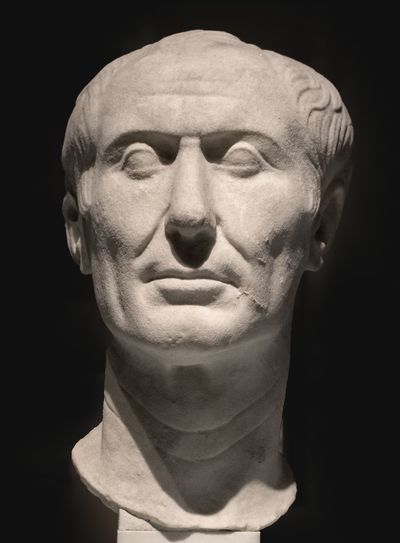
Julius Caesar
General · Ancient
83.3Total
Basic Information
Born
63
-100
Died
—
-44
Era
Ancient
Ancient
Nationality
Roman Empire
Roman Republic
Occupation
Emperor
General
Civilization
Western
Western
Score Comparison
Military (10%)
72.0
88.0
Political (20%)
92.0
78.0
Influence (20%)
88.0
85.0
Legacy (20%)
90.0
82.0
Leadership (15%)
90.0
82.0
Strategy (15%)
78.0
88.0
TOTAL
86.4
83.3
Rankings
🥇
AugustusLeader
Mil: 72.0Pol: 92.0Inf: 88.0
86.4
🥈
Julius Caesar
Mil: 88.0Pol: 78.0Inf: 85.0
83.3
+3.1 behind
How This Comparison Works
Algorithm
Each figure is scored on 6 dimensions (0—100 scale) based on structured historical data: Military (10%), Political (20%), Influence (20%), Legacy (20%), Leadership (15%), Strategy (15%). The weighted total produces the final ranking.
Data Sources
Scores are computed from structured sub-indicators in the database. Scale factors adjust for era (Ancient ×0.85, Modern ×1.0) and civilization size (Eastern ×1.05, Other ×0.80) to account for differences in population and military scale.
Maximum 3 Figures
Comparisons are limited to 2—3 figures to ensure readability and statistical meaningfulness.
Error Margins
±5 points per dimension — Sub-scores are derived from historical records with inherent uncertainty. Two figures within 5 points on a dimension should be considered roughly equivalent in that area.
Total Score Accuracy
±3 points overall — The weighted combination of 6 dimensions produces a total score with approximately ±3 points of uncertainty. Differences of less than 3 points are not statistically significant— the figures are effectively tied.
Known Limitations
- Historical records are incomplete and uneven across civilizations
- Figures from oral-tradition societies may be underrepresented
- Occupation labels can misclassify multi-role figures
- Scores measure capability and impact, not moral character
- Quantitative scoring is a comparison tool, not absolute truth
Capability Radar
Military (10%) — Battles & Warfare
Battles
75
95
Win Rate
80
92
Expansion
85
97
Political (20%) — Governance & Reform
Reform
95
90
Diplomacy
90
85
Economy
85
82
Influence (20%) — Cultural & Global Reach
Cultural
85
88
Global
90
94
Legacy (20%) — Historical Impact
Historical
95
95
Longevity
95
96
Leadership (15%) — Power & Stability
Tenure
95
75
Stability
95
60
Strategy (15%) — Tactics & Innovation
Strategy
85
94
Tactics
70
96
Reform
90
88
Expert Analysis
Julius Caesar vs Augustus: Historical Comparison
Julius Caesar and Augustus were the two titans who dismantled the Roman Republic and forged the Roman Empire, yet they achieved this through starkly different means—Caesar as a conquering general, Augustus as a masterful political architect. While Caesar’s military brilliance and ambition set the stage, Augustus’s institutional genius secured and sustained the imperial system for centuries.
Dimension Analysis
**Military: Julius Caesar 88 / Augustus 72**
Caesar was one of history’s greatest field commanders, conquering Gaul, invading Britain, and winning the civil war through audacious tactics like at Alesia and Pharsalus. Augustus, by contrast, relied on his general Agrippa and suffered a major defeat at Teutoburg Forest, though he professionalized the legions into a standing imperial army.
**Political: Julius Caesar 78 / Augustus 92**
Caesar’s political acumen was undermined by his dictatorial arrogance, which alienated the Senate and led to his assassination. Augustus, however, masterfully cloaked autocracy in republican forms, accumulating powers gradually while maintaining the illusion of restored liberty—a political sleight of hand that ensured his 41-year reign.
**Influence: Julius Caesar 85 / Augustus 88**
Caesar’s crossing of the Rubicon and his assassination became enduring symbols of ambition and political martyrdom; his name became the title “Caesar” for future emperors. Augustus exerted deeper structural influence, creating the imperial bureaucracy, tax system, and the Pax Romana that shaped Mediterranean governance for centuries.
**Legacy: Julius Caesar 82 / Augustus 90**
Caesar’s legacy is dramatic but incomplete—he died before consolidating his reforms, leaving chaos in his wake. Augustus’s legacy is the Roman Empire itself: he established the principate, reformed the calendar, and his reign inaugurated two centuries of relative peace and prosperity.
**Leadership: Julius Caesar 82 / Augustus 90**
Caesar inspired fierce loyalty in his legions but failed to build lasting political alliances, resulting in betrayal. Augustus excelled at delegating, building coalitions, and exercising patience—qualities that allowed him to transform a war-torn republic into a stable empire without provoking fatal opposition.
Verdict
Augustus leads decisively due to his superior political and institutional statecraft, which translated his adoptive father’s military conquests into a durable imperial system that survived for centuries.
FAQ
Q: Who ranks higher? A: Augustus ranks higher overall, scoring 86 to Caesar’s 83, owing to his unmatched political mastery and enduring institutional legacy.
Similar Comparisons
Comments & Discussion
DataNerd6/12/2026
The Legacy dimension (90 vs 82) is fascinating. Augustus built things that lasted centuries. Julius Caesar was brilliant but their impact was more transient. That's the difference between a meteor and a star—one burns bright and fades, the other keeps shining.
ContrarianView6/12/2026
Hot take: the winner is wrong. Julius Caesar faced much tougher opposition and achieved more with less. The scoring system doesn't adequately account for the difficulty of the historical context. Augustus had every advantage—Julius Caesar had to fight for every inch. Context matters more than raw scores.
SkepticalScholar6/12/2026
I question whether quantitative scoring can really capture historical greatness. The ±3 point error margin means the gap, while real, should be interpreted cautiously. History is not a spreadsheet. But I'll admit—this is the most rigorous attempt I've seen.