Loading...
Aurelian vs Tanshihuai
Aurelian leads by 3.8 pts · 2 figures compared
…

Aurelian
Emperor · Ancient
63.0Total
Tanshihuai
Emperor · Ancient
59.2Total
Basic Information
Born
214
141
Died
275
181
Era
Ancient
Ancient
Nationality
Roman Empire
Xianbei
Occupation
Emperor
Emperor
Civilization
Western
Eastern
Score Comparison
Military (10%)
78.0
82.0
Political (20%)
72.0
68.0
Influence (20%)
56.7
52.5
Legacy (20%)
55.0
44.2
Leadership (15%)
62.0
74.0
Strategy (15%)
72.0
55.0
TOTAL
63.0
59.2
Aurelian — Complete Timeline
271 AD
Defeat of the Juthungi and AlamanniWar◆ Major
Aurelian defeated the Juthungi and Alamanni tribes who had invaded Italy, driving them back across the Danube. He also abandoned the province of Dacia, resettling its population south of the Danube to create a more defensible frontier.
Barbarian InvasionDefenseDacia
Impact: regional
Construction of the Aurelian WallsOther◆ Major
Aurelian ordered the construction of a massive defensive wall around Rome, the Aurelian Walls, to protect the city from barbarian invasions. The walls were 19 kilometers long and remained in use for centuries.
FortificationRomeDefense
Impact: nationalconstructive
274 AD
Reunification of the Roman EmpireWar
Aurelian defeated the Gallic Empire under Tetricus I at the Battle of Ch
ReunificationGallic EmpirePalmyrene Empire
Impact: globalconstructive
Monetary ReformReform
Aurelian reformed the Roman currency, introducing a new silver coin (the antoninianus) with a higher silver content to combat inflation. He also attempted to stabilize prices and improve the economy, though with limited long-term success.
CurrencyReformEconomy
Impact: nationalconstructive
275 AD
Assassination of AurelianPolitical Action◆ Major
Aurelian was assassinated by his own officers while on campaign against the Sassanid Empire, due to a conspiracy involving a secretary who feared punishment. His death cut short his plans for further reforms and campaigns.
AssassinationConspiracyEnd of Reign
Impact: globaltragic
Tanshihuai — Complete Timeline
156 AD
Raid on the Han frontier (156 AD)War
Tanshihuai led a large-scale raid into Han territory, attacking commanderies in the northern provinces. The Han forces were unable to stop him, and the raid caused significant destruction and loss of life, demonstrating Xianbei military power.
Han-Xianbei WarRaid
Impact: regionaldestructive
Unification of the Xianbei tribesPolitical Action◆ Major
Tanshihuai united the disparate Xianbei tribes of the Mongolian steppe into a powerful confederation. He established a centralized leadership and expanded Xianbei territory, creating a major rival to the Han dynasty in the north.
UnificationXianbei Confederation
Impact: regionalconstructive
158 AD
Defeat of the Han army at the Battle of the Yinshan MountainsWar◆ Major
Tanshihuai ambushed and defeated a Han punitive expedition in the Yinshan Mountains. The Han commander was killed, and the Xianbei captured large amounts of supplies and weapons, solidifying Tanshihuai's reputation as a formidable military leader.
BattleHan-Xianbei War
Impact: regionaldestructive
160 AD
Establishment of a Xianbei legal codeReform
Tanshihuai implemented a unified legal code for the Xianbei confederation, replacing tribal customs with standardized laws. This reform strengthened central authority and facilitated the administration of the growing empire.
Legal ReformXianbei Empire
Impact: regionalconstructive
Expert Analysis
Origins
Lucius Domitius Aurelianus was born in 214 AD in Sirmium (modern Sremska Mitrovica, Serbia), a province on the Danube frontier. His father was a tenant farmer, possibly a freedman, and his mother was a priestess of the Sun. Aurelian rose through the Roman army, gaining a reputation for discipline and toughness. He served under emperors Gallienus and Claudius Gothicus, commanding cavalry units. His humble origins contrasted with the aristocratic background of many Roman emperors.
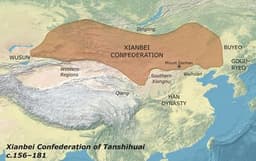
Tanshihuai was born around 140 AD, likely in the eastern Mongolian steppe. He was the son of a Xianbei chieftain, but his early life is obscure. According to Chinese records, he was a man of great strength and intelligence. He began his rise by uniting small Xianbei tribes through marriage alliances and military force. His background was entirely nomadic, with no exposure to settled civilization beyond raids.
Rise to Power
Aurelian's rise accelerated under Emperor Claudius Gothicus. In 268 AD, he played a key role in the Battle of Naissus, where the Romans crushed the Goths. When Claudius died in 270, Aurelian was acclaimed emperor by the Danube legions, bypassing Claudius's brother Quintillus, who ruled briefly. Aurelian quickly secured Rome and faced invasions: the Juthungi and Alamanni crossed the Alps into Italy. In 271, he defeated them at the Battle of Placentia and drove them back. He then abandoned the province of Dacia, a strategic retreat to consolidate borders.
Tanshihuai's rise was more straightforward. Around 156 AD, he became the leader of a major Xianbei tribe. He defeated rival chieftains and forged a confederation stretching from Manchuria to the Altai Mountains. His authority was recognized by the Xianbei people as their supreme leader, a position previously held by none. In 158 AD, he raided Han territories, but his major turning point came in 177 AD: the Han sent a large army to crush him. Tanshihuai ambushed them at the Yinshan Mountains, killing the Han commander and capturing supplies. This victory solidified his control over the steppe.
Leadership & Governance
Aurelian's leadership was authoritarian and reformist. He took the title 'Restorer of the World' and implemented strict discipline. He reformed the Roman currency, minting a new silver coin (antoninianus) with 5% silver content (up from 2% under previous issues). He also attempted religious unification by promoting the cult of Sol Invictus, building a temple in Rome. His most tangible legacy is the Aurelian Walls, 19 km of fortifications built around Rome between 271 and 275 AD. He restored order after the chaos of the third century.
Tanshihuai governed as a nomadic emperor. He divided his confederation into three regions: eastern, central, and western, each under a commander. He implemented a unified legal code, replacing tribal customs with standardized punishments. He also established a system of taxation on trade routes, collecting tribute from caravans. Unlike Aurelian, he did not build cities or infrastructure; his rule was based on personal loyalty and military strength. His governance was efficient for a steppe empire but lacked institutional depth.
Triumph & Tragedy
Aurelian's greatest triumph was the reunification of the Roman Empire. In 273, he defeated the Palmyrene Empire under Queen Zenobia at Emesa and captured her. In 274, he defeated the Gallic Empire under Tetricus I at Châlons. He restored Roman control from Gaul to Syria. His tragedy was his assassination in 275 AD, while marching east against the Sassanids. A secretary, fearing punishment for corruption, forged a list of officers to be executed, prompting his own guards to kill him. He reigned only five years, leaving his reforms incomplete.
Tanshihuai's triumph was the unification of the Xianbei and his victory over the Han in 177 AD. He raided Han territories repeatedly, forcing the Han to pay tribute. His tragedy came after his death around 181 AD: his confederation fragmented within a generation. Without a strong successor, the Xianbei returned to tribal disunity. His empire did not outlast him, unlike Aurelian's walls and reforms.
Character & Destiny
Aurelian was harsh and energetic, known for punishing corruption severely. He was called 'manu ad ferrum' (hand on the sword). His decisiveness saved Rome, but his severity created enemies. His destiny was to be a restorer, not a founder. He scored 78.0 in military and 62.0 in leadership, reflecting his competence but also his fatal lack of political finesse.
Tanshihuai was charismatic and strategic, with a military score of 82.0. He was a unifier of nomads, but his rule depended on personal authority. He scored 74.0 in leadership, higher than Aurelian, but his political score of 68.0 was lower. His destiny was to create a fleeting steppe empire, unable to transition to stable governance.
Legacy
Aurelian's legacy is solid: the Aurelian Walls stood for centuries, his currency reforms stabilized the economy temporarily, and his reunification paved the way for Diocletian's later reforms. He is remembered as a savior of Rome. His influence score of 56.7 reflects his limited long-term impact compared to more transformative emperors.
Tanshihuai's legacy is less tangible. He set a model for steppe unification that later leaders like the Rouran and Turks followed. The Xianbei confederation influenced the development of later nomadic states. His legacy score of 44.2 is lower, partly because his empire collapsed quickly. No monuments or written records survive.
Conclusion
Aurelian had greater impact. Despite a shorter reign, he restored the Roman Empire at a critical moment, and his walls and reforms provided stability that lasted decades. Tanshihuai unified the steppe, but his empire dissolved immediately after his death. Aurelian's total score of 63.0 versus Tanshihuai's 59.2 reflects this. While Tanshihuai was a superior military tactician (82.0 vs 78.0), Aurelian's political achievements (72.0 vs 68.0) and lasting influence (56.7 vs 52.5) give him the edge. The test of time is clear: Aurelian's name is known worldwide; Tanshihuai is obscure outside specialized history.
Rankings
🥇
AurelianLeader
Mil: 78.0Pol: 72.0Inf: 56.7
63.0
🥈
Tanshihuai
Mil: 82.0Pol: 68.0Inf: 52.5
59.2
+3.8 behind
How This Comparison Works
Algorithm
Each figure is scored on 6 dimensions (0—100 scale) based on structured historical data: Military (10%), Political (20%), Influence (20%), Legacy (20%), Leadership (15%), Strategy (15%). The weighted total produces the final ranking.
Data Sources
Scores are computed from structured sub-indicators in the database. Scale factors adjust for era (Ancient ×0.85, Modern ×1.0) and civilization size (Eastern ×1.05, Other ×0.80) to account for differences in population and military scale.
Maximum 3 Figures
Comparisons are limited to 2—3 figures to ensure readability and statistical meaningfulness.
Error Margins
±5 points per dimension — Sub-scores are derived from historical records with inherent uncertainty. Two figures within 5 points on a dimension should be considered roughly equivalent in that area.
Total Score Accuracy
±3 points overall — The weighted combination of 6 dimensions produces a total score with approximately ±3 points of uncertainty. Differences of less than 3 points are not statistically significant— the figures are effectively tied.
Known Limitations
- Historical records are incomplete and uneven across civilizations
- Figures from oral-tradition societies may be underrepresented
- Occupation labels can misclassify multi-role figures
- Scores measure capability and impact, not moral character
- Quantitative scoring is a comparison tool, not absolute truth
Capability Radar
Military (10%) — Battles & Warfare
Battles
85
65
Win Rate
90
70
Expansion
75
80
Political (20%) — Governance & Reform
Reform
80
50
Diplomacy
70
55
Economy
75
45
Influence (20%) — Cultural & Global Reach
Cultural
60
40
Global
65
35
Legacy (20%) — Historical Impact
Historical
80
55
Longevity
70
30
Leadership (15%) — Power & Stability
Tenure
60
60
Stability
65
50
Strategy (15%) — Tactics & Innovation
Strategy
90
75
Tactics
85
60
Reform
80
55
Similar Comparisons
Comments & Discussion
No comments yet. Be the first to share your thoughts!