Loading...
Bahram Chobin vs Julius Caesar
Julius Caesar leads by 31.0 pts · 2 figures compared
…
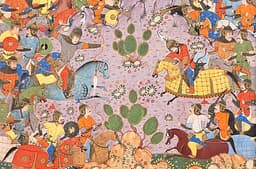
Bahram Chobin
General · Ancient
51.8Total

Julius Caesar
General · Ancient
82.8Total
Basic Information
Born
-530
-100
Died
—
-44
Era
Ancient
Ancient
Nationality
Sassanid Empire
Roman Republic
Occupation
General
General
Civilization
Middle Eastern
Western
Score Comparison
Military (10%)
65.0
88.0
Political (20%)
35.0
78.0
Influence (20%)
50.2
85.0
Legacy (20%)
42.5
82.0
Leadership (15%)
62.6
80.0
Strategy (15%)
75.0
85.0
TOTAL
51.8
82.8
Bahram Chobin — Complete Timeline
590 AD
Rebellion against Hormizd IVWar◆ Major
Bahram Chobin, a Sassanid general, rebelled against King Hormizd IV after a military defeat. He marched on Ctesiphon, deposed Hormizd, and briefly seized the throne, ruling as Bahram VI.
RebellionUsurpationSassanid Civil War
Impact: regional
591 AD
Defeat by Khosrow IIWar◆ Major
Bahram Chobin was defeated by the combined forces of Khosrow II and the Byzantine Empire at the Battle of Blarathon. He fled to Central Asia, where he was assassinated, ending his brief reign.
BattleByzantine AllianceUsurper Defeated
Impact: regionaltragic
Julius Caesar — Complete Timeline
58 BC
Gallic WarsWar◆ Major
Caesar, as proconsul of Gaul, launched a series of campaigns that conquered all of Gaul (modern France, Belgium, and parts of Switzerland). He fought numerous battles, including against the Helvetii, the Belgae, and the Gallic chieftain Vercingetorix. The wars brought immense wealth and a loyal army to Caesar.
Gallic WarsConquestRoman Expansion
Impact: regional
49 BC
Crossing the RubiconPolitical Action◆ Major
Caesar led Legio XIII across the Rubicon River into Italy, defying the Roman Senate's order to disband his army. This act triggered a civil war against Pompey and the Optimates, ultimately leading to Caesar's dictatorship and the end of the Roman Republic.
Roman Civil WarEnd of RepublicPower Struggle
Impact: global
48 BC
Battle of PharsalusWar◆ Major
Caesar's outnumbered army defeated the larger forces of Pompey the Great at Pharsalus in Greece. Caesar's tactical use of a reserve line to counter Pompey's cavalry charge proved decisive. Pompey fled to Egypt, where he was assassinated, leaving Caesar as the undisputed master of the Roman world.
Roman Civil WarBattleDecisive Victory
Impact: regional
44 BC
Appointment as Dictator for LifePolitical Action◆ Major
The Roman Senate appointed Caesar dictator perpetuo (dictator for life), granting him unprecedented personal power. This move concentrated military, legislative, and judicial authority in one person, effectively ending the Roman Republic's traditional system of checks and balances and alarming many senators.
DictatorshipEnd of RepublicPower Consolidation
Impact: regionaldestructive
Assassination on the Ides of MarchPolitical Action◆ Major
A group of Roman senators, led by Marcus Junius Brutus and Gaius Cassius Longinus, stabbed Caesar to death at a meeting of the Senate in the Theatre of Pompey. The assassination was intended to restore the Republic, but instead triggered another civil war that led to the rise of the Roman Empire.
AssassinationRoman PoliticsEnd of Republic
Impact: globaldestructive
Expert Analysis
bahram-chobin-vs-julius-caesar
# The General Who Crossed Two Rivers
On a cold January morning in 49 BCE, Julius Caesar stood at the edge of the Rubicon, a small river in northern Italy. To cross it with his army was to declare war on the Roman Senate, to break centuries of republican tradition, and to set in motion a chain of events that would end with his own murder. He crossed anyway, famously declaring *“Alea iacta est”*—the die is cast. Four decades later and a thousand miles to the east, another general, Bahram Chobin, faced his own Rubicon. He marched on the Sassanid capital of Ctesiphon, not to save the empire but to seize it for himself. Both men gambled everything on ambition. One became the father of an empire; the other became a footnote in its history.
Origins
Julius Caesar was born into the patrician Julian clan, an ancient but politically marginalized family in the Roman Republic. His uncle by marriage was Gaius Marius, the populist general who had reformed the Roman army and fought a civil war against the conservative Sulla. Caesar grew up in the shadow of these violent political feuds. He was a child of the dying Republic, a system that rewarded talent but punished overreach. His world was one of senatorial intrigue, military glory, and public spectacle—a stage where a man could rise by eloquence, bribery, or conquest.
Bahram Chobin came from a very different world. He was a member of the House of Mihran, one of the seven great Parthian clans that dominated the Sassanid Empire. His father, Bahram Gushnasp, had served as a military commander, and his family had produced generals for generations. The Sassanid Empire was a feudal theocracy where the king of kings ruled with the support of Zoroastrian priests and powerful noble families. Bahram Chobin was a product of this system—a warrior-aristocrat trained in cavalry tactics, court politics, and the brutal logic of loyalty and betrayal that defined Persian imperial life.
Rise to Power
Caesar’s path to power was long, deliberate, and layered with debt, cunning, and military brilliance. He served as a military tribune in Asia, then as a quaestor in Spain, where he reportedly wept before a statue of Alexander the Great, lamenting that at his age Alexander had already conquered the world. He climbed the *cursus honorum*—the ladder of Roman magistracies—through a combination of populist reforms, lavish games, and strategic marriages. His alliance with Pompey and Crassus in the First Triumvirate gave him the consulship in 59 BCE and then the governorship of Gaul. There he spent eight years conquering a vast territory, writing his own commentaries, and building an army loyal to him alone.
Bahram Chobin’s rise was more abrupt and more fragile. He first appears in the historical record as a successful general under King Hormizd IV, leading campaigns against the Byzantine Empire and the Turks. His victory over the Western Turkic Khaganate in 588 BCE made him a national hero. But when he suffered a minor defeat against the Byzantines in 589, Hormizd humiliated him by sending him a woman’s distaff and a spindle—a gesture meant to brand him a coward. For a proud Parthian nobleman, this was an unforgivable insult. Bahram Chobin rebelled, marched on Ctesiphon, and forced Hormizd to be deposed and killed. His rise was a coup, not a career.
Leadership & Governance
Caesar governed as a reformer and a pragmatist. As dictator, he overhauled the Roman calendar, extended citizenship to provincial allies, reformed debt laws, and initiated massive public works. He ruled through clemency—pardoning former enemies like Cicero and Brutus—because he understood that mercy could buy loyalty faster than fear. His military genius lay in speed and logistics: he could march his legions faster than any enemy expected, and he understood the psychological power of a decisive battle. At Alesia, he besieged a Gallic stronghold while simultaneously fighting off a relief army, winning through sheer tactical audacity.
Bahram Chobin ruled as a usurper, and his governance reflected that. He minted coins bearing his own image, styled himself as “King of Kings,” and tried to win over the nobility by restoring Zoroastrian orthodoxy. But he never controlled the empire fully. The Byzantine emperor Maurice, seeing an opportunity, allied with Hormizd’s son Khosrow II, who had fled to Constantinople. Bahram Chobin’s military strategy was sound—he fought a defensive campaign against the Byzantine-Persian coalition—but he lacked the political foundation to sustain a rebellion. His defeat at the Battle of Blarathon in 591 was not a failure of generalship but of legitimacy.
Triumph & Tragedy
Caesar’s greatest triumph was his conquest of Gaul, which he immortalized in *Commentarii de Bello Gallico*—a masterpiece of propaganda that shaped Western military literature for two millennia. His greatest tragedy was his assassination on the Ides of March in 44 BCE, stabbed twenty-three times by senators he had pardoned. He died believing he was building a lasting order; instead, he triggered another civil war that ended the Republic forever.
Bahram Chobin’s greatest triumph was his rebellion itself—a daring march on the capital that toppled a king. His tragedy was that he won a throne but could not keep it. After his defeat, he fled to the court of the Turks, where he was eventually assassinated on the orders of Khosrow II. His death was inglorious, far from the battlefield he had once commanded. The details of his end are uncertain; some sources say he was killed by a poisoned blade, others by a hired assassin. He vanished from history like a candle snuffed out by wind.
Character & Destiny
Caesar was driven by a relentless ambition that he disguised as duty. He cultivated an image of magnanimity and self-control, but his decisions were often reckless—crossing the Rubicon, accepting dictatorship for life, ignoring warnings of conspiracy. His character was a paradox: a man who could write elegant Latin prose and weep at Alexander’s statue, yet also order the massacre of entire tribes. His destiny was to become the bridge between Republic and Empire, a role he neither fully chose nor fully controlled.
Bahram Chobin was driven by honor and vengeance. The spindle sent by Hormizd was a wound that could only be washed in blood. He was a man of his time: proud, touchy, and incapable of compromise. His destiny was to be a warning—a reminder that in the Sassanid world, a general who reached too high would be cut down by the combined weight of tradition, foreign intervention, and noble jealousy.
Legacy
Caesar’s legacy is immense. His name became synonymous with imperial power—*Kaiser* in German, *Tsar* in Slavic. His reforms shaped Roman law and administration for centuries. His assassination made him a martyr, and his adopted heir Octavian became Augustus, the first Roman emperor. The world after Caesar was unrecognizable from the world before him.
Bahram Chobin’s legacy is faint. He appears in Persian epic poetry, most notably in Ferdowsi’s *Shahnameh*, where he is remembered as a tragic hero undone by fate. In the West, he is virtually unknown. His rebellion destabilized the Sassanid Empire at a critical moment, contributing to its eventual collapse under the Arab conquests a generation later. But he left no enduring institutions, no lasting reforms, no school of thought.
Conclusion
Why did Caesar succeed where Bahram Chobin failed? Partly it was circumstance: Caesar inherited a Republic already fractured by civil wars, while Chobin faced a stable imperial system with deep roots. Partly it was personality: Caesar could forgive his enemies; Chobin could not forgive an insult. And partly it was luck: Caesar had a brilliant heir in Octavian; Chobin had no one. But perhaps the deepest difference lies in how each man understood power. Caesar saw it as something to be built, brick by brick, through law, propaganda, and time. Chobin saw it as something to be taken, by force, in a single stroke. One built a bridge across the Rubicon; the other tried to cross a river that had no bridge at all.
Rankings
🥇
Julius CaesarLeader
Mil: 88.0Pol: 78.0Inf: 85.0
82.8
🥈
Bahram Chobin
Mil: 65.0Pol: 35.0Inf: 50.2
51.8
+31.0 behind
How This Comparison Works
Algorithm
Each figure is scored on 6 dimensions (0—100 scale) based on structured historical data: Military (10%), Political (20%), Influence (20%), Legacy (20%), Leadership (15%), Strategy (15%). The weighted total produces the final ranking.
Data Sources
Scores are computed from structured sub-indicators in the database. Scale factors adjust for era (Ancient ×0.85, Modern ×1.0) and civilization size (Eastern ×1.05, Other ×0.80) to account for differences in population and military scale.
Maximum 3 Figures
Comparisons are limited to 2—3 figures to ensure readability and statistical meaningfulness.
Error Margins
±5 points per dimension — Sub-scores are derived from historical records with inherent uncertainty. Two figures within 5 points on a dimension should be considered roughly equivalent in that area.
Total Score Accuracy
±3 points overall — The weighted combination of 6 dimensions produces a total score with approximately ±3 points of uncertainty. Differences of less than 3 points are not statistically significant— the figures are effectively tied.
Known Limitations
- Historical records are incomplete and uneven across civilizations
- Figures from oral-tradition societies may be underrepresented
- Occupation labels can misclassify multi-role figures
- Scores measure capability and impact, not moral character
- Quantitative scoring is a comparison tool, not absolute truth
Capability Radar
Military (10%) — Battles & Warfare
Battles
75
95
Win Rate
80
92
Expansion
65
97
Political (20%) — Governance & Reform
Reform
15
90
Diplomacy
25
85
Economy
10
82
Influence (20%) — Cultural & Global Reach
Cultural
30
88
Global
20
94
Legacy (20%) — Historical Impact
Historical
40
95
Longevity
25
96
Leadership (15%) — Power & Stability
Tenure
20
75
Stability
10
60
Strategy (15%) — Tactics & Innovation
Strategy
70
94
Tactics
85
96
Reform
60
88
Similar Comparisons
Comments & Discussion
No comments yet. Be the first to share your thoughts!