Loading...
Ban Ki-moon vs Said Halim Pasha
Ban Ki-moon leads by 5.5 pts · 2 figures compared
…
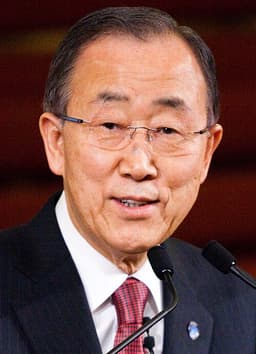
Ban Ki-moon
Politician · Modern
53.2Total

Said Halim Pasha
Politician · Modern
47.7Total
Basic Information
Born
1944
1865
Died
—
1921
Era
Modern
Modern
Nationality
Korea
Ottoman Empire
Occupation
Politician
Politician
Civilization
Eastern
Middle Eastern
Score Comparison
Military (10%)
15.2
49.5
Political (20%)
68.0
37.9
Influence (20%)
58.0
52.5
Legacy (20%)
46.7
45.0
Leadership (15%)
72.0
55.3
Strategy (15%)
44.8
44.1
TOTAL
53.2
47.7
Ban Ki-moon — Complete Timeline
2007 AD
Elected Secretary-General of the United NationsPolitical Action◆ Major
Ban Ki-moon became the eighth Secretary-General of the United Nations, succeeding Kofi Annan. His election was seen as a consensus choice, and he focused on climate change, peacekeeping, and UN reform.
UN Secretary-GeneralLeadershipGlobal Governance
Impact: globalconstructive
2011 AD
Launched the Sustainable Energy for All initiativeReform◆ Major
Ban launched the Sustainable Energy for All initiative, aiming to achieve universal energy access, double energy efficiency, and double renewable energy use by 2030. The initiative mobilized governments and private sector partners.
EnergySustainabilityClimate Change
Impact: globalconstructive
Oversaw UN response to the Syrian Civil WarPolitical Action◆ Major
Ban Ki-moon led UN efforts to address the Syrian Civil War, including humanitarian aid and peace negotiations. The UN faced criticism for failing to stop the conflict, which killed hundreds of thousands and displaced millions.
SyriaHumanitarian CrisisUN Failure
Impact: globaltragic
2015 AD
Adopted the Sustainable Development GoalsReform◆ Major
Ban oversaw the adoption of the 2030 Agenda for Sustainable Development, including 17 Sustainable Development Goals to end poverty, protect the planet, and ensure prosperity for all by 2030.
SDGsDevelopmentGlobal Goals
Impact: globalconstructive
Adopted the Paris Agreement on climate changePolitical Action◆ Major
Ban played a key role in the adoption of the Paris Agreement at COP21, a global treaty to limit global warming to well below 2
Climate ChangeParis AgreementCOP21
Impact: globalconstructive
Said Halim Pasha — Complete Timeline
1913 AD
Appointed Grand VizierPolitical Action◆ Major
Said Halim Pasha was appointed Grand Vizier by Sultan Mehmed V. He served from 1913 to 1917, leading the Ottoman government during World War I. His tenure was dominated by the Committee of Union and Progress.
Grand VizierWorld War ICUP
Impact: national
1914 AD
Signed the Ottoman-German AlliancePolitical Action
Said Halim Pasha signed a secret treaty of alliance with Germany on August 2, 1914. This agreement committed the Ottoman Empire to enter World War I on the side of the Central Powers, leading to the empire's eventual collapse.
AllianceWorld War IGermany
Impact: global
1915 AD
Authorized the Armenian DeportationsPolitical Action
As Grand Vizier, Said Halim Pasha signed the Tehcir Law authorizing the deportation of the Armenian population from eastern Anatolia. This action led to the Armenian Genocide, resulting in the deaths of an estimated 1.5 million Armenians.
Armenian GenocideDeportationWar Crimes
Impact: globaldestructive
1917 AD
Resigned as Grand VizierPolitical Action◆ Major
Said Halim Pasha resigned as Grand Vizier due to disagreements with the CUP leadership over war policy and the Armenian deportations. He was replaced by Mehmed Talat and retired from active politics.
ResignationCUPWorld War I
Impact: national
1921 AD
Assassinated in RomePolitical Action◆ Major
Said Halim Pasha was assassinated in Rome by an Armenian revolutionary, Arshavir Shirakian, as an act of vengeance for his role in the Armenian Genocide. He was shot while riding in a carriage near his home.
AssassinationArmenian GenocideVengeance
Impact: globaltragic
Expert Analysis
Origins
Ban Ki-moon was born on June 13, 1944, in Eumseong, Japanese Korea (now South Korea). His father worked as a warehouse keeper, and the family moved to Chungju when Ban was young. He excelled in English at school and won a Red Cross competition that allowed him to visit the United States in 1962, where he met President John F. Kennedy. He studied international relations at Seoul National University, earning a bachelor's degree in 1970, and later a master's degree in public administration from Harvard Kennedy School in 1985. His early career began as a junior diplomat in 1970, serving in New Delhi and the Korean Embassy in Washington.
Said Halim Pasha was born on January 18, 1865, in Cairo, Egypt, to a prominent Ottoman family. His grandfather was Mehmed Ali Pasha, the founder of modern Egypt. He was educated in private schools in Cairo and later studied political science in Paris. He returned to the Ottoman Empire and entered the diplomatic service, serving as ambassador to Berlin from 1909 to 1912. He was a member of the Committee of Union and Progress (CUP) but often held more cautious views than the central committee.
Rise to Power
Ban Ki-moon rose through the ranks of South Korea's Ministry of Foreign Affairs over three decades. He served as ambassador to Austria and as director-general of American affairs. His breakthrough came in 2004 when he was appointed South Korea's Minister of Foreign Affairs and Trade. In this role, he focused on inter-Korean relations and negotiated with the United States on trade issues. His reputation as a consensus-builder led to his election as UN Secretary-General in 2006, succeeding Kofi Annan. He took office on January 1, 2007, with a mandate to reform the UN and address global challenges.
Said Halim Pasha became Grand Vizier on June 12, 1913, after the CUP consolidated power following the 1913 Ottoman coup d'état. He was seen as a moderate figure who could maintain relations with the Sultan and foreign powers. His tenure was dominated by the aftermath of the Balkan Wars and the looming threat of World War I. He signed the Ottoman-German Alliance on August 2, 1914, secretly committing the empire to enter the war on Germany's side. This decision was driven by a desire to regain lost territories and counter Russian influence.
Leadership & Governance
Ban Ki-moon's leadership style was characterized by quiet diplomacy and incremental progress. He scored 72.0 in leadership, reflecting his ability to build consensus among 193 member states. His governance focused on multilateralism and institutional reform. He launched the Sustainable Energy for All initiative in 2011, aiming to achieve universal energy access by 2030. He also oversaw the adoption of the Paris Agreement in 2015, a landmark climate treaty signed by 196 parties. However, his approach was criticized for being too passive in the face of crises like the Syrian Civil War, where the UN failed to implement a ceasefire.
Said Halim Pasha, with a leadership score of 55.3, governed during wartime. He signed the Tehcir Law on May 27, 1915, authorizing the deportation of Armenians from eastern Anatolia, which led to the Armenian Genocide. He also attempted to maintain Ottoman neutrality early in the war but was overruled by the CUP's pro-German faction. His governance was marked by internal conflicts with the CUP leadership, particularly over war policy and the deportations. He resigned on February 4, 1917, after losing control over policy.
Triumph & Tragedy
Ban Ki-moon's greatest triumph was the adoption of the Paris Agreement and the Sustainable Development Goals (SDGs) in 2015, which set global targets for poverty reduction and climate action. His leadership in launching the UN Women agency in 2010 also advanced gender equality. However, his tenure was marred by the UN's inability to stop the Syrian Civil War, which killed over 400,000 people by 2016. He also faced criticism for the UN's response to the 2010 Haiti cholera outbreak, which was linked to UN peacekeepers.
Said Halim Pasha's tragedy was his role in the Armenian Genocide. The Tehcir Law resulted in the deaths of an estimated 1.5 million Armenians through massacres and forced marches. His diplomatic achievement was the Ottoman-German Alliance, which brought the empire into World War I but ultimately led to its defeat and partition. He was assassinated on December 6, 1921, in Rome by an Armenian revolutionary, Arshavir Shirakian, as revenge for the genocide.
Character & Destiny
Ban Ki-moon was known for his patience and diplomatic tact, earning the nickname "the Slippery Eel" for his ability to navigate complex negotiations. His character shaped his destiny as a consensus-builder who achieved incremental gains rather than bold transformations. He scored 44.8 in strategy, indicating a cautious approach. His legacy is tied to the global governance frameworks he helped create.
Said Halim Pasha was a conservative reformer who believed in preserving the Ottoman Empire but was caught between the CUP's radicalism and the Sultan's authority. His character was indecisive, as he signed the deportation order despite personal reservations. His destiny was sealed by his association with the CUP's wartime policies, leading to his assassination and historical condemnation.
Legacy
Ban Ki-moon's legacy is measured by the Paris Agreement, which has been ratified by 195 parties, and the SDGs, which guide UN development efforts until 2030. His influence score of 58.0 reflects his role in setting global norms. He is remembered as a competent administrator who advanced climate action but failed to reform the Security Council or resolve major conflicts.
Said Halim Pasha's legacy is overwhelmingly negative due to his role in the Armenian Genocide. He scored 45.0 in legacy. His name is associated with the Ottoman Empire's collapse and the mass murder of Armenians. Historians assess him as a weak leader who enabled the CUP's extremist policies.
Conclusion
Ban Ki-moon had greater overall impact than Said Halim Pasha. With a total score of 53.2 compared to 47.7, Ban's contributions to global governance through the Paris Agreement and SDGs have had lasting positive effects on climate policy and development. His leadership score of 72.0 exceeded Said Halim Pasha's 55.3. While Said Halim Pasha's decisions shaped the Middle East's modern borders, his legacy is defined by genocide and imperial collapse. Ban Ki-moon's diplomatic achievements, though imperfect, advanced international cooperation on existential threats. Therefore, Ban Ki-moon stands as the more influential and constructive historical figure.
Rankings
🥇
Ban Ki-moonLeader
Mil: 15.2Pol: 68.0Inf: 58.0
53.2
🥈
Said Halim Pasha
Mil: 49.5Pol: 37.9Inf: 52.5
47.7
+5.5 behind
How This Comparison Works
Algorithm
Each figure is scored on 6 dimensions (0—100 scale) based on structured historical data: Military (10%), Political (20%), Influence (20%), Legacy (20%), Leadership (15%), Strategy (15%). The weighted total produces the final ranking.
Data Sources
Scores are computed from structured sub-indicators in the database. Scale factors adjust for era (Ancient ×0.85, Modern ×1.0) and civilization size (Eastern ×1.05, Other ×0.80) to account for differences in population and military scale.
Maximum 3 Figures
Comparisons are limited to 2—3 figures to ensure readability and statistical meaningfulness.
Error Margins
±5 points per dimension — Sub-scores are derived from historical records with inherent uncertainty. Two figures within 5 points on a dimension should be considered roughly equivalent in that area.
Total Score Accuracy
±3 points overall — The weighted combination of 6 dimensions produces a total score with approximately ±3 points of uncertainty. Differences of less than 3 points are not statistically significant— the figures are effectively tied.
Known Limitations
- Historical records are incomplete and uneven across civilizations
- Figures from oral-tradition societies may be underrepresented
- Occupation labels can misclassify multi-role figures
- Scores measure capability and impact, not moral character
- Quantitative scoring is a comparison tool, not absolute truth
Capability Radar
Military (10%) — Battles & Warfare
Battles
16
24
Win Rate
16
27
Expansion
18
25
Political (20%) — Governance & Reform
Reform
40
35
Diplomacy
75
30
Economy
30
20
Influence (20%) — Cultural & Global Reach
Cultural
20
15
Global
60
30
Legacy (20%) — Historical Impact
Historical
40
40
Longevity
30
20
Leadership (15%) — Power & Stability
Tenure
65
40
Stability
60
10
Strategy (15%) — Tactics & Innovation
Strategy
25
32
Tactics
28
33
Reform
31
35
Similar Comparisons
Comments & Discussion
No comments yet. Be the first to share your thoughts!