Loading...
This comparison has not been analyzed yet.
One-time AI generation (~1 minute). Scores and timeline are already available below.
Basarab I vs Orda Khan
Basarab I leads by 13.4 pts · 2 figures compared
…

Basarab I
Emperor · Medieval
55.1Total
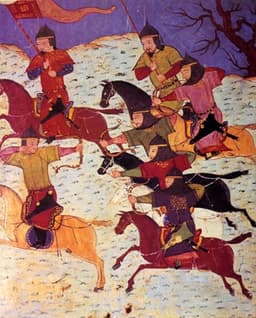
Orda Khan
Emperor · Medieval
41.7Total
Basic Information
Born
1271
1204
Died
1352
1251
Era
Medieval
Medieval
Nationality
Wallachia
Golden Horde
Occupation
Emperor
Emperor
Civilization
Western
Eastern
Score Comparison
Military (10%)
47.5
47.5
Political (20%)
54.7
26.4
Influence (20%)
56.4
49.4
Legacy (20%)
50.0
39.2
Leadership (15%)
65.0
45.0
Strategy (15%)
57.5
41.0
TOTAL
55.1
41.7
Basarab I — Complete Timeline
1310 AD
Founded the Principality of WallachiaPolitical Action◆ Major
Basarab I unified the Romanian lands east of the Olt River and south of the Carpathians, establishing the independent principality of Wallachia. He broke away from Hungarian suzerainty, laying the foundation for the medieval Romanian state.
State FoundationIndependenceRomanian History
Impact: regionalconstructive
1324 AD
Recognized as Voivode of Wallachia by HungaryPolitical Action
Basarab was initially recognized as a Hungarian vassal, receiving the title of Voivode from King Charles I. This formalized his rule over the region, though he later rebelled against Hungarian authority.
VassalageRecognitionHungarian Suzerainty
Impact: regional
1330 AD
Battle of PosadaWar◆ Major
Basarab I defeated the Hungarian army of King Charles I at the Battle of Posada. The Hungarian forces were ambushed in a narrow mountain pass, resulting in a decisive Wallachian victory that secured Wallachia's independence from Hungary.
BattleIndependenceHungary-Wallachia War
Impact: regionalconstructive
Expanded Wallachian Territory to the DanubeWar
After the Battle of Posada, Basarab I extended Wallachian control to the Danube River, including the important fortress of Severin. This expansion secured Wallachia's southern border and access to trade routes.
Territorial ExpansionDanubeFortress
Impact: regionalconstructive
Orda Khan — Complete Timeline
1227 AD
Founded the White HordePolitical Action◆ Major
Orda Khan, as the eldest son of Jochi, inherited the eastern part of the Jochid ulus after his father's death in 1227. He established the White Horde, a semi-autonomous khanate within the Mongol Empire, ruling over the steppes of modern-day Kazakhstan.
White HordeMongol EmpireJochi
Impact: regionalconstructive
1236 AD
Participated in the Mongol Invasion of EuropeWar◆ Major
Orda Khan led his forces as part of the Mongol invasion of Europe under Batu Khan. He commanded troops in the campaigns against the Rus' principalities, Poland, and Hungary, contributing to the Mongol conquest of Eastern Europe.
Mongol InvasionEuropeBatu Khan
Impact: regionaldestructive
1242 AD
Subordinated to Batu KhanPolitical Action
After the Mongol withdrawal from Europe in 1242, Orda Khan acknowledged the supremacy of his younger brother Batu Khan, who established the Golden Horde. Orda's White Horde remained a vassal, paying tribute and providing military support.
Golden HordeVassalageBatu Khan
Impact: regional
This comparison has not been analyzed yet.
One-time AI generation (~1 minute). Scores and timeline are already available below.
Rankings
🥇
Basarab ILeader
Mil: 47.5Pol: 54.7Inf: 56.4
55.1
🥈
Orda Khan
Mil: 47.5Pol: 26.4Inf: 49.4
41.7
+13.4 behind
How This Comparison Works
Algorithm
Each figure is scored on 6 dimensions (0—100 scale) based on structured historical data: Military (10%), Political (20%), Influence (20%), Legacy (20%), Leadership (15%), Strategy (15%). The weighted total produces the final ranking.
Data Sources
Scores are computed from structured sub-indicators in the database. Scale factors adjust for era (Ancient ×0.85, Modern ×1.0) and civilization size (Eastern ×1.05, Other ×0.80) to account for differences in population and military scale.
Maximum 3 Figures
Comparisons are limited to 2—3 figures to ensure readability and statistical meaningfulness.
Error Margins
±5 points per dimension — Sub-scores are derived from historical records with inherent uncertainty. Two figures within 5 points on a dimension should be considered roughly equivalent in that area.
Total Score Accuracy
±3 points overall — The weighted combination of 6 dimensions produces a total score with approximately ±3 points of uncertainty. Differences of less than 3 points are not statistically significant— the figures are effectively tied.
Known Limitations
- Historical records are incomplete and uneven across civilizations
- Figures from oral-tradition societies may be underrepresented
- Occupation labels can misclassify multi-role figures
- Scores measure capability and impact, not moral character
- Quantitative scoring is a comparison tool, not absolute truth
Capability Radar
Military (10%) — Battles & Warfare
Battles
45
20
Win Rate
60
25
Expansion
50
25
Political (20%) — Governance & Reform
Reform
45
15
Diplomacy
55
20
Economy
40
15
Influence (20%) — Cultural & Global Reach
Cultural
40
15
Global
30
10
Legacy (20%) — Historical Impact
Historical
55
20
Longevity
50
15
Leadership (15%) — Power & Stability
Tenure
50
30
Stability
50
25
Strategy (15%) — Tactics & Innovation
Strategy
50
20
Tactics
55
20
Reform
40
10
Similar Comparisons
Comments & Discussion
No comments yet. Be the first to share your thoughts!