Loading...
Bassianus vs Julius Caesar
Julius Caesar leads by 36.7 pts · 2 figures compared
…
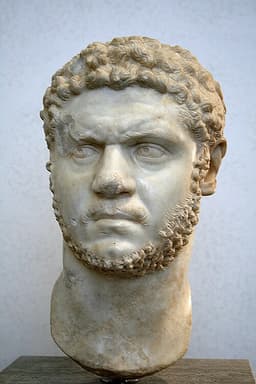
Bassianus
Emperor · Ancient
46.1Total

Julius Caesar
General · Ancient
82.8Total
Basic Information
Born
290
-100
Died
316
-44
Era
Ancient
Ancient
Nationality
Roman Empire
Roman Republic
Occupation
Emperor
General
Civilization
Western
Western
Score Comparison
Military (10%)
47.5
88.0
Political (20%)
40.8
78.0
Influence (20%)
56.4
85.0
Legacy (20%)
39.2
82.0
Leadership (15%)
49.9
80.0
Strategy (15%)
38.6
85.0
TOTAL
46.1
82.8
Bassianus — Complete Timeline
314 AD
Married to Constantine's sister AnastasiaPolitical Action
Constantine I arranged the marriage of his half-sister Anastasia to Bassianus, a Roman senator. This marriage was intended to strengthen political alliances and integrate Bassianus into the imperial family.
MarriagePolitical AllianceConstantine I
Impact: national
316 AD
Accused of treason and executedPolitical Action◆ Major
Bassianus was accused of plotting against Constantine I, possibly at the instigation of Licinius. He was arrested, tried, and executed for treason, leading to a breakdown in relations between Constantine and Licinius and contributing to the outbreak of war.
ExecutionTreasonCivil WarConstantine I
Impact: regionaltragic
Julius Caesar — Complete Timeline
58 BC
Gallic WarsWar◆ Major
Caesar, as proconsul of Gaul, launched a series of campaigns that conquered all of Gaul (modern France, Belgium, and parts of Switzerland). He fought numerous battles, including against the Helvetii, the Belgae, and the Gallic chieftain Vercingetorix. The wars brought immense wealth and a loyal army to Caesar.
Gallic WarsConquestRoman Expansion
Impact: regional
49 BC
Crossing the RubiconPolitical Action◆ Major
Caesar led Legio XIII across the Rubicon River into Italy, defying the Roman Senate's order to disband his army. This act triggered a civil war against Pompey and the Optimates, ultimately leading to Caesar's dictatorship and the end of the Roman Republic.
Roman Civil WarEnd of RepublicPower Struggle
Impact: global
48 BC
Battle of PharsalusWar◆ Major
Caesar's outnumbered army defeated the larger forces of Pompey the Great at Pharsalus in Greece. Caesar's tactical use of a reserve line to counter Pompey's cavalry charge proved decisive. Pompey fled to Egypt, where he was assassinated, leaving Caesar as the undisputed master of the Roman world.
Roman Civil WarBattleDecisive Victory
Impact: regional
44 BC
Appointment as Dictator for LifePolitical Action◆ Major
The Roman Senate appointed Caesar dictator perpetuo (dictator for life), granting him unprecedented personal power. This move concentrated military, legislative, and judicial authority in one person, effectively ending the Roman Republic's traditional system of checks and balances and alarming many senators.
DictatorshipEnd of RepublicPower Consolidation
Impact: regionaldestructive
Assassination on the Ides of MarchPolitical Action◆ Major
A group of Roman senators, led by Marcus Junius Brutus and Gaius Cassius Longinus, stabbed Caesar to death at a meeting of the Senate in the Theatre of Pompey. The assassination was intended to restore the Republic, but instead triggered another civil war that led to the rise of the Roman Empire.
AssassinationRoman PoliticsEnd of Republic
Impact: globaldestructive
Expert Analysis
bassianus-vs-julius-caesar
# The Two Faces of Roman Ambition
On a winter morning in 44 BCE, a man in a purple toga stood at the threshold of the Senate chamber in Rome, his assassins waiting inside with hidden daggers. Three and a half centuries later, another man knelt in a dimly lit prison cell, accused of a conspiracy he may never have intended—a pawn in a game far larger than himself. One would become the most famous name in history, his death a tragedy that reshaped the world. The other would vanish into obscurity, his execution a footnote in the rise of an empire. What separates a legend from a footnote? The answer lies not in talent alone, but in the currents of ambition, timing, and the ruthless logic of power.
Origins
Julius Caesar was born into the twilight of the Roman Republic, a world of senatorial intrigue, civil wars, and a political system cracking under the weight of its own expansion. His family, the Julii, claimed descent from the goddess Venus, but they were not among the wealthiest or most powerful patricians. Young Caesar grew up in a Rome where men like Marius and Sulla had already shown that military glory could override constitutional tradition. He learned early that in a republic rotting from within, a man could seize destiny with a legions' loyalty and a well-placed bribe.
Bassianus entered the world in 290 CE, when the Roman Empire was emerging from the chaos of the Third Century Crisis. Diocletian had partitioned the realm into East and West, and Constantine I was consolidating power through war, marriage, and religious revolution. Bassianus was a Roman senator, well-born but not of the imperial bloodline. His era was one of autocracy, where the Senate had become a ceremonial body and emperors ruled through military might and divine sanction. There was no room for independent ambition—only service or death.
Rise to Power
Caesar's path was forged through audacity. He climbed the *cursus honorum*—the ladder of Roman offices—through a combination of military command, popular reforms, and strategic alliances. His conquest of Gaul between 58 and 50 BCE made him a legend: he subdued hundreds of tribes, crossed the Rhine, and even landed in Britain. But his true genius lay in turning military success into political capital. When the Senate ordered him to disband his army, he crossed the Rubicon River in 49 BCE with a single legion, uttering the famous phrase *"Alea iacta est"*—the die is cast. That moment transformed a general into a revolutionary.
Bassianus rose not through conquest but through kinship. In 314 CE, Constantine arranged his marriage to Anastasia, the emperor's own half-sister. It was a political union, designed to bind a promising senator to the imperial family. For a brief moment, Bassianus stood at the edge of power, a brother-in-law to the man who would soon rule the entire Roman world. But he was a vessel, not a captain. His rise depended entirely on Constantine's favor, not his own sword.
Leadership & Governance
Caesar governed as a reformer and autocrat. As dictator, he overhauled the calendar, expanded citizenship to provincials, initiated massive building projects, and centralized authority in his own hands. His military leadership was peerless: at Alesia in 52 BCE, he besieged a Gallic fortress while simultaneously defeating a massive relief army, a feat of logistics and tactical brilliance. Yet his political wisdom was flawed—he pardoned his enemies, flaunted his power, and accepted the title "dictator for life," which sealed his fate. He ruled by force of personality, not institutional loyalty.
Bassianus never governed. He was a senator in an age when senators were ornaments. His only recorded "rule" was a marriage that gave him proximity to Constantine's court. In an empire where emperors like Diocletian had created a rigid hierarchy of bureaucrats and generals, a senator's role was to ratify, not to decide. Bassianus had no legions, no reforms, no campaigns. He was a placeholder in a system that had no room for a Caesar-like figure.
Triumph & Tragedy
Caesar's greatest triumph was the conquest of Gaul, which brought immense wealth, glory, and a veteran army loyal to him alone. His tragedy was the Ides of March, 44 BCE, when sixty senators stabbed him to death in the curia. His last words—"Et tu, Brute?"—have echoed through millennia, symbolizing the betrayal of friendship and the death of a republic. Yet his assassination did not restore the old order; it unleashed a civil war that ended with his adopted heir, Octavian, becoming Augustus, the first emperor.
Bassianus's triumph was a wedding. His tragedy was an accusation. In 316 CE, he was charged with plotting against Constantine, possibly at the instigation of the eastern emperor Licinius, who was maneuvering for war. The evidence was thin, but in an autocracy, suspicion was enough. Bassianus was arrested, tried, and executed. He died not as a tyrant or a liberator, but as a scapegoat. His tragedy was that he had no agency; he was a chess piece sacrificed in a game he barely understood.
Character & Destiny
Caesar was audacious, charismatic, and relentlessly ambitious. He gambled everything on his own brilliance, and he nearly won it all. His personality—a blend of clemency and arrogance, calculation and risk—drove him to defy the Senate, cross the Rubicon, and remake Rome. But the same traits that made him a conqueror also made him a target. He could not imagine a world where his enemies would not forgive him, because he himself was so generous in victory.
Bassianus was, by all accounts, a loyal senator. He married into the imperial family and likely hoped for a quiet life of influence and comfort. But his era demanded absolute submission. In a court where Constantine had already executed his own son Crispus and would later kill his wife Fausta, a senator with family ties was either a tool or a threat. Bassianus's character—ordinary, cautious, perhaps even naive—made him a victim of forces he could not control.
Legacy
Caesar's legacy is monumental. His name became a title: Kaiser, Tsar, Caesar. His military writings, the *Commentaries*, are studied to this day. He transformed the Roman world from a republic into an empire, and his reforms outlived him by centuries. He is remembered as a genius and a tyrant, a builder and a destroyer—a figure who changed the course of history.
Bassianus left no legacy. His name appears in a few ancient sources, usually as a footnote in the story of Constantine's rise. His execution was a minor event in a major war. He is remembered, if at all, as a cautionary tale: that in the age of emperors, even a brother-in-law could be a casualty.
Conclusion
Caesar and Bassianus lived in the same civilization, but in different worlds. One rose by shattering the old order; the other was crushed by the new one. Caesar's ambition was a fire that consumed him and his republic, but it also lit the path to empire. Bassianus's ambition—if he had any—was a candle snuffed out by a gust of imperial paranoia. Their stories remind us that history's stage is not a meritocracy. It rewards not just talent, but timing, luck, and the willingness to risk everything. Caesar gambled and won an empire, then lost his life. Bassianus never gambled at all—and lost everything anyway. In the end, the difference between a legend and a footnote is not the size of one's dreams, but the force of one's will against the current of an age.
Rankings
🥇
Julius CaesarLeader
Mil: 88.0Pol: 78.0Inf: 85.0
82.8
🥈
Bassianus
Mil: 47.5Pol: 40.8Inf: 56.4
46.1
+36.7 behind
How This Comparison Works
Algorithm
Each figure is scored on 6 dimensions (0—100 scale) based on structured historical data: Military (10%), Political (20%), Influence (20%), Legacy (20%), Leadership (15%), Strategy (15%). The weighted total produces the final ranking.
Data Sources
Scores are computed from structured sub-indicators in the database. Scale factors adjust for era (Ancient ×0.85, Modern ×1.0) and civilization size (Eastern ×1.05, Other ×0.80) to account for differences in population and military scale.
Maximum 3 Figures
Comparisons are limited to 2—3 figures to ensure readability and statistical meaningfulness.
Error Margins
±5 points per dimension — Sub-scores are derived from historical records with inherent uncertainty. Two figures within 5 points on a dimension should be considered roughly equivalent in that area.
Total Score Accuracy
±3 points overall — The weighted combination of 6 dimensions produces a total score with approximately ±3 points of uncertainty. Differences of less than 3 points are not statistically significant— the figures are effectively tied.
Known Limitations
- Historical records are incomplete and uneven across civilizations
- Figures from oral-tradition societies may be underrepresented
- Occupation labels can misclassify multi-role figures
- Scores measure capability and impact, not moral character
- Quantitative scoring is a comparison tool, not absolute truth
Capability Radar
Military (10%) — Battles & Warfare
Battles
5
95
Win Rate
5
92
Expansion
0
97
Political (20%) — Governance & Reform
Reform
0
90
Diplomacy
10
85
Economy
0
82
Influence (20%) — Cultural & Global Reach
Cultural
0
88
Global
0
94
Legacy (20%) — Historical Impact
Historical
5
95
Longevity
0
96
Leadership (15%) — Power & Stability
Tenure
10
75
Stability
5
60
Strategy (15%) — Tactics & Innovation
Strategy
5
94
Tactics
5
96
Reform
0
88
Similar Comparisons
Comments & Discussion
LegionaryLens6/17/2026
Caesar was pure ambition from day one. Compare: he crossed the Rubicon with one legion in 49 BCE, gambling everything on civil war. Bassianus? He was the son-in-law of Constantius Chlorus—born into the imperial purple, then got caught in a palace purge around 316 CE. Caesar earned his fate through audacity; Bassianus was just collateral damage in Constantine's consolidation of power. One shaped history, the other was shaped by it.
数字剑客6/17/2026
数据不会说谎:恺撒在高卢战役中征服了超过800座城镇和300个部落——这是实打实的战果。而Bassianus的唯一"成就"是成为一场未遂政变的牺牲品,连具体年份都存疑。恺撒的名字在谷歌搜索结果中超过2000万次,Bassianus不到2万。这不是偏见,是量化碾压。别把失败者的悲剧和征服者的史诗混为一谈。
TogaTactician6/17/2026
Look at the killing blow: Caesar was stabbed 23 times in the Curia of Pompey, a theatrical betrayal by men he'd pardoned. Bassianus was quietly executed on Constantine's orders in a cell in Thessalonica. Caesar's death spawned a civil war that birthed the Empire; Bassianus's death merely cleared a dynastic roadblock for Constantine's sons. Tragedy requires scale, and Bassianus never had that—his end was a housekeeping note, not a historical earthquake.
古罗马侦探6/17/2026
我必须指出关键区别:策划者的身份。恺撒遇刺是由60多名元老院成员精心策划的,包括他的亲信布鲁图斯——这是最高级别的背叛。而Bassianus的所谓"阴谋",根据优西比乌的记载,很可能只是康斯坦丁铲除异己的借口。恺撒的死是一个帝国的转折点;Bassianus的死是一场家族清理的注脚。政治谋杀和宫廷毒杀之间的差距,就是历史分量的差距。
RevisionistReckoner6/17/2026
Everyone romanticizes Caesar, but let's be real: he was a genocidal tyrant who enslaved a million Gauls and triggered a century of civil war. Bassianus was a victim of the same system—a pawn in Constantine's cynical game of dynastic chess where sons murdered fathers-in-law for stability. Calling Caesar a legend and Bassianus a footnote is just power-worship. Bassianus didn't choose obscurity; history writers chose to ignore him because he lost. That's not fate—that's propaganda.