Loading...
Benjamin Disraeli vs Jose Maria Velasco Ibarra
Benjamin Disraeli leads by 8.5 pts · 2 figures compared
…
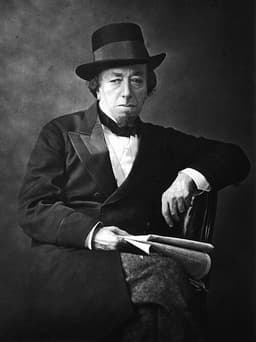
Benjamin Disraeli
Politician · Modern
57.5Total

Jose Maria Velasco Ibarra
Politician · Modern
49.0Total
Basic Information
Born
1804
1893
Died
1881
1979
Era
Modern
Modern
Nationality
United Kingdom
Ecuador
Occupation
Politician
Politician
Civilization
Western
Western
Score Comparison
Military (10%)
47.4
36.6
Political (20%)
62.7
45.1
Influence (20%)
55.0
54.1
Legacy (20%)
55.0
45.8
Leadership (15%)
78.0
55.3
Strategy (15%)
41.7
52.8
TOTAL
57.5
49.0
Benjamin Disraeli — Complete Timeline
1867 AD
Reform Act 1867Reform
As Chancellor of the Exchequer, Disraeli steered the Reform Act 1867 through Parliament, which doubled the electorate by extending the vote to many urban working-class men. This 'leap in the dark' was a major political reform that reshaped British democracy.
Electoral ReformDemocracyWorking Class
Impact: nationalprogressive
1868 AD
Became Prime MinisterPolitical Action
Disraeli became Prime Minister for the first time on February 27, 1868, after the resignation of Lord Derby. His first ministry lasted only 10 months, but he passed the Reform Act 1867 during his time as Chancellor of the Exchequer, which expanded the electorate.
Prime MinisterConservative PartyReform
Impact: national
1875 AD
Purchase of Suez Canal SharesPolitical Action◆ Major
Disraeli arranged the purchase of a 44% stake in the Suez Canal Company from the Khedive of Egypt for
Suez CanalImperialismFinance
Impact: globalconstructive
1876 AD
Royal Titles Act 1876Political Action
Disraeli's government passed the Royal Titles Act 1876, which added 'Empress of India' to Queen Victoria's titles. This formalized British imperial rule in India and was a symbolic assertion of British power, though it was criticized as flattery of the monarch.
MonarchyIndiaImperial Title
Impact: global
1878 AD
Congress of BerlinPolitical Action◆ Major
Disraeli attended the Congress of Berlin in June-July 1878, representing Britain. He secured revisions to the Treaty of San Stefano, limiting Russian influence in the Balkans and gaining Cyprus for Britain. He returned claiming 'peace with honour', boosting his popularity.
Foreign PolicyBalkansDiplomacy
Impact: global
Jose Maria Velasco Ibarra — Complete Timeline
1934 AD
First PresidencyPolitical Action◆ Major
Jose Maria Velasco Ibarra was elected President of Ecuador for the first time. His term was marked by populist rhetoric and conflict with Congress, leading to his overthrow by the military after less than a year.
PresidencyPopulismEcuador
Impact: national
1944 AD
Second Presidency and ExilePolitical Action◆ Major
Velasco returned to power after leading a popular uprising. He enacted social reforms but was again overthrown in 1947 and went into exile. This pattern of return and overthrow defined his political career.
PresidencyExileEcuador
Impact: national
1952 AD
Third Presidency and OverthrowPolitical Action◆ Major
Velasco was elected president for a third time. He completed his term, a rarity in his career, but was overthrown shortly after the end of his term in 1956. He went into exile again.
PresidencyOverthrowEcuador
Impact: national
1968 AD
Fifth Presidency and Final OverthrowPolitical Action◆ Major
Velasco was elected president for a fifth time. He attempted to implement reforms but faced opposition from Congress and the military. He was overthrown in 1972 and went into exile, ending his political career.
PresidencyOverthrowExile
Impact: nationaltragic
Expert Analysis
Origins
Benjamin Disraeli (1804-1881) was born in London into a Jewish literary family. His father, Isaac D'Israeli, was a noted author, and Benjamin was baptized Anglican at age 12. He received a classical education but left school at 17, entering a law office. His early career included failed business ventures and writing novels, such as 'Vivian Grey' (1826).
Jose Maria Velasco Ibarra (1893-1979) was born in Quito, Ecuador, into a middle-class family. His father was a lawyer and politician. Velasco studied law at the Central University of Ecuador, earning a doctorate in jurisprudence. He entered politics as a young man, serving as a deputy in Congress.
Rise to Power
Disraeli entered Parliament in 1837 as a Conservative under the patronage of Lord Lyndhurst. He became a leading figure in the Young England movement, advocating for social reform and imperial expansion. His rise was marked by his rivalry with William Gladstone. He served as Chancellor of the Exchequer in 1852, 1858-1859, and 1866-1868, where he steered the Reform Act 1867, doubling the electorate. He became Prime Minister for the first time in February 1868, but his ministry lasted only 10 months.
Velasco Ibarra first ran for president in 1934 as a populist, winning with 80% of the vote. His campaign focused on anti-oligarchic rhetoric and promises of social justice. However, Congress opposed him, and he was deposed after 11 months. He returned to power in 1944 after leading a popular uprising, but was overthrown again in 1947. This pattern repeated: he was elected five times (1934, 1944, 1952, 1960, 1968) and was deposed four times, with only his third term (1952-1956) completed.
Leadership & Governance
Disraeli's leadership style was pragmatic and opportunistic. He championed 'One Nation Conservatism', emphasizing social reform and imperial unity. Domestically, his government passed the Public Health Act 1875 and the Artisans' and Labourers' Dwellings Improvement Act 1875. In foreign policy, he pursued a strong imperial stance, purchasing a 44% stake in the Suez Canal Company in 1875 for £4 million, and securing British interests at the Congress of Berlin in 1878, limiting Russian influence. Disraeli's political score is 62.7, reflecting his effectiveness in navigating parliamentary politics.
Velasco Ibarra's leadership was charismatic but erratic. He governed through personal appeal rather than institutional strength. His policies were populist, including land reform and public works, but he often clashed with Congress and the military. He completed only one term (1952-1956) due to a favorable political climate. His political score of 45.1 indicates a lower effectiveness in sustaining power. His governance approach was characterized by short-term measures and a lack of institutional support.
Triumph & Tragedy
Disraeli's greatest triumph was the Reform Act 1867, which expanded the electorate and reshaped British politics. Another major success was the purchase of Suez Canal shares, which gave Britain control over the vital waterway. His handling of the Congress of Berlin secured peace and enhanced British prestige. However, his first ministry was brief, and his foreign policy sometimes overextended British resources. He also faced criticism for his imperialist policies, including the Second Anglo-Afghan War (1878-1880).
Velasco Ibarra's triumphs include his repeated electoral victories, demonstrating his enduring popularity. He implemented some social reforms, such as building schools and roads. However, his failures were more prominent: he was deposed four times, unable to complete his terms. His economic policies often led to instability, and his reliance on personal rule weakened democratic institutions. His legacy score of 45.8 reflects a mixed impact.
Character & Destiny
Disraeli was ambitious, witty, and resilient. He overcame anti-Semitism and political setbacks through sheer determination. His character shaped his destiny: he was a master of parliamentary tactics and a visionary of empire. Historians view him as a transformative figure who modernized the Conservative Party and expanded Britain's global role. His leadership score of 78.0 indicates strong charisma and strategic ability.
Velasco Ibarra was idealistic and populist, but also stubborn and authoritarian. His inability to compromise led to repeated downfalls. He believed in his personal mission, often saying 'Give me a balcony and the people are mine.' However, his character prevented him from building lasting institutions. His leadership score of 55.3 reflects a limited effectiveness.
Legacy
Disraeli's legacy endures in the British Conservative Party's identity and in the symbols of empire, such as the title 'Empress of India'. The Reform Act 1867 set a precedent for democratic expansion. His influence score of 55.0 and legacy score of 55.0 indicate a moderate but lasting impact.
Velasco Ibarra's legacy is mixed. He is remembered as a populist who failed to stabilize Ecuador. His repeated deposals weakened the presidency and encouraged military intervention. However, he remains a symbol of popular mobilization. His legacy score of 45.8 reflects a limited positive impact.
Conclusion
Benjamin Disraeli had a greater impact than Jose Maria Velasco Ibarra. Disraeli's total score of 57.5 exceeds Velasco Ibarra's 49.0 by 8.5 points. Disraeli's reforms and imperial policies shaped Britain's trajectory for decades, while Velasco Ibarra's repeated failures left Ecuador's political system unstable. Disraeli's leadership (78.0 vs 55.3) and political skill (62.7 vs 45.1) were superior. Although both were populists, Disraeli's institutional legacy is more enduring. Therefore, Disraeli is the more significant figure.
Rankings
🥇
Benjamin DisraeliLeader
Mil: 47.4Pol: 62.7Inf: 55.0
57.5
🥈
Jose Maria Velasco Ibarra
Mil: 36.6Pol: 45.1Inf: 54.1
49.0
+8.5 behind
How This Comparison Works
Algorithm
Each figure is scored on 6 dimensions (0—100 scale) based on structured historical data: Military (10%), Political (20%), Influence (20%), Legacy (20%), Leadership (15%), Strategy (15%). The weighted total produces the final ranking.
Data Sources
Scores are computed from structured sub-indicators in the database. Scale factors adjust for era (Ancient ×0.85, Modern ×1.0) and civilization size (Eastern ×1.05, Other ×0.80) to account for differences in population and military scale.
Maximum 3 Figures
Comparisons are limited to 2—3 figures to ensure readability and statistical meaningfulness.
Error Margins
±5 points per dimension — Sub-scores are derived from historical records with inherent uncertainty. Two figures within 5 points on a dimension should be considered roughly equivalent in that area.
Total Score Accuracy
±3 points overall — The weighted combination of 6 dimensions produces a total score with approximately ±3 points of uncertainty. Differences of less than 3 points are not statistically significant— the figures are effectively tied.
Known Limitations
- Historical records are incomplete and uneven across civilizations
- Figures from oral-tradition societies may be underrepresented
- Occupation labels can misclassify multi-role figures
- Scores measure capability and impact, not moral character
- Quantitative scoring is a comparison tool, not absolute truth
Capability Radar
Military (10%) — Battles & Warfare
Battles
31
5
Win Rate
34
5
Expansion
36
5
Political (20%) — Governance & Reform
Reform
80
50
Diplomacy
85
30
Economy
70
30
Influence (20%) — Cultural & Global Reach
Cultural
65
40
Global
65
25
Legacy (20%) — Historical Impact
Historical
75
45
Longevity
70
30
Leadership (15%) — Power & Stability
Tenure
75
40
Stability
70
10
Strategy (15%) — Tactics & Innovation
Strategy
39
5
Tactics
38
5
Reform
42
5
Similar Comparisons
Comments & Discussion
No comments yet. Be the first to share your thoughts!