Loading...
Berengar II vs Qalawun
Qalawun leads by 22.5 pts · 2 figures compared
…
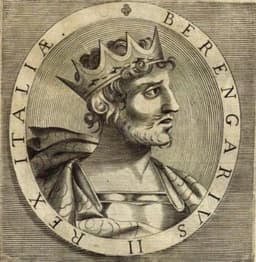
Berengar II
Emperor · Medieval
42.9Total

Qalawun
Emperor · Medieval
65.4Total
Basic Information
Born
900
1222
Died
966
1290
Era
Medieval
Medieval
Nationality
Italy
Egypt
Occupation
Emperor
Emperor
Civilization
Western
Middle Eastern
Score Comparison
Military (10%)
45.0
82.0
Political (20%)
30.8
72.0
Influence (20%)
49.4
58.3
Legacy (20%)
39.2
58.0
Leadership (15%)
51.9
72.0
Strategy (15%)
38.3
65.4
TOTAL
42.9
65.4
Berengar II — Complete Timeline
950 AD
Crowned King of ItalyPolitical Action◆ Major
Berengar II was crowned King of Italy in Pavia after the death of Lothair II. His rule was contested by the German king Otto I, who claimed the Italian throne through his marriage to Lothair's widow, Adelaide.
CoronationItalyKingship
Impact: regional
955 AD
Defeated by Otto I at the Battle of the LechfeldWar
Berengar II was defeated by Otto I at the Battle of the Lechfeld, where Otto also crushed the Magyars. This defeat forced Berengar to submit to Otto's suzerainty, reducing him to a vassal and ending independent Italian rule.
BattleOtto ISubmission
Impact: regionaltragic
962 AD
Rebellion against Otto IWar
Berengar II rebelled against Otto I's authority, attempting to regain full control of Italy. The rebellion failed, leading to Otto's second invasion of Italy and Berengar's eventual capture, solidifying Otto's control over the kingdom.
RebellionOtto IItaly
Impact: regionaldestructive
963 AD
Imprisonment by Otto IOther◆ Major
After a failed rebellion, Berengar II was captured by Otto I and imprisoned in Bamberg, Germany. He died in captivity in 966, marking the end of the independent Lombard kingdom of Italy and the beginning of direct German rule.
ImprisonmentItalyEnd of Independence
Impact: regionaltragic
Qalawun — Complete Timeline
1279 AD
Accession as Sultan (1279)Political Action◆ Major
Qalawun seized the sultanate after deposing his predecessor Al-Said Barakah, son of Baybars. He was a former Mamluk commander under Baybars. His accession marked the beginning of the Qalawunid dynasty, which ruled Egypt for over a century.
SuccessionMamluk SultanateDynasty
Impact: regional
1281 AD
Battle of Homs (1281)War◆ Major
Qalawun defeated a Mongol invasion led by Abaqa Khan of the Ilkhanate at the Second Battle of Homs. The Mamluk victory prevented Mongol incursions into Syria. This battle solidified Mamluk control over the region and deterred future Mongol attacks.
Mongol WarsBattleMamluk Victory
Impact: regionalconstructive
1285 AD
Capture of Margat and Latakia (1285-1287)War◆ Major
Qalawun captured the Crusader fortress of Margat (1285) and the port of Latakia (1287). These conquests further reduced Crusader territory in Syria. The fall of Margat was a significant blow to the Knights Hospitaller.
Crusader WarsConquestMamluk Expansion
Impact: regionaldestructive
1289 AD
Treaty of Tripoli (1289)Political Action◆ Major
Qalawun signed a truce with the Crusader County of Tripoli. However, he soon violated the treaty and captured Tripoli in 1289. The fall of Tripoli eliminated one of the last major Crusader states and paved the way for the capture of Acre.
Crusader WarsTreatyConquest
Impact: regionaldestructive
1290 AD
Death of Qalawun (1290)Other◆ Major
Qalawun died in Cairo while preparing a campaign to capture Acre. He was succeeded by his son Al-Ashraf Khalil, who completed the conquest of Acre. Qalawun's reign established the Qalawunid dynasty and strengthened the Mamluk state.
DeathSuccessionMamluk Sultanate
Impact: regional
Expert Analysis
Origins
Berengar II was born around 900 into the powerful Margrave family of Ivrea in northern Italy. His grandfather, Berengar I, had been King of Italy and Holy Roman Emperor, giving him a lineage steeped in royal ambition. Berengar II inherited the March of Ivrea in 923 and spent his early years navigating the fragmented Italian political landscape, where local nobles and foreign powers vied for control. His formative experiences were shaped by the decline of Carolingian authority and the rise of regional strongmen.
Qalawun was born around 1222 in the Kipchak steppes (modern-day Kazakhstan) and was sold as a slave to the Ayyubid sultan as a child. He rose through the ranks of the Mamluk military elite, becoming a trusted commander under Sultan Baybars. His early life as a military slave (mamluk) instilled discipline, loyalty, and a strategic mindset. Unlike Berengar, Qalawun had no royal blood; his rise was entirely merit-based within the Mamluk system.
Rise to Power
Berengar II became King of Italy in 950 after the death of Lothair II, but his claim was contested by the German king Otto I. Berengar initially sought to consolidate power by marrying his son to the widow of Lothair, but Otto intervened, invading Italy in 951 and forcing Berengar to submit as a vassal. Berengar's authority remained fragile, and his attempts to assert independence led to repeated conflicts with Otto. His turning point came in 955 when Otto defeated the Magyars at the Battle of Lechfeld, which also crushed Berengar's remaining influence.
Qalawun rose to power through military prowess and political maneuvering. He served under Baybars, participating in campaigns against the Crusaders and Mongols. After Baybars' death in 1277, Qalawun deposed Baybars' son, Al-Said Barakah, in 1279 and became sultan. His accession was smooth due to his support among the Mamluk emirs, and he quickly established his legitimacy by continuing the war against external enemies. His military score of 82.0 reflects his effectiveness in securing power through force.
Leadership & Governance
Berengar II ruled Italy as a feudal king, relying on the loyalty of local nobles. His governance was characterized by constant negotiation and conflict with powerful vassals. He attempted to centralize authority but lacked the resources and military strength to enforce his will. His leadership score of 51.9 indicates moderate effectiveness, but his political score of 30.8 shows his inability to build lasting alliances. Berengar's reign was marked by rebellion and submission, culminating in his imprisonment after a failed uprising in 963.
Qalawun, by contrast, was a strong centralizer. He reformed the Mamluk state, stabilizing the currency, building infrastructure, and establishing a bureaucratic system that outlasted his reign. His political score of 72.0 reflects his skill in managing the complex Mamluk factionalism. He also pursued a strategic foreign policy, signing truces with Crusader states only to break them when advantageous. His leadership score of 72.0 underscores his ability to command respect and loyalty from his troops and administrators.
Triumph & Tragedy
Berengar II's greatest success was becoming King of Italy, a position he held for over a decade despite external pressure. However, his greatest failure was his inability to resist Otto I's expansion. His rebellion in 963 led to his capture and imprisonment, ending the independence of the Italian kingdom. Berengar's total score of 42.9 reflects his limited achievements.
Qalawun's triumphs include the decisive victory over the Mongols at the Second Battle of Homs in 1281, which secured Mamluk dominance in Syria, and the capture of Crusader strongholds like Margat (1285) and Tripoli (1289). His greatest failure was his death in 1290 before capturing Acre, though his son completed the task. Qalawun's military score of 82.0 and legacy score of 58.0 highlight his successful campaigns but also the transient nature of his dynasty.
Character & Destiny
Berengar II was ambitious but indecisive, often overestimating his power. His decision to rebel against Otto I after submitting twice proved fatal. Historical assessments portray him as a capable local ruler who lacked the strategic vision to compete with a rising empire. His character sealed his fate: he was imprisoned and died in exile, a footnote in Italian history.
Qalawun was calculating and ruthless, exemplified by his violation of treaties. He was also pragmatic, building alliances and rewarding loyalists. His character enabled him to found a dynasty that ruled for a century, but his reliance on Mamluk factionalism meant his successors faced instability. Historians praise his military acumen and administrative reforms.
Legacy
Berengar II's legacy is minimal: he is remembered as the last independent king of Italy before the Ottonian dynasty. His defeat integrated Italy into the Holy Roman Empire, ending its medieval independence. His legacy score of 39.2 reflects his limited long-term impact.
Qalawun's legacy is substantial. He founded the Qalawunid dynasty, which ruled Egypt and Syria until 1382. His military victories against Mongols and Crusaders shaped the medieval Middle East, and his architectural projects, like the Qalawun complex in Cairo, endure. His legacy score of 58.0 indicates lasting influence, though his dynasty eventually declined.
Conclusion
Qalawun had a far greater impact than Berengar II. With a total score of 65.4 compared to Berengar's 42.9, Qalawun's military, political, and leadership achievements dwarf Berengar's. While Berengar was a minor figure in Italian feudalism, Qalawun was a transformative leader who repelled the Mongols, dismantled Crusader states, and established a dynasty. The data supports a clear conclusion: Qalawun's influence on world history is significantly more profound.
Rankings
🥇
QalawunLeader
Mil: 82.0Pol: 72.0Inf: 58.3
65.4
🥈
Berengar II
Mil: 45.0Pol: 30.8Inf: 49.4
42.9
+22.5 behind
How This Comparison Works
Algorithm
Each figure is scored on 6 dimensions (0—100 scale) based on structured historical data: Military (10%), Political (20%), Influence (20%), Legacy (20%), Leadership (15%), Strategy (15%). The weighted total produces the final ranking.
Data Sources
Scores are computed from structured sub-indicators in the database. Scale factors adjust for era (Ancient ×0.85, Modern ×1.0) and civilization size (Eastern ×1.05, Other ×0.80) to account for differences in population and military scale.
Maximum 3 Figures
Comparisons are limited to 2—3 figures to ensure readability and statistical meaningfulness.
Error Margins
±5 points per dimension — Sub-scores are derived from historical records with inherent uncertainty. Two figures within 5 points on a dimension should be considered roughly equivalent in that area.
Total Score Accuracy
±3 points overall — The weighted combination of 6 dimensions produces a total score with approximately ±3 points of uncertainty. Differences of less than 3 points are not statistically significant— the figures are effectively tied.
Known Limitations
- Historical records are incomplete and uneven across civilizations
- Figures from oral-tradition societies may be underrepresented
- Occupation labels can misclassify multi-role figures
- Scores measure capability and impact, not moral character
- Quantitative scoring is a comparison tool, not absolute truth
Capability Radar
Military (10%) — Battles & Warfare
Battles
35
75
Win Rate
30
80
Expansion
20
70
Political (20%) — Governance & Reform
Reform
20
60
Diplomacy
30
75
Economy
25
65
Influence (20%) — Cultural & Global Reach
Cultural
15
55
Global
10
55
Legacy (20%) — Historical Impact
Historical
20
65
Longevity
15
60
Leadership (15%) — Power & Stability
Tenure
45
70
Stability
20
70
Strategy (15%) — Tactics & Innovation
Strategy
25
75
Tactics
30
70
Reform
10
65
Similar Comparisons
Comments & Discussion
No comments yet. Be the first to share your thoughts!