Loading...
This comparison has not been analyzed yet.
One-time AI generation (~1 minute). Scores and timeline are already available below.
Bhutto Zulfikar Ali vs Charles Njonjo
Charles Njonjo leads by 0.6 pts · 2 figures compared
…
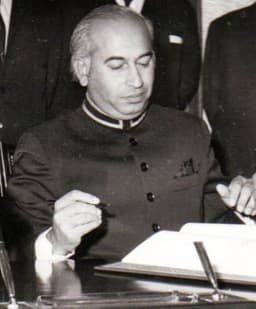
Bhutto Zulfikar Ali
Politician · Modern
52.4Total

Charles Njonjo
Politician · Modern
53.0Total
Basic Information
Born
1928
1920
Died
—
—
Era
Modern
Modern
Nationality
Pakistan
Kenya
Occupation
Politician
Politician
Civilization
Indian
Other
Score Comparison
Military (10%)
45.7
43.3
Political (20%)
55.0
68.0
Influence (20%)
58.3
51.8
Legacy (20%)
52.0
45.0
Leadership (15%)
40.0
66.0
Strategy (15%)
60.0
43.9
TOTAL
52.4
53.0
Bhutto Zulfikar Ali — Complete Timeline
1967 AD
Founding of the Pakistan People's PartyPolitical Action◆ Major
Bhutto founded the Pakistan People's Party (PPP) with a socialist and populist platform. The party quickly gained mass support, especially in West Pakistan, challenging the military regime of Ayub Khan.
PPPSocialismPolitical party
Impact: nationalconstructive
1970 AD
1970 general election victoryPolitical Action
Bhutto's PPP won a majority of seats in West Pakistan in the 1970 general election, while the Awami League won in East Pakistan. The refusal to transfer power to the Awami League led to the Bangladesh Liberation War.
ElectionBangladesh Liberation WarPolitical crisis
Impact: nationaldestructive
1972 AD
Nationalization of industriesReform◆ Major
Bhutto's government nationalized major industries, including steel, banking, and oil. This policy aimed to reduce economic inequality but led to inefficiencies, reduced foreign investment, and long-term economic challenges.
NationalizationEconomic reformSocialism
Impact: national
Simla AgreementPolitical Action◆ Major
Bhutto signed the Simla Agreement with Indian Prime Minister Indira Gandhi, normalizing relations after the 1971 war. The agreement established the Line of Control in Kashmir and committed both countries to bilateral resolution of disputes.
India-Pakistan relationsKashmirPeace treaty
Impact: regionalconstructive
1979 AD
Execution by Zia-ul-HaqPolitical Action
Bhutto was executed by hanging after a controversial murder trial under General Zia-ul-Haq's military regime. His death sparked international outrage and made him a martyr for the PPP, shaping Pakistani politics for decades.
ExecutionMartyrdomMilitary regime
Impact: nationaltragic
Charles Njonjo — Complete Timeline
1963 AD
Attorney General of KenyaPolitical Action◆ Major
Charles Njonjo served as the first Attorney General of independent Kenya from 1963 to 1979. He played a key role in drafting Kenya's constitution and legal framework, establishing the judiciary and legal institutions of the new nation.
Attorney GeneralKenyaLegal Framework
Impact: nationalconstructive
1970 AD
Duke of KabeteshireCultural
Njonjo was informally known as the 'Duke of Kabeteshire' due to his aristocratic demeanor and influence. This nickname reflected his powerful position in Kenyan politics and his close association with President Jomo Kenyatta.
NicknameKenyaPolitical Influence
Impact: national
1982 AD
Involvement in the 1982 coup attemptPolitical Action◆ Major
Njonjo was accused of involvement in the 1982 coup attempt against President Moi. Although he denied the charges, the allegations led to his political downfall and a commission of inquiry that cleared him but damaged his reputation.
Coup AttemptKenyaPolitical Crisis
Impact: nationaldestructive
1983 AD
Resignation from governmentPolitical Action◆ Major
Njonjo resigned as Attorney General in 1979 and later served as Minister for Constitutional Affairs. In 1983, he was forced to resign from the government after being implicated in a plot to overthrow President Daniel arap Moi, though he was later pardoned.
ResignationKenyaPolitical Scandal
Impact: nationaldestructive
This comparison has not been analyzed yet.
One-time AI generation (~1 minute). Scores and timeline are already available below.
Rankings
🥇
Charles NjonjoLeader
Mil: 43.3Pol: 68.0Inf: 51.8
53.0
🥈
Bhutto Zulfikar Ali
Mil: 45.7Pol: 55.0Inf: 58.3
52.4
+0.6 behind
How This Comparison Works
Algorithm
Each figure is scored on 6 dimensions (0—100 scale) based on structured historical data: Military (10%), Political (20%), Influence (20%), Legacy (20%), Leadership (15%), Strategy (15%). The weighted total produces the final ranking.
Data Sources
Scores are computed from structured sub-indicators in the database. Scale factors adjust for era (Ancient ×0.85, Modern ×1.0) and civilization size (Eastern ×1.05, Other ×0.80) to account for differences in population and military scale.
Maximum 3 Figures
Comparisons are limited to 2—3 figures to ensure readability and statistical meaningfulness.
Error Margins
±5 points per dimension — Sub-scores are derived from historical records with inherent uncertainty. Two figures within 5 points on a dimension should be considered roughly equivalent in that area.
Total Score Accuracy
±3 points overall — The weighted combination of 6 dimensions produces a total score with approximately ±3 points of uncertainty. Differences of less than 3 points are not statistically significant— the figures are effectively tied.
Known Limitations
- Historical records are incomplete and uneven across civilizations
- Figures from oral-tradition societies may be underrepresented
- Occupation labels can misclassify multi-role figures
- Scores measure capability and impact, not moral character
- Quantitative scoring is a comparison tool, not absolute truth
Capability Radar
Military (10%) — Battles & Warfare
Battles
42
22
Win Rate
45
25
Expansion
51
27
Political (20%) — Governance & Reform
Reform
70
55
Diplomacy
60
60
Economy
55
50
Influence (20%) — Cultural & Global Reach
Cultural
55
30
Global
55
20
Legacy (20%) — Historical Impact
Historical
60
40
Longevity
50
30
Leadership (15%) — Power & Stability
Tenure
65
60
Stability
30
55
Strategy (15%) — Tactics & Innovation
Strategy
52
28
Tactics
57
31
Reform
60
38
Similar Comparisons
Comments & Discussion
No comments yet. Be the first to share your thoughts!