Loading...
Bhutto Zulfikar Ali vs Napoleon Bonaparte
Napoleon Bonaparte leads by 18.5 pts · 2 figures compared
…
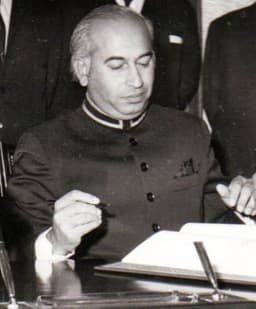
Bhutto Zulfikar Ali
Politician · Modern
52.4Total

Napoleon Bonaparte
General · Modern
70.9Total
Basic Information
Born
1928
1769
Died
—
1821
Era
Modern
Modern
Nationality
Pakistan
France
Occupation
Politician
General
Civilization
Indian
Western
Score Comparison
Military (10%)
45.7
94.0
Political (20%)
55.0
72.0
Influence (20%)
58.3
40.0
Legacy (20%)
52.0
80.0
Leadership (15%)
40.0
78.0
Strategy (15%)
60.0
90.0
TOTAL
52.4
70.9
Bhutto Zulfikar Ali — Complete Timeline
1967 AD
Founding of the Pakistan People's PartyPolitical Action◆ Major
Bhutto founded the Pakistan People's Party (PPP) with a socialist and populist platform. The party quickly gained mass support, especially in West Pakistan, challenging the military regime of Ayub Khan.
PPPSocialismPolitical party
Impact: nationalconstructive
1970 AD
1970 general election victoryPolitical Action
Bhutto's PPP won a majority of seats in West Pakistan in the 1970 general election, while the Awami League won in East Pakistan. The refusal to transfer power to the Awami League led to the Bangladesh Liberation War.
ElectionBangladesh Liberation WarPolitical crisis
Impact: nationaldestructive
1972 AD
Nationalization of industriesReform◆ Major
Bhutto's government nationalized major industries, including steel, banking, and oil. This policy aimed to reduce economic inequality but led to inefficiencies, reduced foreign investment, and long-term economic challenges.
NationalizationEconomic reformSocialism
Impact: national
Simla AgreementPolitical Action◆ Major
Bhutto signed the Simla Agreement with Indian Prime Minister Indira Gandhi, normalizing relations after the 1971 war. The agreement established the Line of Control in Kashmir and committed both countries to bilateral resolution of disputes.
India-Pakistan relationsKashmirPeace treaty
Impact: regionalconstructive
1979 AD
Execution by Zia-ul-HaqPolitical Action
Bhutto was executed by hanging after a controversial murder trial under General Zia-ul-Haq's military regime. His death sparked international outrage and made him a martyr for the PPP, shaping Pakistani politics for decades.
ExecutionMartyrdomMilitary regime
Impact: nationaltragic
Napoleon Bonaparte — Complete Timeline
1799 AD
Coup of 18 BrumaireOther◆ Major
Napoleon Bonaparte, with support from his brother Lucien and key political figures, overthrew the Directory in a bloodless coup. He established the Consulate with himself as First Consul, effectively becoming the ruler of France. This event ended the French Revolution's most unstable period.
French RevolutionCoupRise to Power
Impact: regional
1804 AD
Promulgation of the Napoleonic CodeOther◆ Major
Napoleon enacted the Civil Code of the French, known as the Napoleonic Code, a comprehensive set of laws that replaced the fragmented feudal legal systems. The code established legal equality, protected property rights, and secularized law. It became the basis for legal systems in many European and world countries.
Legal ReformNapoleonic CodeCivil Law
Impact: globalconstructive
1805 AD
Battle of AusterlitzWar◆ Major
Napoleon's Grande Arm
Napoleonic WarsBattleDecisive Victory
Impact: global
1812 AD
Invasion of RussiaWar◆ Major
Napoleon led the Grande Arm
Napoleonic WarsInvasionDisaster
Impact: globaldestructive
1815 AD
Battle of WaterlooWar◆ Major
Napoleon's French army was defeated by the combined forces of the Duke of Wellington's Anglo-Allied army and Gebhard Leberecht von Bl
Napoleonic WarsBattleFinal Defeat
Impact: globaldestructive
Expert Analysis
bhutto-zulfikar-ali-vs-napoleon-bonaparte
### The Corsican and the Sindhi: Two Paths to Power, Two Destinies
On a June morning in 1815, a man who had once ruled an empire from the Pyrenees to the Vistula watched his world collapse in the mud of Waterloo. A little over a century and a half later, on an April night in 1979, another man, who had ruled a nation born of the same imperial dreams, faced a hangman’s noose in a Rawalpindi prison. Napoleon Bonaparte and Zulfikar Ali Bhutto never met, yet their stories are bound by a common thread: the intoxicating, and ultimately lethal, pursuit of absolute power. One died in exile, the other by execution. The difference lies not in their ambition, but in the soil from which they grew.
### Origins: The Island and the Manor
Napoleon was born in 1769 on Corsica, a Mediterranean island sold to France by Genoa just a year before. His family was minor nobility, but they were Corsican first and French a distant second. He spoke Italian before he learned French, and his childhood was steeped in the rough, honor-bound world of a conquered people. This gave him a fierce, almost desperate drive to prove himself. The French Revolution, which erupted when he was twenty, shattered the old order and created a world where a brilliant artillery officer from nowhere could rise to the top.
Zulfikar Ali Bhutto was born in 1928 into the feudal aristocracy of Sindh, in British India. His father, Sir Shah Nawaz Bhutto, was a wealthy landowner and a political figure. Young Zulfikar was sent to the University of Southern California and then to Oxford, where he acquired the polished manners of a British barrister. Where Napoleon had to claw his way up from the periphery, Bhutto was born at the center of power. His ambition was not to conquer a world, but to inherit one—and then reshape it in his own image.
### Rise to Power: The Cannon and the Ballot
Napoleon’s rise was a story of pure momentum. In 1793, at the age of 24, he directed the artillery that drove the British from Toulon. By 1795, he was a general. By 1799, he had seized control of the French government in the coup of 18 Brumaire. His path was forged by gunpowder and audacity. He was not elected; he was accepted. A nation exhausted by chaos and terror turned to the man who promised order, glory, and a sword.
Bhutto’s rise was more deliberate, a masterclass in political architecture. After serving in the cabinet of General Ayub Khan, he broke away in 1967 to found the Pakistan People’s Party (PPP), a socialist, populist movement that spoke directly to the masses. His slogan—*“Roti, Kapra aur Makan”* (Bread, Cloth, and Shelter)—was a genius stroke. It was not a call to war, but a promise of dignity. In the 1970 general election, his PPP won a majority of seats in West Pakistan. But the real victory went to the Awami League in East Pakistan, a result that led to civil war and the creation of Bangladesh. Bhutto inherited a shattered nation.
### Leadership & Governance: The Code and the Nationalization
As emperor, Napoleon was a whirlwind of reform. He centralized the state, established the Bank of France, and, most enduringly, codified French law in the Napoleonic Code of 1804, which enshrined equality before the law, property rights, and secular governance. His military strategy was a revolution in itself: speed, massed artillery, and the destruction of enemy armies in a single decisive battle. His genius was in organization. He turned a chaotic army into a machine.
Bhutto governed a nation in crisis. He signed the Simla Agreement with India in 1972, normalizing relations and securing the return of captured territory. It was a diplomatic victory that bought Pakistan time. Domestically, he launched a sweeping nationalization of industries—steel, banking, oil—aimed at breaking the power of the old elite. But these reforms were blunt instruments. They alienated the business class, failed to deliver efficiency, and created a bloated bureaucracy. Where Napoleon built a system that outlasted him, Bhutto built a system that depended entirely on him.
### Triumph & Tragedy: Austerlitz and the Noose
Napoleon’s greatest moment was Austerlitz, December 2, 1805, where he crushed the armies of Russia and Austria. It was a masterpiece of deception and timing, a battle so perfect it became a textbook example for generations. His tragedy was the invasion of Russia in 1812. He lost half a million men to the cold and the vastness, a miscalculation born of overconfidence. He was exiled to Elba, escaped, and then lost at Waterloo. His final years were spent on the remote island of Saint Helena, dictating his memoirs.
Bhutto’s triumph was the 1973 Constitution, which gave Pakistan a parliamentary system and a federal structure. It was a fragile achievement, but it was truly his. His tragedy was the 1977 election, which he was widely accused of rigging. This sparked mass protests, and General Zia-ul-Haq seized power. Bhutto was arrested, tried for the murder of a political opponent, and sentenced to death. On April 4, 1979, he was hanged. His last words were reportedly, “Lord, help me, for I am innocent.”
### Character & Destiny: The Man and the Mirror
Napoleon was a man of immense will. He once said, “Impossible is a word to be found only in the dictionary of fools.” He trusted his star, and for a long time, it did not fail him. But his downfall came from the same source as his rise: he could not stop. He needed war to legitimize his rule, and war eventually consumed him.
Bhutto was a man of immense charm and intellect. He could convince an Oxford don and a Sindhi peasant in the same hour. But he was also deeply vain and intolerant of dissent. His arrogance led him to believe he could manipulate the army and the judiciary forever. He could not. In the end, the very system he had built—a centralized, personalistic rule—was turned against him.
### Legacy: The Stone and the Shadow
Napoleon’s legacy is carved in stone. The Napoleonic Code influences legal systems from France to Louisiana to Japan. His military tactics are still studied. He changed the map of Europe forever. He is remembered as a titan.
Bhutto’s legacy is more ambiguous. He is the father of Pakistan’s leftist politics and the founder of a political dynasty that still dominates the country. His daughter, Benazir, became prime minister. But his nationalizations damaged the economy, and his authoritarian tendencies set a dangerous precedent. He is remembered as a martyr by his followers and as a warning by his critics.
### Conclusion: The Two Faces of Ambition
Napoleon and Bhutto both reached for the sun. One fell from a throne, the other from a gallows. The Corsican built an empire on the ruins of a revolution; the Sindhi built a party on the hopes of a new nation. Both were brilliant, both were flawed, and both were destroyed by the very forces they sought to command. Their stories remind us that power is not a possession but a relationship—between a leader and his time, his people, and his own soul. In the end, the same ambition that raised them up also cast them down, leaving behind not just a legacy, but a question that haunts every age: what is the price of greatness?
Rankings
🥇
Napoleon BonaparteLeader
Mil: 94.0Pol: 72.0Inf: 40.0
70.9
🥈
Bhutto Zulfikar Ali
Mil: 45.7Pol: 55.0Inf: 58.3
52.4
+18.5 behind
How This Comparison Works
Algorithm
Each figure is scored on 6 dimensions (0—100 scale) based on structured historical data: Military (10%), Political (20%), Influence (20%), Legacy (20%), Leadership (15%), Strategy (15%). The weighted total produces the final ranking.
Data Sources
Scores are computed from structured sub-indicators in the database. Scale factors adjust for era (Ancient ×0.85, Modern ×1.0) and civilization size (Eastern ×1.05, Other ×0.80) to account for differences in population and military scale.
Maximum 3 Figures
Comparisons are limited to 2—3 figures to ensure readability and statistical meaningfulness.
Error Margins
±5 points per dimension — Sub-scores are derived from historical records with inherent uncertainty. Two figures within 5 points on a dimension should be considered roughly equivalent in that area.
Total Score Accuracy
±3 points overall — The weighted combination of 6 dimensions produces a total score with approximately ±3 points of uncertainty. Differences of less than 3 points are not statistically significant— the figures are effectively tied.
Known Limitations
- Historical records are incomplete and uneven across civilizations
- Figures from oral-tradition societies may be underrepresented
- Occupation labels can misclassify multi-role figures
- Scores measure capability and impact, not moral character
- Quantitative scoring is a comparison tool, not absolute truth
Capability Radar
Military (10%) — Battles & Warfare
Battles
42
95
Win Rate
45
90
Expansion
51
95
Political (20%) — Governance & Reform
Reform
70
95
Diplomacy
60
80
Economy
55
85
Influence (20%) — Cultural & Global Reach
Cultural
55
85
Global
55
90
Legacy (20%) — Historical Impact
Historical
60
95
Longevity
50
90
Leadership (15%) — Power & Stability
Tenure
65
85
Stability
30
70
Strategy (15%) — Tactics & Innovation
Strategy
52
95
Tactics
57
98
Reform
60
92
Similar Comparisons
Comments & Discussion
TheButcherOfBastille6/17/2026
Napoleon died in his bed because he knew when to burn empires and build thrones. Bhutto got the rope because he played democracy as a stage show but couldn’t stand the final act. Napoleon lost at Waterloo, but he’d already cemented his legacy. Bhutto lost at the polls, then tried to rig the system he claimed to love. One understood military force as a final argument; the other thought populist charisma could override reality. History doesn’t forgive amateurs with execution warrants.
血色土地主6/17/2026
Bhutto是封建土壤里长出的现代政客,Napoleon是革命熔炉锻造的军事天才。一个靠祖传土地和牛津口音上台,一个凭炮火和法典称王。Bhutto以为自己能像Napoleon那样收买军队,结果被自己扶持的Zia亲手吊死。Napoleon至少懂得法典比刺刀长久,Bhutto却只会用刺刀吓唬农民。区别在于,一个征服了大陆,一个连自己的内阁都管不住。这就是种姓和军阶的终极差别。
TheSkepticalEye6/17/2026
Let's not romanticize this. Napoleon's "genius" rested on 600,000 men dying in Russia alone. Bhutto's "tragedy" was losing an election he probably rigged. We compare them because both died dramatically, but Napoleon fought wars that reshaped Europe for a decade; Bhutto nationalized industries and then begged for IMF loans. If we're ranking dictators on impact, Napoleon is a 10, Bhutto a 3. If we're ranking on competence, Bhutto's execution was his final, and only, decisive act.
拿破仑的锤子6/17/2026
说Bhutto像Napoleon,那是侮辱军事科学。Napoleon的战役至今是西点教材,Bhutto的军事决策是什么?1971年印度入侵东巴基斯坦,他跑去联合国哭诉,结果丢了半个国家。Napoleon能在奥斯特里茨用三万人击溃俄奥联军,Bhutto连自己军队的忠诚都保不住。拿一个靠演讲上台的律师和一个靠炮火征服大陆的统帅比,就像拿锄头比大炮。不是所有野心家都配叫Bonaparte。
HistorysShadow6/17/2026
Two men who believed power was a personal possession. Napoleon thought he owned France; Bhutto thought he owned Pakistan. Both were wrong. Napoleon’s error was invading Russia; Bhutto’s was trusting his army chief. But one left the Napoleonic Code, the other left a daughter in politics. Legacy-wise, Bhutto was a footnote in South Asian drama, Napoleon rewrote European law. If you want tragedy, pick Bhutto. If you want impact, pick the man who made kings tremble.