Loading...
This comparison has not been analyzed yet.
One-time AI generation (~1 minute). Scores and timeline are already available below.
Bimbisara vs Philip the Arab
Bimbisara leads by 9.4 pts · 2 figures compared
…
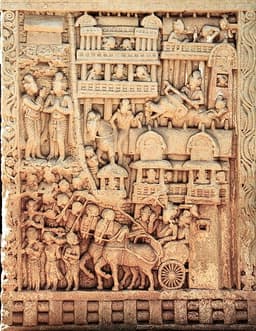
Bimbisara
Emperor · Ancient
57.3Total

Philip the Arab
Emperor · Ancient
47.9Total
Basic Information
Born
-558
204
Died
-491
249
Era
Ancient
Ancient
Nationality
India
Roman Empire
Occupation
Emperor
Emperor
Civilization
Indian
Western
Score Comparison
Military (10%)
60.0
40.0
Political (20%)
60.0
54.7
Influence (20%)
55.7
47.1
Legacy (20%)
49.2
38.3
Leadership (15%)
72.0
65.7
Strategy (15%)
52.5
45.0
TOTAL
57.3
47.9
Bimbisara — Complete Timeline
550 BC
Married Princess Chellana of LicchaviPolitical Action
Bimbisara married Chellana, daughter of the Licchavi chief Chetaka of Vaishali. This marriage alliance strengthened Magadha's ties with the powerful Licchavi republic and produced his son Ajatashatru.
Marriage AllianceDiplomacy
Impact: regional
540 BC
Conquered AngaWar◆ Major
Bimbisara annexed the kingdom of Anga (modern Bihar) to the Magadha empire. This conquest gave Magadha control over the Ganges river trade route and access to the sea, strengthening its economic and military power.
ConquestMagadha Expansion
Impact: regional
530 BC
Established Diplomatic Relations with the BuddhaPolitical Action◆ Major
Bimbisara met Gautama Buddha and became a lay follower, donating the Veluvana Bamboo Grove monastery near Rajagriha. This patronage helped establish Buddhism in Magadha and provided the Buddha with a permanent residence during the rainy season.
BuddhismPatronageReligion
Impact: regionalconstructive
491 BC
Imprisoned and Killed by AjatashatruPolitical Action◆ Major
Bimbisara was imprisoned by his son Ajatashatru, who seized the throne. According to Buddhist sources, Bimbisara died in captivity, possibly by starvation or suicide. This event marked a violent succession in Magadha.
Succession CrisisPatricide
Impact: nationaltragic
Philip the Arab — Complete Timeline
244 AD
Treaty with the Sassanid EmpireWar
Upon becoming emperor, Philip the Arab concluded a peace treaty with the Sassanid king Shapur I. The terms included a substantial payment to the Persians and Roman withdrawal from disputed territories, securing a temporary end to hostilities.
Sassanid EmpirePeace TreatyDiplomacy
Impact: regional
Accession as Roman EmperorPolitical Action◆ Major
After the death of Emperor Gordian III under suspicious circumstances during the Persian campaign, Philip the Arab, then praetorian prefect, was proclaimed emperor by the Roman army. He quickly negotiated peace with the Sassanid Empire.
Imperial AccessionSassanid PeaceThird Century
Impact: global
248 AD
Celebration of Rome's Millennium (Saeculum Novum)Cultural◆ Major
Philip the Arab presided over grand celebrations marking the 1,000th anniversary of the founding of Rome. The Ludi Saeculares (Secular Games) were held with great pomp, including spectacles and sacrifices, symbolizing the empire's continuity.
Roman MillenniumSecular GamesCelebration
Impact: globalconstructive
249 AD
Defeat and Death at the Battle of VeronaWar◆ Major
Rebel commander Decius, proclaimed emperor by the Danubian legions, defeated Philip's forces near Verona. Philip was killed in the battle, either by enemy soldiers or assassinated by his own men, ending his five-year reign.
Civil WarBattleDecius
Impact: globaltragic
This comparison has not been analyzed yet.
One-time AI generation (~1 minute). Scores and timeline are already available below.
Rankings
🥇
BimbisaraLeader
Mil: 60.0Pol: 60.0Inf: 55.7
57.3
🥈
Philip the Arab
Mil: 40.0Pol: 54.7Inf: 47.1
47.9
+9.4 behind
How This Comparison Works
Algorithm
Each figure is scored on 6 dimensions (0—100 scale) based on structured historical data: Military (10%), Political (20%), Influence (20%), Legacy (20%), Leadership (15%), Strategy (15%). The weighted total produces the final ranking.
Data Sources
Scores are computed from structured sub-indicators in the database. Scale factors adjust for era (Ancient ×0.85, Modern ×1.0) and civilization size (Eastern ×1.05, Other ×0.80) to account for differences in population and military scale.
Maximum 3 Figures
Comparisons are limited to 2—3 figures to ensure readability and statistical meaningfulness.
Error Margins
±5 points per dimension — Sub-scores are derived from historical records with inherent uncertainty. Two figures within 5 points on a dimension should be considered roughly equivalent in that area.
Total Score Accuracy
±3 points overall — The weighted combination of 6 dimensions produces a total score with approximately ±3 points of uncertainty. Differences of less than 3 points are not statistically significant— the figures are effectively tied.
Known Limitations
- Historical records are incomplete and uneven across civilizations
- Figures from oral-tradition societies may be underrepresented
- Occupation labels can misclassify multi-role figures
- Scores measure capability and impact, not moral character
- Quantitative scoring is a comparison tool, not absolute truth
Capability Radar
Military (10%) — Battles & Warfare
Battles
45
45
Win Rate
50
40
Expansion
65
15
Political (20%) — Governance & Reform
Reform
75
40
Diplomacy
70
55
Economy
65
45
Influence (20%) — Cultural & Global Reach
Cultural
55
25
Global
40
15
Legacy (20%) — Historical Impact
Historical
60
30
Longevity
55
20
Leadership (15%) — Power & Stability
Tenure
70
50
Stability
60
35
Strategy (15%) — Tactics & Innovation
Strategy
55
30
Tactics
40
35
Reform
60
20
Similar Comparisons
Comments & Discussion
No comments yet. Be the first to share your thoughts!