Loading...
Bohdan Khmelnytsky vs Carl Gustaf Emil Mannerheim
Carl Gustaf Emil Mannerheim leads by 1.8 pts · 2 figures compared
…
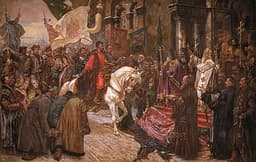
Bohdan Khmelnytsky
General · Modern
61.2Total

Carl Gustaf Emil Mannerheim
General · Modern
63.0Total
Basic Information
Born
1595
1867
Died
1657
1951
Era
Modern
Modern
Nationality
Ukraine
Finland
Occupation
General
General
Civilization
Western
Western
Score Comparison
Military (10%)
61.7
65.0
Political (20%)
62.7
70.0
Influence (20%)
58.3
55.0
Legacy (20%)
52.0
55.0
Leadership (15%)
80.0
78.0
Strategy (15%)
60.7
68.0
TOTAL
61.2
63.0
Bohdan Khmelnytsky — Complete Timeline
1648 AD
Battle of Zhovti VodyWar◆ Major
Khmelnytsky's Cossack forces, allied with Crimean Tatars, defeated a Polish army at Zhovti Vody. This victory marked the beginning of the Khmelnytsky Uprising, leading to widespread rebellion across Ukraine.
BattleUprisingPoland
Impact: regional
Election as Hetman of the Zaporozhian HostPolitical Action◆ Major
Bohdan Khmelnytsky was elected Hetman of the Zaporozhian Cossacks at a council on the Dnieper River. This election formalized his leadership of the Cossack uprising against the Polish-Lithuanian Commonwealth.
ElectionCossackHetman
Impact: regionalconstructive
1649 AD
Siege of ZbarazhWar◆ Major
Khmelnytsky besieged the Polish fortress of Zbarazh for over six weeks. The siege ended with the Treaty of Zboriv, which granted autonomy to the Cossack Hetmanate but failed to achieve full independence.
SiegePolandTreaty
Impact: regional
1651 AD
Battle of BerestechkoWar◆ Major
Khmelnytsky's forces suffered a major defeat at Berestechko against the Polish army, with heavy Cossack casualties. This battle forced him to sign the unfavorable Treaty of Bila Tserkva, reducing Cossack autonomy.
BattleDefeatPoland
Impact: regionaltragic
1654 AD
Treaty of PereiaslavPolitical Action
Khmelnytsky signed the Treaty of Pereiaslav with Tsar Alexis of Russia, placing the Cossack Hetmanate under Russian protection. This treaty shifted Ukraine's allegiance from Poland to Russia, with lasting geopolitical consequences.
TreatyRussiaUkraine
Impact: regional
Carl Gustaf Emil Mannerheim — Complete Timeline
1939 AD
Winter War CommandWar◆ Major
Mannerheim commanded Finnish forces during the Winter War against the Soviet Union. Despite being outnumbered, Finnish troops inflicted heavy losses on the Red Army, defending Finnish independence until the Moscow Peace Treaty in March 1940.
Winter WarFinnish-Soviet WarDefense
Impact: regional
1941 AD
Continuation War AllianceWar◆ Major
Mannerheim led Finland as co-belligerent with Nazi Germany against the Soviet Union in the Continuation War. Finnish forces recaptured lost territories but later halted at the old border, avoiding deeper involvement in the Siege of Leningrad.
Continuation WarWorld War IIAlliance
Impact: regional
1942 AD
Marshal of Finland AppointmentPolitical Action
Mannerheim was granted the title Marshal of Finland, the only person to hold this rank. The honor recognized his military leadership and role as commander-in-chief during the Continuation War.
TitleMilitary HonorLeadership
Impact: national
1944 AD
Lapland WarWar
Under Mannerheim's direction, Finnish forces turned against their former German allies in the Lapland War. The campaign forced German troops to withdraw into Norway, fulfilling the armistice terms and securing Finland's position.
Lapland WarWorld War IICampaign
Impact: regional
Moscow Armistice NegotiationsPolitical Action◆ Major
Mannerheim succeeded Risto Ryti as President of Finland in August 1944 and negotiated the Moscow Armistice with the Soviet Union. Finland ceded territories, paid reparations, and agreed to expel German forces from Lapland, ending hostilities.
ArmisticePeace TreatyPresidency
Impact: national
Expert Analysis
Origins
Bohdan Khmelnytsky was born in 1595 into a Ukrainian noble family, likely in Subotiv, part of the Polish-Lithuanian Commonwealth. He received a Jesuit education, learning Latin and Polish, and later served in the Polish military. His father was a Cossack officer, and Khmelnytsky inherited a significant estate. Personal grievances—including a Polish nobleman's seizure of his land and the death of his son—fueled his later rebellion.
Carl Gustaf Emil Mannerheim was born on June 4, 1867, in Askainen, Finland, into a Swedish-speaking aristocratic family. He attended the Hamina Cadet School and later the Nicholas Cavalry School in St. Petersburg, serving in the Russian Imperial Army. His early career included service in the Russo-Japanese War and intelligence missions in Central Asia. His Finnish identity was shaped by his noble background and military service to the Russian Empire.
Rise to Power
Khmelnytsky's rise began in 1648 when he was elected Hetman of the Zaporozhian Cossacks at a council on the Dnieper River. He allied with the Crimean Tatars and defeated Polish forces at the Battle of Zhovti Vody (April 1648) and the Battle of Korsun (May 1648). These victories catalyzed a mass Cossack uprising, spreading across Ukraine. By 1649, his forces besieged Zbarazh, leading to the Treaty of Zboriv, which granted autonomy to the Cossack Hetmanate.
Mannerheim's rise came after Finland's independence in 1917. He returned from Russia and became Commander-in-Chief of the Finnish forces during the Finnish Civil War (1918), leading the White Guards to victory. He served as Regent of Finland briefly in 1919 and later as chairman of the Defense Council, building Finland's military. His leadership during the Winter War (1939-1940) against the Soviet Union cemented his status as Finland's military leader.
Leadership & Governance
Khmelnytsky led the Cossack Hetmanate as a military state, combining authoritarian rule with Cossack democracy. He centralized power, minted coins, and conducted foreign policy. However, his governance relied heavily on alliances with the Crimean Tatars and later Russia, limiting his autonomy. He signed the Treaty of Pereiaslav in 1654, placing the Hetmanate under Russian protection—a move that ultimately subordinated Ukraine to Moscow.
Mannerheim's leadership was pragmatic and diplomatic. As Commander-in-Chief and later President, he balanced military necessity with political survival. During the Continuation War (1941-1944), he allied Finland with Nazi Germany to regain lost territories, but he avoided deep ideological commitment. In 1944, he negotiated the Moscow Armistice, turning against Germany in the Lapland War. His governance preserved Finland's independence and parliamentary system.
Triumph & Tragedy
Khmelnytsky's greatest success was launching a rebellion that freed large parts of Ukraine from Polish rule and establishing the Cossack Hetmanate. The Treaty of Zboriv (1649) granted autonomy, and his military campaigns, including victories at Zhovti Vody and Korsun, demonstrated tactical skill. However, his alliance with Russia led to the erosion of Ukrainian autonomy. The Battle of Berestechko (1651) was a major defeat, forcing him to accept a disadvantageous treaty. His legacy is marred by the eventual loss of independence to Russia, scoring 61.7 in military and 62.7 in political.
Mannerheim's triumph was leading Finland through two wars against the Soviet Union while maintaining sovereignty. The Winter War, where Finnish forces inflicted heavy losses on a vastly larger enemy, became a symbol of resilience. He scored 78.0 in leadership. However, the Continuation War's alliance with Nazi Germany tainted his legacy, and the Moscow Armistice forced territorial concessions. His failure to prevent the war's devastation and the subsequent Lapland War against former allies are tragedies, scoring 65.0 in military.
Character & Destiny
Khmelnytsky was pragmatic and ruthless, driven by personal revenge and national ambition. He shifted alliances as needed, but his decision to seek Russian protection was a strategic miscalculation that traded one master for another. His character—assertive but diplomatically naive—shaped a destiny where Ukrainian autonomy was sacrificed for survival.
Mannerheim was disciplined, strategic, and politically astute. He served the Russian Empire loyally for decades before switching to Finnish nationalism. His ability to navigate between great powers—Nazi Germany and the Soviet Union—preserved Finland's independence. His destiny was to be the father of modern Finland, though his wartime alliances remain controversial.
Legacy
Khmelnytsky is a national hero in Ukraine, celebrated as a founder of Ukrainian statehood. The city of Khmelnytskyi and numerous monuments honor him. However, his legacy is ambiguous: the Treaty of Pereiaslav is seen as a step toward Russian domination. His scores: Influence 58.3, Legacy 52.0.
Mannerheim is revered in Finland as the Marshal of Finland and a unifier. His birthday is celebrated as a flag day. The Mannerheim Cross and Mannerheim Museum commemorate him. His legacy includes Finland's independent defense policy and NATO alignment. Scores: Influence 55.0, Legacy 55.0.
Conclusion
Mannerheim had a greater impact. Despite a total score difference of only 1.8 points (63.0 vs. 61.2), his leadership preserved a sovereign Finland, which remains independent today. Khmelnytsky's rebellion, while pivotal, ultimately led to Ukraine's subjugation to Russia. Mannerheim's strategic decisions—allying with and then turning against Germany—demonstrated superior geopolitical acumen. His legacy is one of successful national defense, while Khmelnytsky's is one of incomplete liberation. Mannerheim's higher political (70.0 vs. 62.7) and strategic (68.0 vs. 60.7) scores reflect this.
Rankings
🥇
Carl Gustaf Emil MannerheimLeader
Mil: 65.0Pol: 70.0Inf: 55.0
63.0
🥈
Bohdan Khmelnytsky
Mil: 61.7Pol: 62.7Inf: 58.3
61.2
+1.8 behind
How This Comparison Works
Algorithm
Each figure is scored on 6 dimensions (0—100 scale) based on structured historical data: Military (10%), Political (20%), Influence (20%), Legacy (20%), Leadership (15%), Strategy (15%). The weighted total produces the final ranking.
Data Sources
Scores are computed from structured sub-indicators in the database. Scale factors adjust for era (Ancient ×0.85, Modern ×1.0) and civilization size (Eastern ×1.05, Other ×0.80) to account for differences in population and military scale.
Maximum 3 Figures
Comparisons are limited to 2—3 figures to ensure readability and statistical meaningfulness.
Error Margins
±5 points per dimension — Sub-scores are derived from historical records with inherent uncertainty. Two figures within 5 points on a dimension should be considered roughly equivalent in that area.
Total Score Accuracy
±3 points overall — The weighted combination of 6 dimensions produces a total score with approximately ±3 points of uncertainty. Differences of less than 3 points are not statistically significant— the figures are effectively tied.
Known Limitations
- Historical records are incomplete and uneven across civilizations
- Figures from oral-tradition societies may be underrepresented
- Occupation labels can misclassify multi-role figures
- Scores measure capability and impact, not moral character
- Quantitative scoring is a comparison tool, not absolute truth
Capability Radar
Military (10%) — Battles & Warfare
Battles
65
75
Win Rate
70
70
Expansion
60
40
Political (20%) — Governance & Reform
Reform
50
65
Diplomacy
60
80
Economy
45
60
Influence (20%) — Cultural & Global Reach
Cultural
60
65
Global
50
55
Legacy (20%) — Historical Impact
Historical
65
70
Longevity
55
60
Leadership (15%) — Power & Stability
Tenure
55
70
Stability
40
75
Strategy (15%) — Tactics & Innovation
Strategy
65
85
Tactics
60
80
Reform
55
75
Similar Comparisons
Comments & Discussion
No comments yet. Be the first to share your thoughts!