Loading...
This comparison has not been analyzed yet.
One-time AI generation (~1 minute). Scores and timeline are already available below.
Boleslaw III Wrymouth vs Issik Qaghan
Issik Qaghan leads by 3.3 pts · 2 figures compared
…
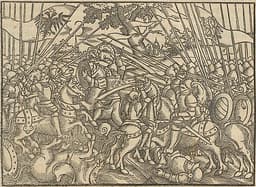
Boleslaw III Wrymouth
Emperor · Medieval
43.7Total

Issik Qaghan
Emperor · Medieval
47.0Total
Basic Information
Born
1086
520
Died
1138
553
Era
Medieval
Medieval
Nationality
Poland
Gokturk Khaganate
Occupation
Emperor
Emperor
Civilization
Western
Eastern
Score Comparison
Military (10%)
20.0
47.5
Political (20%)
30.8
36.5
Influence (20%)
51.8
50.2
Legacy (20%)
47.5
41.7
Leadership (15%)
51.9
51.9
Strategy (15%)
45.0
60.0
TOTAL
43.7
47.0
Boleslaw III Wrymouth — Complete Timeline
1109 AD
Battle of NakłoWar◆ Major
Bolesław III defeated the Pomeranian forces at Nakło, securing Polish control over Pomerania. This victory expanded Polish territory and influence in the Baltic region.
PomeraniaMilitary CampaignExpansion
Impact: regionalconstructive
Conflict with Henry V of GermanyWar◆ Major
Bolesław III successfully defended Poland against an invasion by Holy Roman Emperor Henry V at the Battle of Głogów and the Battle of Hundsfeld. The Polish forces repelled the imperial army, preserving Polish independence.
Holy Roman EmpireDefenseIndependence
Impact: nationalconstructive
1121 AD
Conquest of PomeraniaWar◆ Major
Bolesław III completed the conquest of Pomerania, incorporating the region into the Polish state. He forced the Pomeranian duke Wartislaw I to become a vassal, extending Polish authority to the Baltic coast.
PomeraniaConquestBaltic
Impact: regionalconstructive
1138 AD
Testament of Bolesław III WrymouthPolitical Action
Bolesław III issued his testament dividing the Polish realm among his four sons, with the senior prince ruling Kraków. This act established the principle of seniorate and initiated the period of feudal fragmentation in Poland, which lasted nearly two centuries.
Feudal FragmentationSuccessionPoland
Impact: nationaldestructive
Issik Qaghan — Complete Timeline
552 AD
Accession as Khagan of the GöktürksPolitical Action◆ Major
Issik Qaghan succeeded his father Bumin Qaghan as the second ruler of the First Turkic Khaganate. His reign continued the consolidation of the newly established empire in Central Asia.
SuccessionTurkic KhaganateCentral Asia
Impact: regional
553 AD
Western expansion of the Turkic KhaganateWar◆ Major
Issik Qaghan led military campaigns westward, expanding the Turkic state's territory beyond the Altai Mountains. This expansion brought the G
Territorial ExpansionMilitary CampaignSteppe
Impact: regionalconstructive
Death and successionPolitical Action
Issik Qaghan died after a short reign of about one year. He was succeeded by his brother Muqan Qaghan, who further expanded the khaganate. Issik's brief rule set the stage for the empire's rapid growth.
SuccessionDeathTurkic Khaganate
Impact: regional
This comparison has not been analyzed yet.
One-time AI generation (~1 minute). Scores and timeline are already available below.
Rankings
🥇
Issik QaghanLeader
Mil: 47.5Pol: 36.5Inf: 50.2
47.0
🥈
Boleslaw III Wrymouth
Mil: 20.0Pol: 30.8Inf: 51.8
43.7
+3.3 behind
How This Comparison Works
Algorithm
Each figure is scored on 6 dimensions (0—100 scale) based on structured historical data: Military (10%), Political (20%), Influence (20%), Legacy (20%), Leadership (15%), Strategy (15%). The weighted total produces the final ranking.
Data Sources
Scores are computed from structured sub-indicators in the database. Scale factors adjust for era (Ancient ×0.85, Modern ×1.0) and civilization size (Eastern ×1.05, Other ×0.80) to account for differences in population and military scale.
Maximum 3 Figures
Comparisons are limited to 2—3 figures to ensure readability and statistical meaningfulness.
Error Margins
±5 points per dimension — Sub-scores are derived from historical records with inherent uncertainty. Two figures within 5 points on a dimension should be considered roughly equivalent in that area.
Total Score Accuracy
±3 points overall — The weighted combination of 6 dimensions produces a total score with approximately ±3 points of uncertainty. Differences of less than 3 points are not statistically significant— the figures are effectively tied.
Known Limitations
- Historical records are incomplete and uneven across civilizations
- Figures from oral-tradition societies may be underrepresented
- Occupation labels can misclassify multi-role figures
- Scores measure capability and impact, not moral character
- Quantitative scoring is a comparison tool, not absolute truth
Capability Radar
Military (10%) — Battles & Warfare
Battles
45
45
Win Rate
40
50
Expansion
40
60
Political (20%) — Governance & Reform
Reform
20
25
Diplomacy
30
40
Economy
25
30
Influence (20%) — Cultural & Global Reach
Cultural
30
25
Global
20
15
Legacy (20%) — Historical Impact
Historical
45
30
Longevity
40
20
Leadership (15%) — Power & Stability
Tenure
55
35
Stability
10
30
Strategy (15%) — Tactics & Innovation
Strategy
30
55
Tactics
35
40
Reform
20
30
Similar Comparisons
Comments & Discussion
No comments yet. Be the first to share your thoughts!