Loading...
Boleslaw III Wrymouth vs Julius Caesar
Julius Caesar leads by 39.1 pts · 2 figures compared
…
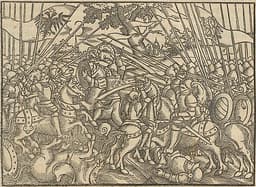
Boleslaw III Wrymouth
Emperor · Medieval
43.7Total

Julius Caesar
General · Ancient
82.8Total
Basic Information
Born
1086
-100
Died
1138
-44
Era
Medieval
Ancient
Nationality
Poland
Roman Republic
Occupation
Emperor
General
Civilization
Western
Western
Score Comparison
Military (10%)
20.0
88.0
Political (20%)
30.8
78.0
Influence (20%)
51.8
85.0
Legacy (20%)
47.5
82.0
Leadership (15%)
51.9
80.0
Strategy (15%)
45.0
85.0
TOTAL
43.7
82.8
Boleslaw III Wrymouth — Complete Timeline
1109 AD
Battle of NakłoWar◆ Major
Bolesław III defeated the Pomeranian forces at Nakło, securing Polish control over Pomerania. This victory expanded Polish territory and influence in the Baltic region.
PomeraniaMilitary CampaignExpansion
Impact: regionalconstructive
Conflict with Henry V of GermanyWar◆ Major
Bolesław III successfully defended Poland against an invasion by Holy Roman Emperor Henry V at the Battle of Głogów and the Battle of Hundsfeld. The Polish forces repelled the imperial army, preserving Polish independence.
Holy Roman EmpireDefenseIndependence
Impact: nationalconstructive
1121 AD
Conquest of PomeraniaWar◆ Major
Bolesław III completed the conquest of Pomerania, incorporating the region into the Polish state. He forced the Pomeranian duke Wartislaw I to become a vassal, extending Polish authority to the Baltic coast.
PomeraniaConquestBaltic
Impact: regionalconstructive
1138 AD
Testament of Bolesław III WrymouthPolitical Action
Bolesław III issued his testament dividing the Polish realm among his four sons, with the senior prince ruling Kraków. This act established the principle of seniorate and initiated the period of feudal fragmentation in Poland, which lasted nearly two centuries.
Feudal FragmentationSuccessionPoland
Impact: nationaldestructive
Julius Caesar — Complete Timeline
58 BC
Gallic WarsWar◆ Major
Caesar, as proconsul of Gaul, launched a series of campaigns that conquered all of Gaul (modern France, Belgium, and parts of Switzerland). He fought numerous battles, including against the Helvetii, the Belgae, and the Gallic chieftain Vercingetorix. The wars brought immense wealth and a loyal army to Caesar.
Gallic WarsConquestRoman Expansion
Impact: regional
49 BC
Crossing the RubiconPolitical Action◆ Major
Caesar led Legio XIII across the Rubicon River into Italy, defying the Roman Senate's order to disband his army. This act triggered a civil war against Pompey and the Optimates, ultimately leading to Caesar's dictatorship and the end of the Roman Republic.
Roman Civil WarEnd of RepublicPower Struggle
Impact: global
48 BC
Battle of PharsalusWar◆ Major
Caesar's outnumbered army defeated the larger forces of Pompey the Great at Pharsalus in Greece. Caesar's tactical use of a reserve line to counter Pompey's cavalry charge proved decisive. Pompey fled to Egypt, where he was assassinated, leaving Caesar as the undisputed master of the Roman world.
Roman Civil WarBattleDecisive Victory
Impact: regional
44 BC
Appointment as Dictator for LifePolitical Action◆ Major
The Roman Senate appointed Caesar dictator perpetuo (dictator for life), granting him unprecedented personal power. This move concentrated military, legislative, and judicial authority in one person, effectively ending the Roman Republic's traditional system of checks and balances and alarming many senators.
DictatorshipEnd of RepublicPower Consolidation
Impact: regionaldestructive
Assassination on the Ides of MarchPolitical Action◆ Major
A group of Roman senators, led by Marcus Junius Brutus and Gaius Cassius Longinus, stabbed Caesar to death at a meeting of the Senate in the Theatre of Pompey. The assassination was intended to restore the Republic, but instead triggered another civil war that led to the rise of the Roman Empire.
AssassinationRoman PoliticsEnd of Republic
Impact: globaldestructive
Expert Analysis
boleslaw-iii-wrymouth-vs-julius-caesar
# The Crosser and the Divider
On a January morning in 49 BCE, Julius Caesar stood at the banks of the Rubicon, a small river that marked the boundary between his province and Rome itself. To cross was treason, to turn back was oblivion. He crossed. Nearly twelve centuries later, in 1138, another ruler lay dying in a Polish palace, his hands trembling as he signed a document that would undo everything he had built. Bolesław III Wrymouth divided his kingdom among four sons, ensuring that Poland would not stand united for two centuries. One man broke every rule to seize power; the other wrote rules to surrender it. Why did two warriors, both hardened by decades of battle, choose such opposite fates?
Origins
Julius Caesar was born into the twilight of the Roman Republic, a world of senatorial intrigue, civil wars, and crumbling traditions. His family, the Julian clan, claimed descent from Venus herself, but their wealth was modest by Roman standards. The young Caesar grew up watching his uncle Gaius Marius and his rival Sulla tear the Republic apart with their armies. He learned early that in Rome, politics was war by other means, and war was politics at its most honest.
Bolesław III entered a very different world in 1086. Poland was a young kingdom, Christian for barely a century, surrounded by the Holy Roman Empire to the west, pagan tribes to the north and east, and the endless steppe beyond. His father, Władysław I Herman, was a weak ruler dominated by a powerful palatine. Bolesław’s childhood was a school of survival: his older brother Zbigniew was exiled, their father played them against each other, and the Polish throne was a prize won through ambush and assassination rather than election.
Rise to Power
Caesar’s path was a masterclass in patience. He fled Rome during Sulla’s proscriptions, served as a military tribune in Asia, and returned to climb the political ladder step by step: quaestor, aedile, pontifex maximus, praetor, consul. Each office brought debts, alliances, and enemies. His conquest of Gaul from 58 to 50 BCE was not just a war of expansion but a political machine: the loot funded his debts, the legions swore loyalty to him alone, and his commentaries made him a legend while he was still alive.
Bolesław’s rise was more brutal and direct. After his father’s death in 1102, he and his half-brother Zbigniew divided Poland between them. But division bred war. In 1106, Bolesław attacked Zbigniew, blinded him in a ritual of medieval cruelty, and reunited the kingdom under one ruler. Where Caesar maneuvered through senatorial votes and provincial commands, Bolesław simply killed his rival. The difference speaks to their worlds: Rome had institutions, however corrupt; Poland had only the sword.
Leadership & Governance
As dictator, Caesar governed with breathtaking speed. He reformed the calendar, granted citizenship to Gauls, launched public works that employed the urban poor, and centralized tax collection. His military genius was equally sweeping: at Alesia in 52 BCE, he built a double ring of fortifications to trap both the Gaulish army and its relief force, a feat of engineering and logistics that still stuns military historians. Yet his political wisdom was flawed. He pardoned his enemies, promoted men based on talent rather than birth, and treated the Senate as a rubber stamp. He believed that generosity would win loyalty; instead, it bred contempt.
Bolesław’s greatest triumph came in 1109, when he crushed the Pomeranians at Nakło and, months later, repelled the Holy Roman Emperor Henry V at Głogów. The siege of Głogów became Polish legend: Henry V used Polish hostages as human shields, but Bolesław refused to surrender, and his men fought through their own countrymen’s screams. By 1121, he had conquered all of Pomerania, doubling Poland’s coastline and securing its northern border. But his governance was less impressive. He ruled through personal loyalty and brute force, building no lasting institutions, no administrative reforms, no system that could survive him.
Triumph & Tragedy
Caesar’s triumph was also his tragedy. In 45 BCE, he returned to Rome as dictator for life, his image stamped on coins, his statue placed among the kings. He was planning a campaign against Parthia when, on the Ides of March 44 BCE, sixty senators stabbed him to death. His last moments, according to Plutarch, were not a dramatic speech but a shocked silence when he saw his friend Brutus among the assassins.
Bolesław’s tragedy came not in death but in legacy. In 1138, he issued his testament, dividing Poland among his four sons, with the eldest holding Kraków as senior prince. This “Testament of Bolesław III Wrymouth” was meant to prevent civil war. Instead, it created two centuries of fragmentation, foreign invasions, and a Poland so weak that the Teutonic Knights could carve out their own state on its soil. Bolesław died knowing his life’s work—the conquest of Pomerania, the defense against Germany—would crumble within a generation.
Character & Destiny
Caesar was a gambler who calculated every risk. He crossed the Rubicon not on impulse but after years of planning. He was vain, ambitious, and ruthless when necessary, yet also merciful, charismatic, and remarkably modern in his vision of a unified Mediterranean world. His character drove him to push boundaries until the boundaries pushed back.
Bolesław was a survivor, hardened by betrayal and shaped by a world where mercy was weakness. His nickname “Wrymouth” came from a childhood accident that left his face twisted, and perhaps that physical deformity mirrored a spiritual one: he could conquer but not build, fight but not govern. His testament was an act of love for his sons, but love without wisdom is a kind of poison.
Legacy
Caesar’s legacy transformed the world. His name became synonymous with emperor—Kaiser, Tsar, Caesar—and his reforms laid the foundation for the Roman Empire that would last another five centuries. His writings shaped Western military doctrine, and his assassination taught every future ruler that absolute power is never absolute.
Bolesław’s legacy is a warning. He is remembered as the man who broke Poland, whose good intentions paved the road to fragmentation. His military victories are footnotes in Polish history, overshadowed by the chaos that followed. The seniorate system he created collapsed into civil war, and Poland would not reunite until Władysław the Elbow-High in 1320—nearly two centuries later.
Conclusion
Standing at the Rubicon, Caesar knew that some lines, once crossed, can never be uncrossed. Lying on his deathbed, Bolesław believed that lines could be drawn on parchment to hold a kingdom together. Both were wrong, but in opposite ways. Caesar’s crossing destroyed the Republic but created an empire; Bolesław’s dividing destroyed his kingdom and created nothing. The difference between them is not just talent or circumstance, but a deeper truth about power: it can be seized in a moment, but it can never be divided without loss.
Rankings
🥇
Julius CaesarLeader
Mil: 88.0Pol: 78.0Inf: 85.0
82.8
🥈
Boleslaw III Wrymouth
Mil: 20.0Pol: 30.8Inf: 51.8
43.7
+39.1 behind
How This Comparison Works
Algorithm
Each figure is scored on 6 dimensions (0—100 scale) based on structured historical data: Military (10%), Political (20%), Influence (20%), Legacy (20%), Leadership (15%), Strategy (15%). The weighted total produces the final ranking.
Data Sources
Scores are computed from structured sub-indicators in the database. Scale factors adjust for era (Ancient ×0.85, Modern ×1.0) and civilization size (Eastern ×1.05, Other ×0.80) to account for differences in population and military scale.
Maximum 3 Figures
Comparisons are limited to 2—3 figures to ensure readability and statistical meaningfulness.
Error Margins
±5 points per dimension — Sub-scores are derived from historical records with inherent uncertainty. Two figures within 5 points on a dimension should be considered roughly equivalent in that area.
Total Score Accuracy
±3 points overall — The weighted combination of 6 dimensions produces a total score with approximately ±3 points of uncertainty. Differences of less than 3 points are not statistically significant— the figures are effectively tied.
Known Limitations
- Historical records are incomplete and uneven across civilizations
- Figures from oral-tradition societies may be underrepresented
- Occupation labels can misclassify multi-role figures
- Scores measure capability and impact, not moral character
- Quantitative scoring is a comparison tool, not absolute truth
Capability Radar
Military (10%) — Battles & Warfare
Battles
45
95
Win Rate
40
92
Expansion
40
97
Political (20%) — Governance & Reform
Reform
20
90
Diplomacy
30
85
Economy
25
82
Influence (20%) — Cultural & Global Reach
Cultural
30
88
Global
20
94
Legacy (20%) — Historical Impact
Historical
45
95
Longevity
40
96
Leadership (15%) — Power & Stability
Tenure
55
75
Stability
10
60
Strategy (15%) — Tactics & Innovation
Strategy
30
94
Tactics
35
96
Reform
20
88
Similar Comparisons
Comments & Discussion
历史判官老张6/17/2026
说Bolesław是“分裂者”太客气了,他根本就是波兰版的周幽王—分封四子把自己祖宗百年基业拆成碎片,让德意志人高兴,让鞑靼人趁虚而入。凯撒跨过卢比孔时至少知道自己在赌什么,而这货临终签遗嘱时手抖,可能只是因为意识到自己是个历史罪人。
Data_Monger_17766/17/2026
Let's be real—comparing a Roman general to a Polish duke is like comparing a hurricane to a drizzle. Caesar's crossing is hyperfocused in one legendary moment; Bolesław's division is spread over years of political dithering. The analysis gives Bolesław credit for "strategic foresight," but I see a guy who couldn't manage his heirs and botched the succession. Hard pass on the false equivalence.
古典学杠精6/17/2026
凯撒的家族可是尤利乌斯,人家祖上据说跟维纳斯挂钩,Bolesław呢?皮雅斯特家族,顶多认识几个维京海盗。这俩对比就像拿《伊利亚特》跟《波兰编年史》比文学价值—都不是一个量级的传承。凯撒跨过卢比孔是个人史诗,Bolesław撕碎波兰是王朝平庸剧,别美化后者了。
Historian4946/17/2026
Caesar's crossing of the Rubicon was a masterstroke of decisive ambition, while Bolesław's testament was a cowardly abdication of responsibility. One man seized history by the throat; the other let it slip through his fingers, fracturing Poland for 200 years. You can't compare a conqueror to a divider—Caesar built an empire, Bolesław built a mess.