Loading...
Bulent Ecevit vs Fernando Henrique Cardoso
Fernando Henrique Cardoso leads by 7.3 pts · 2 figures compared
…
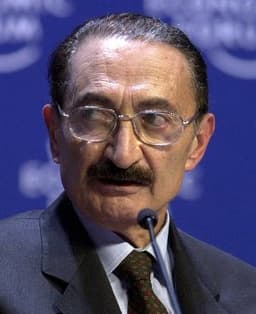
Bulent Ecevit
Politician · Modern
54.3Total

Fernando Henrique Cardoso
Politician · Modern
61.6Total
Basic Information
Born
1925
1931
Died
—
—
Era
Modern
Modern
Nationality
Turkey
Brazil
Occupation
Politician
Politician
Civilization
Middle Eastern
Western
Score Comparison
Military (10%)
47.5
50.0
Political (20%)
68.0
82.0
Influence (20%)
60.0
61.0
Legacy (20%)
50.0
52.0
Leadership (15%)
53.2
80.0
Strategy (15%)
38.3
40.8
TOTAL
54.3
61.6
Bulent Ecevit — Complete Timeline
1974 AD
Ordered the Cyprus InvasionWar
Ecevit ordered the Turkish military invasion of Cyprus following a Greek-backed coup on the island. The invasion led to the partition of Cyprus and the establishment of the Turkish Republic of Northern Cyprus.
Cyprus InvasionMilitary ActionPartition
Impact: regionaldestructive
First Term as Prime Minister of TurkeyPolitical Action◆ Major
Bulent Ecevit became Prime Minister of Turkey for the first time, leading a coalition government of the Republican People's Party (CHP). He served as prime minister four times between 1974 and 1999.
Prime MinisterRepublican People's PartyCoalition
Impact: nationalconstructive
1980 AD
Ousted by the 1980 Military CoupPolitical Action◆ Major
The Turkish military coup overthrew Ecevit's government. He was arrested and banned from politics for a decade, along with other party leaders.
Military CoupArrestPolitical Ban
Impact: nationaldestructive
1999 AD
Return to Politics and Fourth Term as Prime MinisterPolitical Action◆ Major
Ecevit returned as prime minister after the 1999 elections, leading a coalition government. His term was marked by economic crisis and the capture of PKK leader Abdullah Ocalan.
Return to PoliticsCoalitionEconomic Crisis
Impact: national
Capture of Abdullah OcalanPolitical Action◆ Major
Under Ecevit's government, Turkish authorities captured Abdullah Ocalan, leader of the Kurdistan Workers' Party (PKK), in Kenya. Ocalan's capture led to a ceasefire and reduced violence.
PKKAbdullah OcalanCounterterrorism
Impact: nationalconstructive
Fernando Henrique Cardoso — Complete Timeline
1993 AD
Appointed Minister of FinancePolitical Action◆ Major
Fernando Henrique Cardoso was appointed Minister of Finance by President Itamar Franco in May 1993. He was tasked with stabilizing Brazil's economy, which was suffering from hyperinflation.
Finance MinistryEconomic PolicyBrazil
Impact: nationalconstructive
1994 AD
Implemented the Plano RealReform
Cardoso led the implementation of the Plano Real (Real Plan) in 1994, a comprehensive economic stabilization program. It introduced a new currency, the real, and successfully ended hyperinflation, bringing price stability to Brazil.
Economic StabilizationPlano RealBrazil
Impact: nationalconstructive
Elected President of BrazilPolitical Action◆ Major
Cardoso was elected president of Brazil in 1994 as the candidate of the Brazilian Social Democracy Party (PSDB). He assumed office on January 1, 1995, with a mandate to continue economic reforms.
PresidencyElectionBrazil
Impact: nationalconstructive
1995 AD
Privatized State-Owned EnterprisesReform◆ Major
Cardoso's government privatized several state-owned enterprises, including the mining company Vale do Rio Doce and the telecommunications system Telebr
PrivatizationEconomic ReformBrazil
Impact: national
Created the Bolsa Escola ProgramReform◆ Major
Cardoso created the Bolsa Escola (School Grant) program in 1995, a conditional cash transfer that provided payments to poor families in exchange for keeping their children in school. This program later evolved into Bolsa Fam
Social PolicyEducationBrazil
Impact: nationalprogressive
1998 AD
Re-elected President of BrazilPolitical Action◆ Major
Cardoso was re-elected president in 1998, winning in the first round. His second term focused on fiscal austerity, privatization, and social programs, though economic growth remained modest.
Re-electionEconomic ReformBrazil
Impact: nationalconstructive
Expert Analysis
Origins
Bulent Ecevit was born in 1925 in Istanbul, Turkey, into a middle-class family. His father was a professor of law and his mother a painter. He studied at Robert College and later at the School of Language, History, and Geography in Ankara. He began his career as a journalist and poet, joining the Republican People's Party (CHP) in the 1950s. His intellectual background and nationalist leanings shaped his political outlook.
Fernando Henrique Cardoso was born in 1931 in Rio de Janeiro, Brazil, into a family of military and political figures. His father was a general and his mother a teacher. He studied sociology at the University of São Paulo, earning a doctorate. He became a prominent academic, developing dependency theory. His exile during the military dictatorship in the 1960s and 1970s deepened his commitment to democracy and economic reform.
Rise to Power
Ecevit rose through the CHP ranks, becoming party leader in 1972 after defeating Ismet Inonu. He became Prime Minister in 1974, leading a coalition. His decision to invade Cyprus in July 1974, following a Greek-backed coup, boosted his popularity at home but isolated Turkey internationally. He served as prime minister three times before the 1980 military coup overthrew him and banned him from politics. He returned in the late 1980s, becoming prime minister again in 1999 after the elections.
Cardoso's rise was based on his intellectual reputation. He was appointed Minister of Finance in 1993 by President Itamar Franco. He designed and implemented the Plano Real, which introduced a new currency and ended hyperinflation. The plan's success made him a frontrunner for the presidency. He won the 1994 election in the first round, taking office in 1995. His popularity allowed him to be re-elected in 1998, also in the first round.
Leadership & Governance
Ecevit's leadership style was populist and nationalist. He emphasized social democracy but often faced coalition instability. His governance was marked by ideological rigidity and a tendency to confront military and secularist establishments. He pushed for economic reforms but struggled with inflation and debt. His government's capture of PKK leader Abdullah Ocalan in 1999 was a major achievement, but his handling of the 2001 economic crisis was poor, leading to a severe recession.
Cardoso led as a pragmatic centrist. He focused on economic stabilization, fiscal discipline, and privatization. His government sold state enterprises like Vale do Rio Doce and Telebrás, raising revenue and reducing state intervention. He also expanded social programs like Bolsa Escola, later Bolsa Família. His leadership style was consensus-building, relying on a broad coalition in Congress. He respected democratic institutions and left office with high approval ratings.
Triumph & Tragedy
Ecevit's greatest triumph was the Cyprus invasion, which secured Turkish Cypriot autonomy and is still celebrated in Turkey. He also oversaw the capture of Ocalan, a key victory against the PKK. However, his greatest tragedy was the 2001 economic crisis, which devastated the Turkish economy and led to his party's collapse. The 1980 coup also ended his earlier reforms and led to his political ban.
Cardoso's triumph was the Real Plan, which ended decades of hyperinflation and stabilized Brazil's economy. It laid the foundation for future growth. His privatization and social programs also had lasting impact. However, his failure to address inequality sufficiently and his reliance on IMF loans during crises were criticized. The 1999 currency crisis forced a devaluation, though he managed to avoid a meltdown.
Character & Destiny
Ecevit was known for his integrity and stubbornness. He was a poet and intellectual, but his inflexibility often led to political isolation. His nationalist stance on Cyprus made him a hero to many Turks, but his economic mismanagement tarnished his legacy. He scored 53.2 in leadership and 38.3 in strategy, reflecting his inability to navigate economic complexities.
Cardoso was a pragmatic sociologist who believed in gradual change. He was a skilled negotiator and communicator. His character shaped his destiny: he used his academic background to design effective policies and his political savvy to implement them. He scored 80.0 in leadership and 40.8 in strategy, showing his strength in governance but caution in bold moves.
Legacy
Ecevit's legacy is mixed. He is remembered for Cyprus and the Ocalan capture, but also for economic turmoil. His party, the CHP, remains influential but has moved away from his policies. He scored 50.0 in legacy, reflecting limited enduring impact. The Cyprus issue remains unresolved, and his economic record is a cautionary tale.
Cardoso's legacy is more positive. The Real Plan's stability lasted, and his reforms modernized Brazil. His social programs were expanded by successors. He scored 52.0 in legacy, higher than Ecevit. His influence on Brazilian politics continues, though his privatization is debated. He is seen as a successful reformer.
Conclusion
Fernando Henrique Cardoso had greater impact than Bulent Ecevit. Cardoso's Real Plan fundamentally transformed Brazil's economy, ending hyperinflation and enabling growth. His governance style was more effective, with a leadership score of 80.0 vs. Ecevit's 53.2. While Ecevit's Cyprus invasion was a significant geopolitical event, it did not lead to sustainable stability or prosperity. Cardoso's total score of 61.6 surpasses Ecevit's 54.3 by 7.3 points. In the long term, Cardoso's policies created conditions for Brazil's emergence as a major economy, whereas Ecevit's tenure ended in crisis. Thus, Cardoso's impact was greater.
Rankings
🥇
Fernando Henrique CardosoLeader
Mil: 50.0Pol: 82.0Inf: 61.0
61.6
🥈
Bulent Ecevit
Mil: 47.5Pol: 68.0Inf: 60.0
54.3
+7.3 behind
How This Comparison Works
Algorithm
Each figure is scored on 6 dimensions (0—100 scale) based on structured historical data: Military (10%), Political (20%), Influence (20%), Legacy (20%), Leadership (15%), Strategy (15%). The weighted total produces the final ranking.
Data Sources
Scores are computed from structured sub-indicators in the database. Scale factors adjust for era (Ancient ×0.85, Modern ×1.0) and civilization size (Eastern ×1.05, Other ×0.80) to account for differences in population and military scale.
Maximum 3 Figures
Comparisons are limited to 2—3 figures to ensure readability and statistical meaningfulness.
Error Margins
±5 points per dimension — Sub-scores are derived from historical records with inherent uncertainty. Two figures within 5 points on a dimension should be considered roughly equivalent in that area.
Total Score Accuracy
±3 points overall — The weighted combination of 6 dimensions produces a total score with approximately ±3 points of uncertainty. Differences of less than 3 points are not statistically significant— the figures are effectively tied.
Known Limitations
- Historical records are incomplete and uneven across civilizations
- Figures from oral-tradition societies may be underrepresented
- Occupation labels can misclassify multi-role figures
- Scores measure capability and impact, not moral character
- Quantitative scoring is a comparison tool, not absolute truth
Capability Radar
Military (10%) — Battles & Warfare
Battles
30
31
Win Rate
40
30
Expansion
30
34
Political (20%) — Governance & Reform
Reform
55
85
Diplomacy
50
75
Economy
45
90
Influence (20%) — Cultural & Global Reach
Cultural
40
40
Global
50
55
Legacy (20%) — Historical Impact
Historical
55
60
Longevity
40
50
Leadership (15%) — Power & Stability
Tenure
60
65
Stability
40
70
Strategy (15%) — Tactics & Innovation
Strategy
40
38
Tactics
35
38
Reform
20
41
Similar Comparisons
Comments & Discussion
No comments yet. Be the first to share your thoughts!