Loading...
Camille Chamoun vs Moncef Marzouki
Camille Chamoun leads by 2.6 pts · 2 figures compared
…
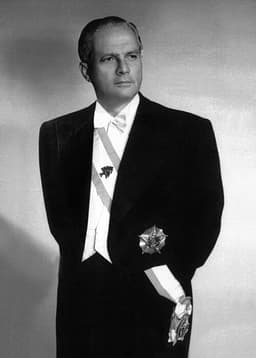
Camille Chamoun
Politician · Modern
51.4Total

Moncef Marzouki
Politician · Modern
48.8Total
Basic Information
Born
1900
1945
Died
1987
—
Era
Modern
Modern
Nationality
Lebanon
Tunisia
Occupation
Politician
Politician
Civilization
Middle Eastern
Middle Eastern
Score Comparison
Military (10%)
39.4
40.4
Political (20%)
61.3
68.0
Influence (20%)
53.3
54.1
Legacy (20%)
45.0
43.3
Leadership (15%)
65.0
40.0
Strategy (15%)
39.6
42.4
TOTAL
51.4
48.8
Camille Chamoun — Complete Timeline
1952 AD
Elected President of LebanonPolitical Action◆ Major
Camille Chamoun was elected President of Lebanon on September 23, 1952, succeeding Bechara El Khoury. His election marked a shift in Lebanese politics, and he served a six-year term until 1958.
PresidencyElectionLebanon
Impact: national
1958 AD
1958 Lebanon crisis and U.S. interventionWar◆ Major
President Chamoun faced a major political crisis when Muslim factions rebelled against his pro-Western policies and alleged attempts to amend the constitution for a second term. The U.S. intervened by landing Marines in Beirut to stabilize the government.
Civil WarU.S. InterventionPolitical Crisis
Impact: regionaldestructive
Refused to resign during the 1958 crisisPolitical Action
Chamoun refused to resign despite widespread opposition and the formation of a rebel government in Tripoli. He remained in power until the end of his term in September 1958, when he handed over to Fuad Chehab.
ResistancePolitical StalemateTransition
Impact: national
Founded the National Liberal PartyPolitical Action
After leaving the presidency, Chamoun founded the National Liberal Party (NLP) in 1958. The party became a major political force representing Maronite Christian interests and played a role in the Lebanese Civil War.
Political PartyMaronitePost-presidency
Impact: national
1975 AD
Role in the Lebanese Civil WarWar◆ Major
Chamoun's National Liberal Party and its militia, the Tigers, fought in the Lebanese Civil War as part of the Christian Lebanese Front. He opposed the Taif Agreement and remained a polarizing figure until his death in 1987.
Civil WarMilitiaChristian Faction
Impact: nationaldestructive
Moncef Marzouki — Complete Timeline
2001 AD
Founding of the Congress for the Republic partyPolitical Action
Marzouki founded the Congress for the Republic (CPR) party as a secular, left-leaning opposition movement. The party was banned under President Zine El Abidine Ben Ali, forcing Marzouki into exile in France.
Political PartyOpposition
Impact: nationalconstructive
2011 AD
Election as President of TunisiaPolitical Action◆ Major
Following the Tunisian Revolution, the Constituent Assembly elected Moncef Marzouki as President of Tunisia. He became the first democratically elected president in the country's history, serving from 2011 to 2014.
DemocracyArab SpringElection
Impact: nationalprogressive
2014 AD
Tunisian Constitution of 2014Reform◆ Major
Marzouki oversaw the adoption of a new constitution, which established a mixed presidential-parliamentary system, guaranteed human rights, and enshrined gender equality. The constitution was widely praised as a model for the Arab world.
ConstitutionReformDemocracy
Impact: nationalconstructive
Defeat in 2014 presidential electionPolitical Action◆ Major
Marzouki lost the presidential runoff to Beji Caid Essebsi, receiving 44.3% of the vote. This marked the first peaceful democratic transfer of power in Tunisia's history.
ElectionDemocracy
Impact: national
Expert Analysis
Origins
Camille Chamoun was born on April 3, 1900, into a prominent Maronite Christian family in Deir el-Qamar, Lebanon. He studied law in Beirut and Paris, and entered politics early, serving as a deputy in the Lebanese parliament from 1934. His background was rooted in the French mandate era and the Christian-dominated political establishment.
Moncef Marzouki was born on July 7, 1945, in Grombalia, Tunisia, into a middle-class family. He studied medicine at the University of Strasbourg and became a neurologist. His political activism began under the repressive regime of Zine El Abidine Ben Ali, leading him to found the Congress for the Republic (CPR) party in 2001, which was banned.
Rise to Power
Chamoun's rise was marked by his role in Lebanon's independence from France. He served as minister of finance, interior, and foreign affairs before being elected president on September 23, 1952, after the resignation of Bechara El Khoury. His election was supported by a coalition of Christian factions and Western powers.
Marzouki's rise came from the Tunisian Revolution. After Ben Ali's ouster in January 2011, Marzouki returned from exile and was elected president by the Constituent Assembly on December 12, 2011, as a compromise candidate between Islamist and secular parties. He became the first democratically elected president of Tunisia.
Leadership & Governance
Chamoun's leadership was pro-Western and authoritarian. He aligned with the US and UK during the Cold War, which alienated Muslim factions. His refusal to amend the constitution to allow Muslim representation led to the 1958 crisis. He requested US intervention, leading to Operation Blue Bat, where 14,000 US Marines landed in Beirut. His governance score of 65.0 reflects his ability to maintain power but at the cost of national unity.
Marzouki's governance was consensus-driven. He oversaw the drafting of the 2014 constitution, which established a mixed system and protected human rights. However, his leadership score of 40.0 indicates limited executive power and struggles with the Islamist Ennahda party. He prioritized reconciliation but faced criticism for indecision.
Triumph & Tragedy
Chamoun's triumph was maintaining his presidency through the 1958 crisis and securing US intervention, which preserved his government. However, his refusal to compromise deepened sectarian divides and set a precedent for foreign intervention. His legacy score of 45.0 reflects mixed outcomes.
Marzouki's triumph was overseeing the peaceful adoption of Tunisia's democratic constitution in 2014, a model for the Arab world. His tragedy was losing the 2014 presidential election to Beji Caid Essebsi, receiving only 44.3% of the vote. His political score of 68.0 is high, but his influence waned after defeat.
Character & Destiny
Chamoun was stubborn and determined, believing in his role as a Christian leader. His refusal to resign despite widespread opposition showed his resolve but also his inflexibility. Historians assess him as a polarizing figure who prioritized his faction over national unity.
Marzouki was principled and idealistic, but often seen as aloof and ineffective. His medical background influenced his humanitarian approach, but his lack of political ruthlessness limited his impact. His strategy score of 42.4 reflects poor tactical maneuvering.
Legacy
Chamoun's legacy is tied to the 1958 crisis and the precedent of US intervention in Lebanon. His National Liberal Party continued after his death, but his actions contributed to the sectarian tensions that erupted in the 1975 civil war. His influence score of 53.3 is moderate.
Marzouki's legacy is as a transitional figure who helped establish Tunisia's democracy. The 2014 constitution endures, and his human rights advocacy remains influential. However, his personal political decline limits his long-term impact. His legacy score of 43.3 is lower than Chamoun's.
Conclusion
Camille Chamoun had a greater immediate impact on Lebanon's trajectory, scoring 51.4 total influence compared to Marzouki's 48.8. Despite his flaws, Chamoun's actions during the 1958 crisis and his role in shaping Lebanon's sectarian politics had enduring consequences. Marzouki's democratic achievements are significant but less transformative. Chamoun's higher leadership score (65.0 vs 40.0) and political score (61.3 vs 68.0) reflect his ability to wield power decisively. Thus, Chamoun's overall impact was greater, even if his legacy is more controversial.
Rankings
🥇
Camille ChamounLeader
Mil: 39.4Pol: 61.3Inf: 53.3
51.4
🥈
Moncef Marzouki
Mil: 40.4Pol: 68.0Inf: 54.1
48.8
+2.6 behind
How This Comparison Works
Algorithm
Each figure is scored on 6 dimensions (0—100 scale) based on structured historical data: Military (10%), Political (20%), Influence (20%), Legacy (20%), Leadership (15%), Strategy (15%). The weighted total produces the final ranking.
Data Sources
Scores are computed from structured sub-indicators in the database. Scale factors adjust for era (Ancient ×0.85, Modern ×1.0) and civilization size (Eastern ×1.05, Other ×0.80) to account for differences in population and military scale.
Maximum 3 Figures
Comparisons are limited to 2—3 figures to ensure readability and statistical meaningfulness.
Error Margins
±5 points per dimension — Sub-scores are derived from historical records with inherent uncertainty. Two figures within 5 points on a dimension should be considered roughly equivalent in that area.
Total Score Accuracy
±3 points overall — The weighted combination of 6 dimensions produces a total score with approximately ±3 points of uncertainty. Differences of less than 3 points are not statistically significant— the figures are effectively tied.
Known Limitations
- Historical records are incomplete and uneven across civilizations
- Figures from oral-tradition societies may be underrepresented
- Occupation labels can misclassify multi-role figures
- Scores measure capability and impact, not moral character
- Quantitative scoring is a comparison tool, not absolute truth
Capability Radar
Military (10%) — Battles & Warfare
Battles
23
24
Win Rate
25
23
Expansion
25
26
Political (20%) — Governance & Reform
Reform
40
55
Diplomacy
55
50
Economy
35
40
Influence (20%) — Cultural & Global Reach
Cultural
30
30
Global
30
35
Legacy (20%) — Historical Impact
Historical
40
40
Longevity
30
20
Leadership (15%) — Power & Stability
Tenure
60
60
Stability
20
35
Strategy (15%) — Tactics & Innovation
Strategy
31
28
Tactics
35
35
Reform
38
38
Similar Comparisons
Comments & Discussion
No comments yet. Be the first to share your thoughts!