Loading...
Camille Chamoun vs Napoleon Bonaparte
Napoleon Bonaparte leads by 19.5 pts · 2 figures compared
…
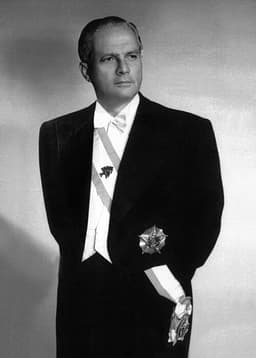
Camille Chamoun
Politician · Modern
51.4Total

Napoleon Bonaparte
General · Modern
70.9Total
Basic Information
Born
1900
1769
Died
1987
1821
Era
Modern
Modern
Nationality
Lebanon
France
Occupation
Politician
General
Civilization
Middle Eastern
Western
Score Comparison
Military (10%)
39.4
94.0
Political (20%)
61.3
72.0
Influence (20%)
53.3
40.0
Legacy (20%)
45.0
80.0
Leadership (15%)
65.0
78.0
Strategy (15%)
39.6
90.0
TOTAL
51.4
70.9
Camille Chamoun — Complete Timeline
1952 AD
Elected President of LebanonPolitical Action◆ Major
Camille Chamoun was elected President of Lebanon on September 23, 1952, succeeding Bechara El Khoury. His election marked a shift in Lebanese politics, and he served a six-year term until 1958.
PresidencyElectionLebanon
Impact: national
1958 AD
1958 Lebanon crisis and U.S. interventionWar◆ Major
President Chamoun faced a major political crisis when Muslim factions rebelled against his pro-Western policies and alleged attempts to amend the constitution for a second term. The U.S. intervened by landing Marines in Beirut to stabilize the government.
Civil WarU.S. InterventionPolitical Crisis
Impact: regionaldestructive
Refused to resign during the 1958 crisisPolitical Action
Chamoun refused to resign despite widespread opposition and the formation of a rebel government in Tripoli. He remained in power until the end of his term in September 1958, when he handed over to Fuad Chehab.
ResistancePolitical StalemateTransition
Impact: national
Founded the National Liberal PartyPolitical Action
After leaving the presidency, Chamoun founded the National Liberal Party (NLP) in 1958. The party became a major political force representing Maronite Christian interests and played a role in the Lebanese Civil War.
Political PartyMaronitePost-presidency
Impact: national
1975 AD
Role in the Lebanese Civil WarWar◆ Major
Chamoun's National Liberal Party and its militia, the Tigers, fought in the Lebanese Civil War as part of the Christian Lebanese Front. He opposed the Taif Agreement and remained a polarizing figure until his death in 1987.
Civil WarMilitiaChristian Faction
Impact: nationaldestructive
Napoleon Bonaparte — Complete Timeline
1799 AD
Coup of 18 BrumaireOther◆ Major
Napoleon Bonaparte, with support from his brother Lucien and key political figures, overthrew the Directory in a bloodless coup. He established the Consulate with himself as First Consul, effectively becoming the ruler of France. This event ended the French Revolution's most unstable period.
French RevolutionCoupRise to Power
Impact: regional
1804 AD
Promulgation of the Napoleonic CodeOther◆ Major
Napoleon enacted the Civil Code of the French, known as the Napoleonic Code, a comprehensive set of laws that replaced the fragmented feudal legal systems. The code established legal equality, protected property rights, and secularized law. It became the basis for legal systems in many European and world countries.
Legal ReformNapoleonic CodeCivil Law
Impact: globalconstructive
1805 AD
Battle of AusterlitzWar◆ Major
Napoleon's Grande Arm
Napoleonic WarsBattleDecisive Victory
Impact: global
1812 AD
Invasion of RussiaWar◆ Major
Napoleon led the Grande Arm
Napoleonic WarsInvasionDisaster
Impact: globaldestructive
1815 AD
Battle of WaterlooWar◆ Major
Napoleon's French army was defeated by the combined forces of the Duke of Wellington's Anglo-Allied army and Gebhard Leberecht von Bl
Napoleonic WarsBattleFinal Defeat
Impact: globaldestructive
Expert Analysis
camille-chamoun-vs-napoleon-bonaparte
# The Emperor and the President: Two Men, Two Worlds, One Century
On a June morning in 1815, Napoleon Bonaparte watched his Imperial Guard march toward the British lines at Waterloo, the sun breaking through the Belgian mist. He had staked everything on this final gamble. One hundred and forty-three years later, in the summer of 1958, Camille Chamoun sat in the presidential palace in Beirut, watching American Marines wade ashore at his request—a foreign intervention to save his presidency. One man commanded the largest army Europe had ever seen; the other commanded little more than his own party militia. Yet both faced the same fundamental question: when the world shifts beneath your feet, do you bend or break? Napoleon bent the world to his will until it snapped back. Chamoun bent his country to his vision until it shattered.
Origins
Napoleon Bonaparte was born in 1769 on the island of Corsica, a Mediterranean rock that had passed from Genoese to French control only months before his birth. His family was minor nobility, speaking Italian-accented French in a household that resented French rule. This outsider’s hunger—the burning need to prove himself to a society that looked down on his accent and his origins—never left him. He attended military school on scholarship, a poor Corsican among rich French aristocrats, and emerged with a conviction that genius alone, not birth, should determine destiny.
Camille Chamoun was born in 1900 into a Maronite Christian family in the mountain village of Deir el-Qamar, a town that had been a seat of power for Lebanon’s Christian community for centuries. Unlike Napoleon, Chamoun was born into an established elite. His father was a judge; his family had connections to the French Mandate authorities who ruled Lebanon after World War I. Where Napoleon had to claw his way up from the margins, Chamoun was born near the center of power—but in a country where power was always shared, always negotiated, always fragile.
The difference in their worlds was not merely one of scale but of structure. Napoleon came of age in revolutionary France, where old hierarchies had collapsed and a young man of talent could rise to command armies and nations. Chamoun came of age in Ottoman Lebanon, then French-mandated Lebanon, where power was divided by sect, family, and foreign patronage. Napoleon’s France was a volcano; Chamoun’s Lebanon was a mosaic.
Rise to Power
Napoleon’s ascent was a series of explosions. At 24, he drove the British out of Toulon. At 26, he put down a royalist uprising in Paris with a “whiff of grapeshot.” At 27, he conquered Italy. At 30, he seized power in a coup d’état. The French Revolution had created a vacuum at the top, and Napoleon filled it with sheer velocity. He understood something that his more cautious contemporaries did not: in times of chaos, the man who acts fastest wins.
Chamoun’s rise was slower, more deliberate. He was elected to the Lebanese parliament in 1934, served as a diplomat and minister, and cultivated relationships with both the French authorities and the emerging Lebanese political class. When President Bechara El Khoury was forced to resign in 1952 amid corruption allegations, Chamoun was the compromise candidate—acceptable to the Maronite establishment, the Sunni Muslim elite, and the Western powers. He was elected President of Lebanon on September 23, 1952. Where Napoleon seized power, Chamoun was handed it.
Leadership & Governance
Napoleon governed as he fought: with speed, clarity, and total control. His Napoleonic Code unified French law, established merit-based promotion, and reformed education. He built roads, canals, and a centralized state that functioned with military precision. But he also centralized power in his own hands, suppressed dissent, and made himself emperor. His political wisdom was real but limited—he understood how to organize a state for war but not how to sustain peace.
Chamoun governed a country that was not a nation but a collection of communities. Lebanon’s 1943 National Pact had divided power among Maronite Christians, Sunni Muslims, and Shia Muslims in a delicate balance. Chamoun tried to tip that balance toward the West, toward the Maronites, and toward himself. He aligned Lebanon with the United States and Britain, refused to break relations with France and Britain during the Suez Crisis of 1956, and accepted the Eisenhower Doctrine’s promise of American support against communism. To his Christian supporters, he was a defender of sovereignty. To his Muslim opponents, he was a tool of the West.
The crisis came in 1958. Muslim factions, inspired by Egypt’s Gamal Abdel Nasser and his pan-Arab nationalism, rebelled against Chamoun’s pro-Western policies. They demanded his resignation. Chamoun refused. He stayed in the presidential palace while rebel forces controlled much of the countryside. The United States intervened, landing 14,000 Marines and soldiers in Beirut. The crisis ended with a compromise: Chamoun would step down at the end of his term, and a new president acceptable to all sides would be elected.
Triumph & Tragedy
Napoleon’s greatest triumph was the Empire at its height in 1810–1812, when he controlled most of continental Europe, had married a Habsburg princess, and seemed to have achieved the impossible: a Corsican outsider as master of Europe. His greatest tragedy was the invasion of Russia in 1812, where he lost over 400,000 men to winter, starvation, and guerilla warfare. He never recovered.
Chamoun’s greatest triumph was surviving the 1958 crisis without being overthrown or assassinated, preserving his presidency and his political life. His greatest tragedy was what came after. The 1958 crisis never truly resolved; it merely postponed. When the Lebanese Civil War erupted in 1975, Chamoun’s National Liberal Party and its militia, the Tigers, fought as one faction among many. The man who had once been president became a warlord. He died in 1987, having seen his country descend into a fifteen-year war that killed over 100,000 people.
Character & Destiny
Napoleon was driven by an insatiable hunger for glory. “I live only for posterity,” he once said. “Death is nothing, but to live defeated and without glory is to die every day.” This hunger made him tireless, brilliant, and ultimately self-destructive. He could not stop. Conquest was not a means to an end; it was the only end he understood.
Chamoun was driven by a different hunger: the need to preserve his community’s position in a changing world. He saw the rise of Arab nationalism as an existential threat to Lebanon’s Christian minority. He was not wrong. But his solution—clinging to Western patronage and refusing to compromise—made the threat materialize faster. He was a skillful politician but a poor nation-builder. He could manage crises but not prevent them.
Legacy
Napoleon’s legacy is everywhere. The Napoleonic Code influenced legal systems across Europe and the Americas. His military tactics are still studied. He reshaped the map of Europe and the idea of what a state could be. He is remembered as both a hero and a tyrant, a genius and a megalomaniac.
Chamoun’s legacy is narrower. In Lebanon, he is remembered as a symbol of Maronite resistance and a figure who could not adapt to changing times. The National Liberal Party he founded still exists but is a shadow of its former self. His name appears in history books as a footnote to the 1958 crisis and a precursor to the civil war.
Conclusion
Napoleon and Chamoun lived in different worlds, but they faced the same cruel arithmetic of power. Napoleon tried to conquer the world and failed because he could not stop. Chamoun tried to preserve his world and failed because he could not change. One was destroyed by his ambition, the other by his rigidity. Both believed they were masters of their fate. Both were proven wrong by forces larger than themselves—for Napoleon, the winter of Russia and the coalition of Europe; for Chamoun, the passions of Arab nationalism and the sectarian divisions of his country.
In the end, perhaps the most telling difference is this: Napoleon died in exile on a remote Atlantic island, but his ideas conquered the world. Chamoun died in his own country, but his ideas could not conquer even his own street. One man reshaped history; the other was reshaped by it. Both teach the same lesson: the arc of history bends toward neither glory nor caution, but toward forces that no single man can control.
Rankings
🥇
Napoleon BonaparteLeader
Mil: 94.0Pol: 72.0Inf: 40.0
70.9
🥈
Camille Chamoun
Mil: 39.4Pol: 61.3Inf: 53.3
51.4
+19.5 behind
How This Comparison Works
Algorithm
Each figure is scored on 6 dimensions (0—100 scale) based on structured historical data: Military (10%), Political (20%), Influence (20%), Legacy (20%), Leadership (15%), Strategy (15%). The weighted total produces the final ranking.
Data Sources
Scores are computed from structured sub-indicators in the database. Scale factors adjust for era (Ancient ×0.85, Modern ×1.0) and civilization size (Eastern ×1.05, Other ×0.80) to account for differences in population and military scale.
Maximum 3 Figures
Comparisons are limited to 2—3 figures to ensure readability and statistical meaningfulness.
Error Margins
±5 points per dimension — Sub-scores are derived from historical records with inherent uncertainty. Two figures within 5 points on a dimension should be considered roughly equivalent in that area.
Total Score Accuracy
±3 points overall — The weighted combination of 6 dimensions produces a total score with approximately ±3 points of uncertainty. Differences of less than 3 points are not statistically significant— the figures are effectively tied.
Known Limitations
- Historical records are incomplete and uneven across civilizations
- Figures from oral-tradition societies may be underrepresented
- Occupation labels can misclassify multi-role figures
- Scores measure capability and impact, not moral character
- Quantitative scoring is a comparison tool, not absolute truth
Capability Radar
Military (10%) — Battles & Warfare
Battles
23
95
Win Rate
25
90
Expansion
25
95
Political (20%) — Governance & Reform
Reform
40
95
Diplomacy
55
80
Economy
35
85
Influence (20%) — Cultural & Global Reach
Cultural
30
85
Global
30
90
Legacy (20%) — Historical Impact
Historical
40
95
Longevity
30
90
Leadership (15%) — Power & Stability
Tenure
60
85
Stability
20
70
Strategy (15%) — Tactics & Innovation
Strategy
31
95
Tactics
35
98
Reform
38
92
Similar Comparisons
Comments & Discussion
MARCHER IMPOSSIBLE6/17/2026
Comparing Chamoun to Napoleon is like comparing a firecracker to a supernova. Napoleon reshaped continental law, created the Napoleonic Code, and conquered from Madrid to Moscow. Chamoun couldn't even hold a single city. The 1958 Lebanon crisis was solved by American intervention, not his leadership. One man changed Europe permanently; the other couldn't keep his own government stable without foreign troops. History remembers titans and also-rans differently.|
老枪新兵6/17/2026
拿破仑像一把利剑,刺穿旧欧洲的铠甲;夏蒙像一支蜡烛,照亮自己的房间。拿破仑1812年远征莫斯科,损失50万大军都没垮;夏蒙1958年面对几百人的叛乱,就喊美国人来救命。真正的领袖是能在暴风雨中掌舵的人,而不是在暴风雨来临时就躲在别人屋檐下的。这就是将军和总统的区别——一个创造历史,一个被历史抛弃。|
CODEBREAKER_SATIRIST6/17/2026
The comparison's numbers are deliberately misleading. Napoleon commanded 600,000 men for the Russian invasion; Chamoun's entire military force couldn't fill a Paris opera house. But raw size misses the point—the true metric is overreach. Napoleon's audacity failed at Waterloo; Chamoun's sectarian balancing act collapsed under its own contradictions. Both men saw their ambitions devour them from the inside. It's not the size of the army that matters, but the blindness of the leader.|
玉碎瓦全6/17/2026
说拿破仑和夏蒙面对同样的问题,那是历史学的偷懒。拿破仑的问题是:我要征服多少个国家才能满足?夏蒙的问题是:我要分裂多少份才能保持平衡?拿破仑有二十年的帝国可以挥霍,夏蒙只有六个年头的总统任期。拿一个昙花一现的木偶和一个改变世界的巨人来比较,本身就是对历史的侮辱。夏蒙最好的时刻,也不过是拿破仑最差的开始。|
CAESAR'S_SHADOW6/17/2026
Forget the army size. The real divide is legacy. Napoleon's shadow darkened Europe for decades after his death—every dictator from Hitler to Mussolini measured themselves against him. Chamoun? He's a footnote in a region of footnotes, remembered only by Lebanese historians and sectarian diehards. One man's ambition changed the world's political DNA; the other's ambition couldn't even change his country's electoral system. That's not comparison. That's category error.