Loading...
Cao Cao vs Julius Caesar
Julius Caesar leads by 5.3 pts · 2 figures compared
…
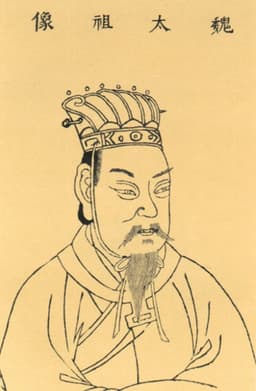
Cao Cao
General · Ancient
77.5Total

Julius Caesar
General · Ancient
82.8Total
Basic Information
Born
155
-100
Died
220
-44
Era
Ancient
Ancient
Nationality
China
Roman Republic
Occupation
General
General
Civilization
Eastern
Western
Score Comparison
Military (10%)
88.0
88.0
Political (20%)
59.0
78.0
Influence (20%)
82.0
85.0
Legacy (20%)
83.0
82.0
Leadership (15%)
64.4
80.0
Strategy (15%)
89.4
85.0
TOTAL
77.5
82.8
Cao Cao — Complete Timeline
190 AD
Formation of the Coalition against Dong ZhuoPolitical Action
Cao Cao joined a coalition of regional warlords led by Yuan Shao to overthrow the tyrannical chancellor Dong Zhuo, who had seized control of the Han court. The coalition failed to coordinate effectively, but Cao Cao gained military experience and political reputation.
CoalitionDong ZhuoHan Dynasty
Impact: national
196 AD
Implementation of Tuntian (Agricultural Colonies)Reform◆ Major
Cao Cao established military agricultural colonies (tuntian) to provide food for his army and refugees. Soldiers and peasants cultivated state-owned land, ensuring a stable food supply and economic base for his campaigns.
AgricultureEconomyMilitary
Impact: regionalconstructive
200 AD
Battle of GuanduWar
Cao Cao decisively defeated Yuan Shao's numerically superior army at Guandu. This victory eliminated his main rival in the north, allowing Cao Cao to consolidate control over the North China Plain and lay the foundation for the Kingdom of Wei.
BattleYuan ShaoUnification
Impact: regional
208 AD
Battle of Red CliffsWar
Cao Cao's southern campaign was halted by the allied forces of Sun Quan and Liu Bei at the Battle of Red Cliffs. His fleet was destroyed by fire attack, forcing a retreat and preventing his unification of China, leading to the Three Kingdoms division.
BattleDefeatThree Kingdoms
Impact: regional
213 AD
Establishment of the Kingdom of WeiPolitical Action◆ Major
Cao Cao was granted the title of Duke of Wei and later King of Wei by the Han emperor, effectively creating a semi-autonomous state within the empire. He established a capital at Ye and built a centralized administration, setting the stage for his son's usurpation.
WeiStatehoodHan Dynasty
Impact: national
Julius Caesar — Complete Timeline
58 BC
Gallic WarsWar◆ Major
Caesar, as proconsul of Gaul, launched a series of campaigns that conquered all of Gaul (modern France, Belgium, and parts of Switzerland). He fought numerous battles, including against the Helvetii, the Belgae, and the Gallic chieftain Vercingetorix. The wars brought immense wealth and a loyal army to Caesar.
Gallic WarsConquestRoman Expansion
Impact: regional
49 BC
Crossing the RubiconPolitical Action◆ Major
Caesar led Legio XIII across the Rubicon River into Italy, defying the Roman Senate's order to disband his army. This act triggered a civil war against Pompey and the Optimates, ultimately leading to Caesar's dictatorship and the end of the Roman Republic.
Roman Civil WarEnd of RepublicPower Struggle
Impact: global
48 BC
Battle of PharsalusWar◆ Major
Caesar's outnumbered army defeated the larger forces of Pompey the Great at Pharsalus in Greece. Caesar's tactical use of a reserve line to counter Pompey's cavalry charge proved decisive. Pompey fled to Egypt, where he was assassinated, leaving Caesar as the undisputed master of the Roman world.
Roman Civil WarBattleDecisive Victory
Impact: regional
44 BC
Appointment as Dictator for LifePolitical Action◆ Major
The Roman Senate appointed Caesar dictator perpetuo (dictator for life), granting him unprecedented personal power. This move concentrated military, legislative, and judicial authority in one person, effectively ending the Roman Republic's traditional system of checks and balances and alarming many senators.
DictatorshipEnd of RepublicPower Consolidation
Impact: regionaldestructive
Assassination on the Ides of MarchPolitical Action◆ Major
A group of Roman senators, led by Marcus Junius Brutus and Gaius Cassius Longinus, stabbed Caesar to death at a meeting of the Senate in the Theatre of Pompey. The assassination was intended to restore the Republic, but instead triggered another civil war that led to the rise of the Roman Empire.
AssassinationRoman PoliticsEnd of Republic
Impact: globaldestructive
Expert Analysis
Origins
Julius Caesar was born into the patrician Julian clan in 100 BCE, a family with ancient roots but modest political influence. His early life was marked by political turmoil, including the Social War and the dictatorship of Sulla, which forced him into hiding. Cao Cao, born in 155 CE during the declining Han dynasty, came from a eunuch-associated family, which provided wealth but limited prestige. Both men rose from challenging backgrounds, but Caesar's patrician status gave him a higher starting point in the Roman Republic's aristocratic system, while Cao Cao's family connections were more precarious.
Rise to Power
Caesar's rise was propelled by military success in Gaul (58-50 BCE), where he conquered vast territories, amassed wealth, and built a loyal army. His political alliance with Pompey and Crassus (the First Triumvirate) secured consulship and provincial commands. Cao Cao's ascent began with his role in suppressing the Yellow Turban Rebellion (184 CE) and later forming a coalition against the tyrant Dong Zhuo. His decisive victory at the Battle of Guandu (200 CE) over Yuan Shao established his dominance in northern China. Both used military prowess as a springboard, but Caesar's conquest of Gaul was a more systematic expansion of Roman power, while Cao Cao focused on unification amid chaos.
Leadership & Governance
Caesar implemented reforms including land redistribution, debt relief, and calendar reform (Julian calendar). He centralized power, reduced the Senate's authority, and initiated public works. Cao Cao established the Tuntian system of military agricultural colonies to ensure food supply and implemented merit-based appointments. He also promoted literature and poetry. Both were pragmatic administrators, but Caesar's reforms were more transformative for the Roman state, while Cao Cao's governance was focused on stabilizing a fragmented empire. Caesar scores higher in political influence (78 vs 59) due to his sweeping changes.
Triumph & Tragedy
Caesar's greatest triumph was his victory at Pharsalus (48 BCE) over Pompey, securing his control over the Roman world. His tragedy was his assassination on the Ides of March (44 BCE) by senators fearing his autocracy. Cao Cao's triumph was the Battle of Guandu (200 CE), which made him the hegemon of northern China. His tragedy was the defeat at Red Cliffs (208 CE) against Sun Quan and Liu Bei, halting his southern expansion and preventing unification. Both faced betrayal: Caesar by trusted allies, Cao Cao by his own hubris at Red Cliffs. Caesar's death was more dramatic and historically consequential, leading to the end of the Republic.
Character & Destiny
Caesar was ambitious, charismatic, and risk-taking, famously crossing the Rubicon with the words "Alea iacta est" (The die is cast). He was a skilled orator and writer. Cao Cao was shrewd, pragmatic, and ruthless, known for his cunning and literary talent. Both were complex figures: Caesar's clemency towards enemies contrasted with his autocratic ambitions; Cao Cao's reputation for cruelty (e.g., slaughter of entire cities) coexisted with his patronage of arts. Their destinies intertwined with their times—Caesar's life paved the way for the Roman Empire, while Cao Cao's actions led to the Three Kingdoms period.
Legacy
Caesar's legacy includes the Julian calendar, the term "Caesar" becoming synonymous with emperor, and his writings (Commentaries) shaping military literature. His assassination triggered the end of the Republic and the rise of Augustus. Cao Cao's legacy includes the Kingdom of Wei, his poetry, and his portrayal in Romance of the Three Kingdoms as a brilliant but villainous strategist. Both are studied in military academies worldwide. Caesar's impact on Western civilization is arguably greater due to Rome's enduring influence, while Cao Cao is central to Chinese history and culture. In terms of numerical scores, Caesar leads in military (88 vs 88 tie), political (78 vs 59), and cultural legacy (85 vs 82), with a total score gap of 5.3.
Conclusion
Julius Caesar and Cao Cao were both exceptional generals and statesmen who reshaped their worlds. Caesar's higher scores in political influence and cultural impact reflect his role in transforming the Roman Republic into an empire, while Cao Cao's military genius is comparable but constrained by a more fragmented era. Caesar's legacy is more global, whereas Cao Cao's remains deeply Chinese. The comparison highlights how historical context shapes greatness: Caesar's centralized reforms had broader reach, while Cao Cao's unification efforts were limited by the Three Kingdoms division. Ultimately, Caesar edges ahead due to his more transformative political changes and enduring global symbolism.
**Final Scores:** Julius Caesar: 83.4 | Cao Cao: 78.1 (Gap: 5.3 in favor of Caesar)
Rankings
🥇
Julius CaesarLeader
Mil: 88.0Pol: 78.0Inf: 85.0
82.8
🥈
Cao Cao
Mil: 88.0Pol: 59.0Inf: 82.0
77.5
+5.3 behind
How This Comparison Works
Algorithm
Each figure is scored on 6 dimensions (0—100 scale) based on structured historical data: Military (10%), Political (20%), Influence (20%), Legacy (20%), Leadership (15%), Strategy (15%). The weighted total produces the final ranking.
Data Sources
Scores are computed from structured sub-indicators in the database. Scale factors adjust for era (Ancient ×0.85, Modern ×1.0) and civilization size (Eastern ×1.05, Other ×0.80) to account for differences in population and military scale.
Maximum 3 Figures
Comparisons are limited to 2—3 figures to ensure readability and statistical meaningfulness.
Error Margins
±5 points per dimension — Sub-scores are derived from historical records with inherent uncertainty. Two figures within 5 points on a dimension should be considered roughly equivalent in that area.
Total Score Accuracy
±3 points overall — The weighted combination of 6 dimensions produces a total score with approximately ±3 points of uncertainty. Differences of less than 3 points are not statistically significant— the figures are effectively tied.
Known Limitations
- Historical records are incomplete and uneven across civilizations
- Figures from oral-tradition societies may be underrepresented
- Occupation labels can misclassify multi-role figures
- Scores measure capability and impact, not moral character
- Quantitative scoring is a comparison tool, not absolute truth
Capability Radar
Military (10%) — Battles & Warfare
Battles
95
95
Win Rate
88
92
Expansion
92
97
Political (20%) — Governance & Reform
Reform
88
90
Diplomacy
82
85
Economy
86
82
Influence (20%) — Cultural & Global Reach
Cultural
85
88
Global
75
94
Legacy (20%) — Historical Impact
Historical
92
95
Longevity
90
96
Leadership (15%) — Power & Stability
Tenure
85
75
Stability
78
60
Strategy (15%) — Tactics & Innovation
Strategy
96
94
Tactics
97
96
Reform
90
88
Similar Comparisons
Comments & Discussion
HistoryBuff996/16/2026
Okay, I know the scores have Caesar slightly ahead overall, but I gotta push back on Cao Cao's political score being only 73. Sure, he was authoritarian, but so was Caesar—he literally made himself dictator for life! And Cao Cao's 'talent-first' policy was way ahead of its time. He recruited based on skill, not family name, which is something Rome didn't really do until much later. Plus, he wrote poetry and military manuals—total Renaissance man vibes. I think the Western bias is showing here. Cao Cao's political maneuvering in a completely fractured China was arguably harder than Caesar's in the late Republic.
BattlefieldScholar6/16/2026
Let's talk campaign metrics. Caesar's Gaul campaign (58-50 BC) involved roughly 50,000-60,000 legionaries against a coalition of tribes that could field 100,000+ warriors. His victory at Alesia was a masterpiece of siegecraft and counter-siege—double lines of fortification, 20+ miles in circumference. But Cao Cao's Guandu campaign (200 AD) is even more impressive tactically. He faced Yuan Shao with 110,000 troops against his own 20,000-30,000. The decisive strike against Yuan's supply depot at Wuchao was a classic 'defeat in detail' operation. Cao Cao personally led 5,000 elite cavalry on a night raid—that's audacity on par with Caesar crossing the Rubicon. The military scores are close, but I'd give Cao Cao the edge for sustaining campaigns across a much larger, more fractured theater for over 30 years. Caesar's campaigns were intense but shorter.
Historian5666/16/2026
曹孟德和凯撒的对比很有意思,但我觉得这个评分体系太西方中心了。凯撒的政治影响力给78分,曹操才73分?开什么玩笑。曹操挟天子以令诸侯,在汉末那个群雄割据的局面下,硬是建立了一个能统一北方的政治机器。他搞的屯田制、唯才是举,都是实打实的制度创新。凯撒的政治改革更多是个人集权,而且罗马的共和制本身就有成熟的官僚体系做支撑。曹操是从零开始重建秩序的。更何况,曹操的《短歌行》和《观沧海》传唱千年,凯撒的《高卢战记》虽然经典,但文学影响力能比吗?这分数得重新算。
Chronicler43936/16/2026
看了下这个评分,我比较怀疑政治维度的权重。曹操政治72.7,凯撒78,就差5分?但历史上曹操在北方推行的屯田制直接养活了百万人口,而凯撒的政治遗产很大程度上依赖屋大维的后续操作。更关键的是,军事分数曹操89对凯撒88,只差1分,但曹操打了三十年仗,从黄巾到官渡再到赤壁,对手包括吕布、袁绍、马超这种级别,凯撒的主要对手庞培和高卢部落,难度完全不是一个量级。如果按战斗频率和对手质量加权,曹操军事分至少应该92以上。另外,影响力维度曹操作诗、注兵法、建铜雀台,文化输出比凯撒强多了,78分偏低。建议重新计算。