Loading...
Carl Gustaf Emil Mannerheim vs Claude Auchinleck
Carl Gustaf Emil Mannerheim leads by 7.8 pts · 2 figures compared
…

Carl Gustaf Emil Mannerheim
General · Modern
63.0Total
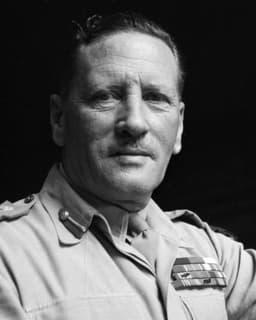
Claude Auchinleck
General · Modern
55.2Total
Basic Information
Born
1867
1884
Died
1951
1981
Era
Modern
Modern
Nationality
Finland
United Kingdom
Occupation
General
General
Civilization
Western
Western
Score Comparison
Military (10%)
65.0
72.5
Political (20%)
70.0
39.4
Influence (20%)
55.0
61.0
Legacy (20%)
55.0
50.0
Leadership (15%)
78.0
54.2
Strategy (15%)
68.0
61.2
TOTAL
63.0
55.2
Carl Gustaf Emil Mannerheim — Complete Timeline
1939 AD
Winter War CommandWar◆ Major
Mannerheim commanded Finnish forces during the Winter War against the Soviet Union. Despite being outnumbered, Finnish troops inflicted heavy losses on the Red Army, defending Finnish independence until the Moscow Peace Treaty in March 1940.
Winter WarFinnish-Soviet WarDefense
Impact: regional
1941 AD
Continuation War AllianceWar◆ Major
Mannerheim led Finland as co-belligerent with Nazi Germany against the Soviet Union in the Continuation War. Finnish forces recaptured lost territories but later halted at the old border, avoiding deeper involvement in the Siege of Leningrad.
Continuation WarWorld War IIAlliance
Impact: regional
1942 AD
Marshal of Finland AppointmentPolitical Action
Mannerheim was granted the title Marshal of Finland, the only person to hold this rank. The honor recognized his military leadership and role as commander-in-chief during the Continuation War.
TitleMilitary HonorLeadership
Impact: national
1944 AD
Lapland WarWar
Under Mannerheim's direction, Finnish forces turned against their former German allies in the Lapland War. The campaign forced German troops to withdraw into Norway, fulfilling the armistice terms and securing Finland's position.
Lapland WarWorld War IICampaign
Impact: regional
Moscow Armistice NegotiationsPolitical Action◆ Major
Mannerheim succeeded Risto Ryti as President of Finland in August 1944 and negotiated the Moscow Armistice with the Soviet Union. Finland ceded territories, paid reparations, and agreed to expel German forces from Lapland, ending hostilities.
ArmisticePeace TreatyPresidency
Impact: national
Claude Auchinleck — Complete Timeline
1941 AD
Appointed Commander-in-Chief of India CommandOther◆ Major
Auchinleck was appointed Commander-in-Chief of the Indian Army in January 1941. He oversaw the expansion and training of Indian forces for service in the Middle East, East Africa, and Southeast Asia, building a multi-ethnic army that grew to over two million men.
World War IIIndia
Impact: national
Appointed Commander-in-Chief of Middle East CommandOther◆ Major
Auchinleck replaced Archibald Wavell as Commander-in-Chief of Middle East Command in July 1941. He assumed command of British forces in North Africa, Iraq, and Persia during a critical period when German forces under Rommel were threatening Egypt and the Suez Canal.
World War IINorth Africa
Impact: national
Launched Operation CrusaderOther◆ Major
Auchinleck launched Operation Crusader on November 18, 1941, an offensive to relieve the besieged garrison at Tobruk. After heavy tank battles at Sidi Rezegh, British forces relieved Tobruk on December 10, forcing Rommel to retreat to El Agheila and lifting the 242-day siege.
World War IINorth AfricaVictory
Impact: nationalconstructive
1942 AD
Defeated at the First Battle of El AlameinOther◆ Major
Auchinleck personally took command of the Eighth Army in June 1942 after the fall of Tobruk. He halted Rommel's advance at the First Battle of El Alamein in July 1942, preventing the Axis from reaching Alexandria and the Suez Canal, but failed to destroy the German forces.
World War IINorth AfricaStalemate
Impact: national
Relieved of Command and Replaced by MontgomeryOther◆ Major
Auchinleck was relieved of command in August 1942 by Prime Minister Churchill, who lost confidence in his leadership. He was replaced by General Harold Alexander as Commander-in-Chief and Bernard Montgomery as commander of the Eighth Army, a decision that remains controversial among historians.
World War IINorth AfricaDismissal
Impact: nationaldestructive
1943 AD
Appointed Commander-in-Chief of India Command (Second Term)Other◆ Major
Auchinleck returned as Commander-in-Chief of the Indian Army in June 1943, a position he held until 1947. He oversaw the Burma Campaign, the defense against the Japanese invasion of India, and the post-war demobilization and partition of the Indian Army between India and Pakistan.
World War IIIndiaPartition
Impact: national
Expert Analysis
Origins
Carl Gustaf Emil Mannerheim was born on June 4, 1867, in Askainen, Grand Duchy of Finland, then part of the Russian Empire. He came from a Swedish-speaking aristocratic family; his father was a count and his mother was the daughter of a wealthy industrialist. Mannerheim attended the Hamina Cadet School but was expelled for disciplinary reasons. He then transferred to the Nicholas Cavalry School in St. Petersburg, graduating in 1889. He served in the Russian Imperial Army, rising to the rank of lieutenant general by 1917. His formative experiences included service in the Russo-Japanese War and World War I, where he commanded cavalry units. In 1906-1908, he undertook a scientific expedition across Central Asia, gathering intelligence for the Russian General Staff.
Claude John Eyre Auchinleck was born on June 21, 1884, in Aldershot, England. His father was a colonel in the Royal Artillery, but the family had limited financial means. Auchinleck attended Wellington College and then the Royal Military Academy, Sandhurst, graduating in 1904. He was commissioned into the Indian Army, serving in the 62nd Punjabis. His early career included service in Egypt and Mesopotamia during World War I, where he was wounded at the Battle of Shaiba in 1915. He later served in the Third Anglo-Afghan War and the Waziristan campaign. Auchinleck's background was firmly within the British colonial military structure, with a focus on Indian troops.
Rise to Power
Mannerheim's rise to prominence began after the Russian Revolution. He returned to Finland in December 1917, just as Finland declared independence. The Finnish Senate appointed him Commander-in-Chief of the White Army in January 1918 during the Finnish Civil War. He led the Whites to victory over the Red Guards by May 1918, securing his reputation as a military leader. However, political tensions led him to leave Finland temporarily. He returned in 1919 and ran for president but lost. He remained a key figure, serving as chairman of the Defence Council from 1931, where he oversaw the construction of the Mannerheim Line fortifications. The Winter War (1939-1940) catapulted him to international fame as he commanded Finnish forces against the Soviet Union.
Auchinleck's rise was more gradual. He served in various staff and command roles in India, becoming Deputy Chief of the General Staff in India in 1935. In 1940, he was appointed General Officer Commanding-in-Chief of the Northern Command in England. His big break came in January 1941 when he was appointed Commander-in-Chief of the India Command, where he expanded the Indian Army to over a million men. In July 1941, he replaced Archibald Wavell as Commander-in-Chief of Middle East Command, taking charge of the North African campaign. This was his highest command, where he faced the Afrika Korps under Erwin Rommel.
Leadership & Governance
Mannerheim's leadership style was autocratic but pragmatic. As Commander-in-Chief, he made strategic decisions with minimal political interference. He maintained morale through personal example and respect. He was known for his calm demeanor and ability to inspire loyalty. In governance, as President in 1944-1946, he steered Finland through the difficult transition from war to peace, personally negotiating the Moscow Armistice. He scored 78.0 in leadership, reflecting his ability to command respect from both soldiers and politicians. His strategy score of 68.0 reflects his effective defensive tactics in the Winter War and his decision to align with Germany in the Continuation War, which allowed Finland to regain lost territories.
Auchinleck's leadership was more collegial. He was known for his honesty and integrity, but he struggled with political maneuvering. He was a thorough planner but sometimes indecisive in execution. He scored 54.2 in leadership, lower than Mannerheim, partly due to his inability to maintain Churchill's confidence. His strategy score of 61.2 reflects his success in Operation Crusader but also the setbacks at Gazala and Tobruk. Auchinleck's governance was limited to military command; he never held political office. His approach was to delegate to subordinates, which sometimes led to confusion.
Triumph & Tragedy
Mannerheim's greatest triumph was leading Finland through the Winter War, where outnumbered Finnish forces inflicted heavy losses on the Soviet Union, scoring a military achievement that scored 65.0 in military. His tragedy was the Continuation War alliance with Nazi Germany, which, while successful in recapturing territory, tarnished Finland's reputation and led to severe terms in the Moscow Armistice. He also faced the Lapland War against former German allies, a difficult campaign. His biggest personal tragedy was the death of his daughter in 1936.
Auchinleck's triumph was Operation Crusader (November 1941), which relieved Tobruk and pushed Rommel back. He also halted Rommel's advance at the First Battle of El Alamein in July 1942, a defensive victory. His tragedy was the fall of Tobruk in June 1942, a major defeat that led to his relief. He was replaced by Montgomery in August 1942, a personal and professional blow. Auchinleck's military score of 72.5 is higher than Mannerheim's 65.0, reflecting his command of larger forces and more complex operations.
Character & Destiny
Mannerheim was reserved, disciplined, and stoic. He was a monarchist at heart but accepted the republican system. His character was shaped by his aristocratic background and service to the Russian Tsar. He was meticulous in planning but flexible in execution. His destiny was to become Finland's most revered military leader, even as his political role was temporary. He died in 1951 in Switzerland, having lived in exile after the war.
Auchinleck was known as 'the Auk', a nickname reflecting his no-nonsense approach. He was honest to a fault, which sometimes made him appear indecisive. He was deeply committed to the Indian Army and its soldiers. His destiny was to be overshadowed by Montgomery, though later historians have rehabilitated his reputation. He died in 1981 in Marrakech, Morocco.
Legacy
Mannerheim's legacy is immense in Finland. He is considered the father of the Finnish military and a symbol of national resistance. The Mannerheim Cross is the highest military decoration. His name is commemorated in streets, monuments, and a museum. His legacy score of 55.0 reflects his national importance but limited global impact. His strategy of aligning with Germany is still debated.
Auchinleck's legacy is more mixed. He is remembered as a capable commander who was unfairly scapegoated. His work in building the Indian Army had lasting impact on India and Pakistan. His legacy score of 50.0 is lower, partly because his achievements were overshadowed by Montgomery's later successes. However, his role in the First Battle of El Alamein is increasingly recognized.
Conclusion
Carl Gustaf Mannerheim had a greater overall impact than Claude Auchinleck. Mannerheim's leadership score of 78.0 and total score of 63.0 exceed Auchinleck's 54.2 and 55.2 respectively. Mannerheim's influence on Finland's survival as an independent nation is undeniable. While Auchinleck's military score is higher, his political score of 39.4 reflects his inability to navigate high command. Mannerheim's strategic decisions shaped Finland's fate, while Auchinleck's were often reversed. Mannerheim's legacy endures as a national hero; Auchinleck remains a figure of historical debate. Thus, Mannerheim's impact is more profound and enduring.
Rankings
🥇
Carl Gustaf Emil MannerheimLeader
Mil: 65.0Pol: 70.0Inf: 55.0
63.0
🥈
Claude Auchinleck
Mil: 72.5Pol: 39.4Inf: 61.0
55.2
+7.8 behind
How This Comparison Works
Algorithm
Each figure is scored on 6 dimensions (0—100 scale) based on structured historical data: Military (10%), Political (20%), Influence (20%), Legacy (20%), Leadership (15%), Strategy (15%). The weighted total produces the final ranking.
Data Sources
Scores are computed from structured sub-indicators in the database. Scale factors adjust for era (Ancient ×0.85, Modern ×1.0) and civilization size (Eastern ×1.05, Other ×0.80) to account for differences in population and military scale.
Maximum 3 Figures
Comparisons are limited to 2—3 figures to ensure readability and statistical meaningfulness.
Error Margins
±5 points per dimension — Sub-scores are derived from historical records with inherent uncertainty. Two figures within 5 points on a dimension should be considered roughly equivalent in that area.
Total Score Accuracy
±3 points overall — The weighted combination of 6 dimensions produces a total score with approximately ±3 points of uncertainty. Differences of less than 3 points are not statistically significant— the figures are effectively tied.
Known Limitations
- Historical records are incomplete and uneven across civilizations
- Figures from oral-tradition societies may be underrepresented
- Occupation labels can misclassify multi-role figures
- Scores measure capability and impact, not moral character
- Quantitative scoring is a comparison tool, not absolute truth
Capability Radar
Military (10%) — Battles & Warfare
Battles
75
65
Win Rate
70
55
Expansion
40
50
Political (20%) — Governance & Reform
Reform
65
20
Diplomacy
80
40
Economy
60
15
Influence (20%) — Cultural & Global Reach
Cultural
65
30
Global
55
45
Legacy (20%) — Historical Impact
Historical
70
55
Longevity
60
40
Leadership (15%) — Power & Stability
Tenure
70
30
Stability
75
25
Strategy (15%) — Tactics & Innovation
Strategy
85
75
Tactics
80
70
Reform
75
60
Similar Comparisons
Comments & Discussion
No comments yet. Be the first to share your thoughts!